 English
 Français
News
Home / Author / Sophia Lin — Product Sales Executive / Pre-Waxed Braided Cotton Candle Wick Rolls for Consistent, High-Volume Candle Production
Content

Reliable wick performance is one of the most important factors in candle manufacturing. The wick controls how efficiently fuel is drawn from the wax pool, how the flame develops, how evenly the candle burns, and how much soot or smoke may be produced during use. Even when a candle has an attractive vessel, carefully selected fragrance, and high-quality wax, an unsuitable wick can compromise the finished product. For commercial candle producers, therefore, wick selection is not simply a component purchasing decision. It is a production, quality-control, safety, and customer-satisfaction decision.
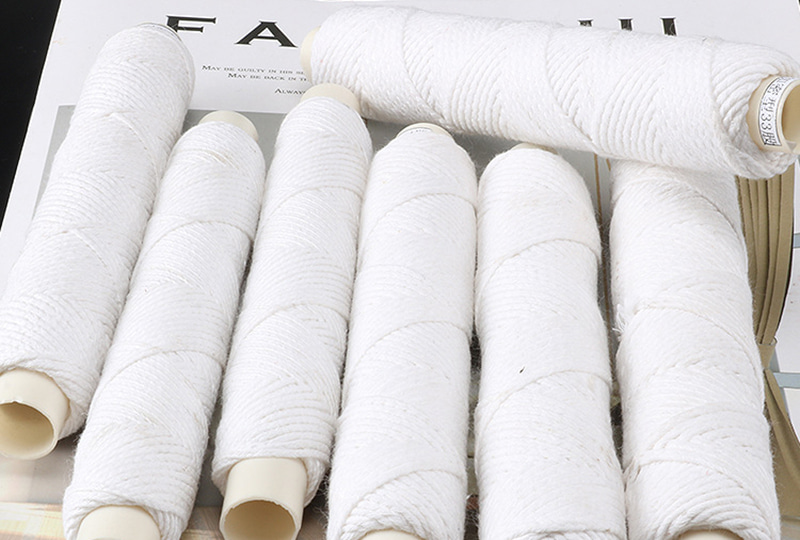
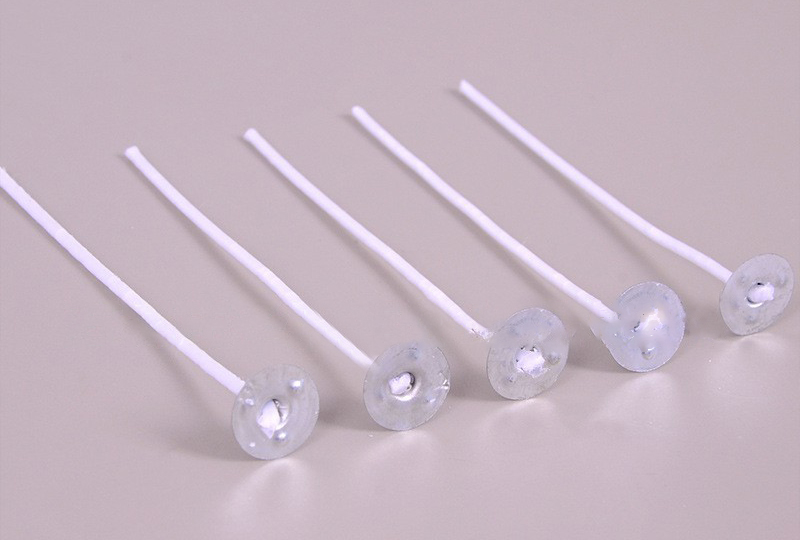
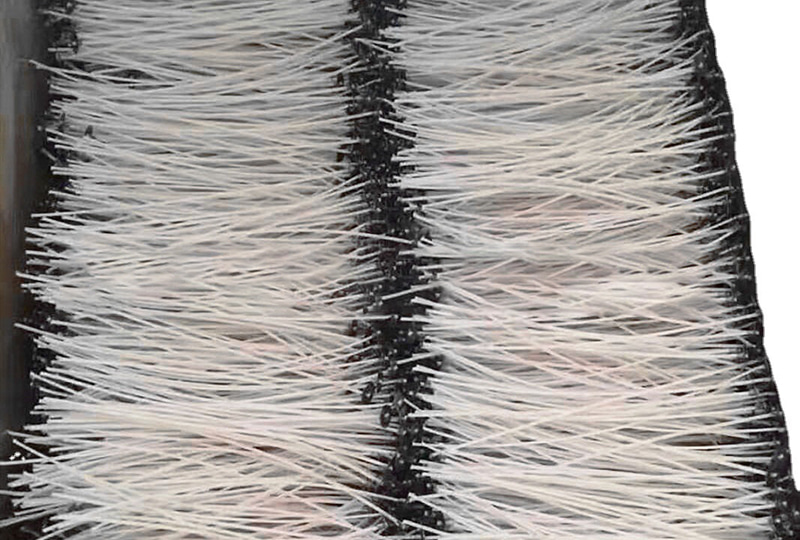
Pre-Waxed Braided Cotton Candle Wick Roll is designed to support professional candle manufacturing, craft production, private-label programs, and OEM projects that require reliable wick material in continuous lengths. The product combines a multi-strand braided cotton construction with a pre-waxed coating that improves handling during assembly. It can be supplied as a continuous roll for cutting and tabbing workflows, while individual metal sustainer tabs may be supplied separately or attached according to production requirements.
The roll format provides a practical alternative to buying only pre-cut, pre-tabbed wicks. It gives candle manufacturers greater control over wick length, tab placement, production speed, and packaging configuration. At the same time, the pre-waxed surface helps the wick remain straight and manageable during insertion into molds, jars, tins, tea light cups, and other candle vessels. This balance between flexibility and production efficiency makes the product suitable for both established manufacturers and growing businesses developing multiple candle collections.
Supported by an organized supply chain, quality-control procedures, customization capabilities, and coordinated production resources, this candle wick solution is intended for customers who need consistent specifications across repeated orders. It is available in multiple braid sizes and overall diameters to accommodate applications ranging from small tea lights to larger container candles and selected molded candle formats.
Pre-Waxed Braided Cotton Candle Wick Roll
A candle wick is the pathway through which liquid wax travels toward the flame. When the candle is lit, heat melts the wax around the wick and creates a liquid fuel reservoir. Capillary action then draws the liquid wax upward through the wick, where heat vaporizes the fuel before combustion. The quality and structure of the wick influence how quickly this process occurs and how stable the flame remains.
If a wick is too small for the wax type and vessel diameter, it may create a narrow melt pool and leave excessive wax around the container walls. This condition is commonly known as tunneling. The candle may appear to burn slowly, but much of the wax remains unused. A wick that is too large may produce an excessively tall flame, rapid wax consumption, smoking, soot, or overheating of the container. Correct wick selection must therefore consider vessel diameter, wax formulation, fragrance concentration, dye load, wick length, and the intended burn profile.
Commercial candle producers also need to consider repeatability. A wick that performs well in one sample but varies from roll to roll can create inconsistent finished products. Differences in braid density, diameter, wax coating, or fiber structure may affect flame height and melt-pool formation. Such variation increases the need for re-testing and may create product complaints when candles from the same collection burn differently.
A continuous pre-waxed roll addresses several of these manufacturing concerns. When the braid specification remains consistent throughout the production batch, the manufacturer can establish a wick selection for a particular vessel and wax combination, then reproduce that specification across a larger number of candles. This reduces avoidable variation and supports more systematic testing, documentation, and quality assurance.
The wick is formed from multiple cotton strands braided into a unified structure. Braiding helps hold the individual fibers together while maintaining pathways through which melted wax can travel. The resulting wick provides a balance of flexibility, strength, and capillary action that is suitable for a wide range of candle formulations.
Compared with a loose bundle of fibers, a braided wick is easier to handle during cutting, tabbing, centering, and placement. The braid is less likely to separate during production and can maintain its general form while being pulled from a roll. This is especially useful on semi-automatic production lines or in workshops where operators need to process large quantities of wicks efficiently.
The multi-strand construction also allows the product to be manufactured in different braid sizes. Strand count and overall diameter can be selected according to the application. Smaller sizes may be suitable for narrow tea light vessels or compact candles, while larger sizes may be evaluated for wider containers and candles requiring greater fuel delivery.
The pre-waxed coating stiffens the cotton braid slightly. This added rigidity allows the wick to stand more easily during assembly and helps it remain in position while wax is poured. A pre-waxed wick can be simpler to thread through a metal sustainer tab, position in a mold, or secure at the center of a vessel than a completely untreated cotton braid.
Pre-waxing is also beneficial when production teams need to reduce preparation steps. Instead of purchasing untreated wick, coating it, drying it, and then preparing it for candle assembly, manufacturers can receive a material that is ready for cutting and placement. This can reduce handling time and help improve workflow consistency, particularly for customers producing multiple candle styles or fulfilling repeat wholesale orders.
During burning, the pre-wax coating is intended to melt into the surrounding wax pool. It does not function as a separate permanent layer on the finished candle. When the coating is compatible with the selected candle wax and used within an appropriate wick size, it integrates into the normal fuel system of the candle without being designed to leave a distinct residue.
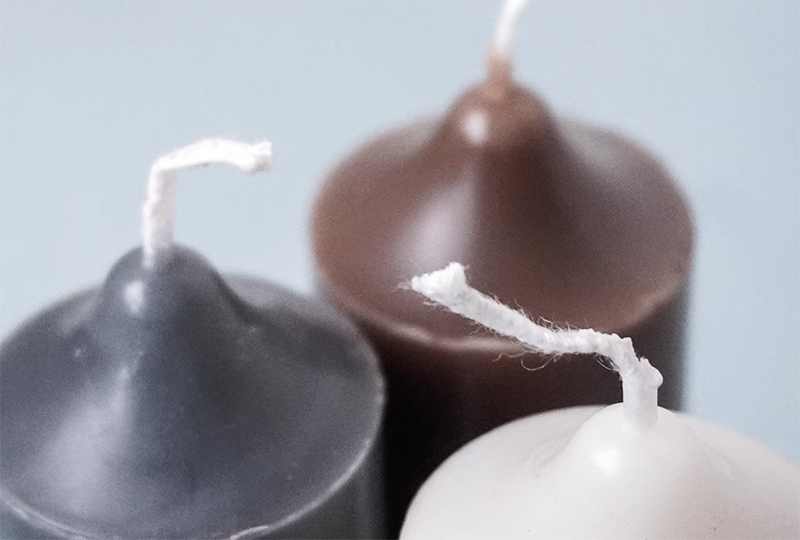
The braided construction is designed to curl gently as it burns. This movement can help the charred tip move away from the hottest central part of the flame, supporting controlled combustion and reducing the need for constant manual trimming during a normal burn cycle.
Self-trimming behavior does not eliminate the importance of candle care. Consumers should still follow recommended wick-trimming instructions before relighting a candle, particularly after a long burn or when a visible carbon buildup develops. However, a wick that naturally manages its char more effectively can support a cleaner and more stable burn profile when correctly matched to the candle formulation.
Pre-cut wicks are convenient for standardized products, but they may not be ideal for a manufacturer producing several vessel sizes. A continuous roll allows operators to cut the wick to different lengths according to the candle design. Shorter cuts can be used for shallow tea lights, while longer cuts can be prepared for tall jars, pillar molds, or specialty containers.
Length flexibility is especially valuable for businesses that offer customized candles. Customers may request different vessel heights, private-label packaging, seasonal shapes, or limited-edition designs. A roll format allows the production team to adjust wick lengths without maintaining a separate pre-cut inventory for every possible product configuration.
Continuous rolls are compatible with manual, semi-automatic, and high-volume cutting processes. Operators can measure and cut a predetermined length, attach a metal sustainer tab, and prepare the wick for placement. For larger manufacturers, the roll can be integrated into production equipment designed for dispensing, cutting, and tabbing continuous wick material.
The separate-tab option also gives manufacturers control over the final assembly process. Some customers may already use their own tabbing equipment or prefer a particular sustainer-tab diameter. Others may require a ready-to-use product with tabs pre-attached. Supporting both configurations makes the supply model more adaptable to different factory layouts, machinery, and labor systems.
Maintaining multiple packages of pre-cut wicks can create unnecessary inventory complexity. Each wick length, tab style, and size may require separate stock-keeping units. A continuous roll reduces the number of basic wick items that must be stored while preserving the ability to produce several finished candle formats.
This approach may also help reduce packaging waste associated with individually bundled or pre-cut wicks. The exact savings depend on the production method, roll size, packaging design, and operator practices, but the general format is well suited to manufacturers seeking a more streamlined component-storage system.
Candle businesses frequently adjust their collections according to market demand. A company may move from small gift sets to larger home-fragrance jars, introduce a new vessel diameter, or test a different wax blend. A roll-based wick supply makes it easier to support these changes during product development and trial production.
Because the material can be cut in-house, the same basic wick specification may be evaluated across several vessel heights and assembly styles. This does not replace burn testing, but it can make the development process more efficient by reducing the number of separate component formats required at the testing stage.
The product is intended for evaluation across a broad range of candle formats. Typical applications include tea lights, container candles, jar candles, molded candles, gift-set candles, and selected OEM or private-label products. The correct wick size should always be determined through testing rather than selected only by vessel diameter.
| Application | Potential Production Benefit | Important Evaluation Factors |
|---|---|---|
| Tea light candles | Short, repeatable wick cuts and efficient high-volume tabbing | Small vessel diameter, shallow wax depth, short burn duration |
| Container and jar candles | Flexible length selection for different vessel heights | Wax blend, fragrance load, diameter, glass temperature |
| Molded candles | Pre-waxed stiffness can simplify positioning before pouring | Mold shape, wax hardness, release method, candle stability |
| Gift sets | One roll specification can support coordinated candle sizes | Visual consistency, packaging requirements, burn performance |
| OEM and private-label projects | Adaptable component supply for customized product programs | Brand specifications, testing records, labeling, order volume |
| Trial and sample production | Allows varied wick lengths without ordering many pre-cut formats | Development schedule, sample quantities, test documentation |
For tea light production, the roll format can support fast cutting and tab attachment. Tea lights usually have small vessel diameters and limited wax depth, so the wick must be appropriately scaled to avoid an oversized flame. Consistent cutting is particularly important because small differences in wick length or centering can be noticeable in compact candles.
For jar candles, manufacturers can use the continuous roll to prepare wicks for different vessel heights while keeping the same selected braid specification. Jar candles often contain fragrance oils, dyes, and wax blends that affect combustion. Testing should therefore include the complete finished formulation, not only the wick in isolation.
For molded candles, the pre-waxed coating may make the wick easier to position and keep upright before the wax solidifies. The suitability of a specific wick size will depend on the shape and diameter of the mold. Tall or irregular forms may need additional support during pouring and cooling, even when the wick itself has sufficient stiffness.
The supplier behind this product operates as an international trading and supply-chain partner with a focus on household products, home fragrance, and daily necessities. Its supply model coordinates product development, sourcing, customization, inspection, and export support rather than treating the wick as an isolated commodity.
For buyers, this coordination can be valuable when a candle program includes more than one component. A customer may need wick material, vessels, fragrance products, gift packaging, labels, color boxes, or complete finished candles. A supply partner able to organize several production resources can help reduce communication gaps and simplify purchasing across the product line.
The company reports relationships with multiple candle factories, jar customization partners, and color-box factories. This network supports a broader manufacturing program and may help customers combine candle components into finished OEM or private-label collections. It also provides additional flexibility when customers need different packaging formats or product styles for various markets.
Quality assurance is essential for wick products because visual inspection alone cannot determine final burn performance. The company describes an in-house laboratory and quality-control process covering key stages from raw-material selection to finished-goods inspection. This approach provides a structured basis for reviewing component consistency and production results.
For a braided cotton wick, quality checks may include examination of braid uniformity, general diameter, coating coverage, roll continuity, cleanliness, and packaging condition. Depending on the order specification, customers may also request measurements or samples for their own validation process. The exact inspection protocol should be confirmed during quotation and order approval.
Finished candles require additional testing because performance depends on the interaction between the wick and the complete candle system. A supplier with product-development and testing coordination capabilities can help customers organize samples for evaluation across different waxes, fragrances, colors, vessel sizes, and burn conditions.
Commercial buyers need confidence that repeated orders will remain close to the approved sample. Consistency in braid construction and pre-waxing is important because changes in material behavior can affect cutting, tabbing, placement, and burning. Maintaining a defined product specification across production rolls supports more predictable manufacturing results.
Batch-based quality control also benefits documentation. When a wick size is approved for a specific candle, the manufacturer can record the product code, diameter category, vessel type, wax formula, fragrance load, and test result. Future production can then be compared with the approved reference instead of relying only on operator memory.
The company provides flexible support for bulk orders, smaller trial runs, and replenishment programs. It reports daily capacity of up to 50,000 units across its broader product network. While the actual capacity for a specific wick order depends on size, roll configuration, packaging, and production scheduling, this wider capability is useful for customers developing a product line that may progress from samples to commercial quantities.
Trial orders are important for candle companies that need to validate a new wick before committing to a large purchase. Small-volume testing allows the customer to evaluate flame height, melt-pool width, burn time, soot formation, and container temperature. Once the wick is approved, the supply chain can be organized for repeat ordering and larger production volumes.
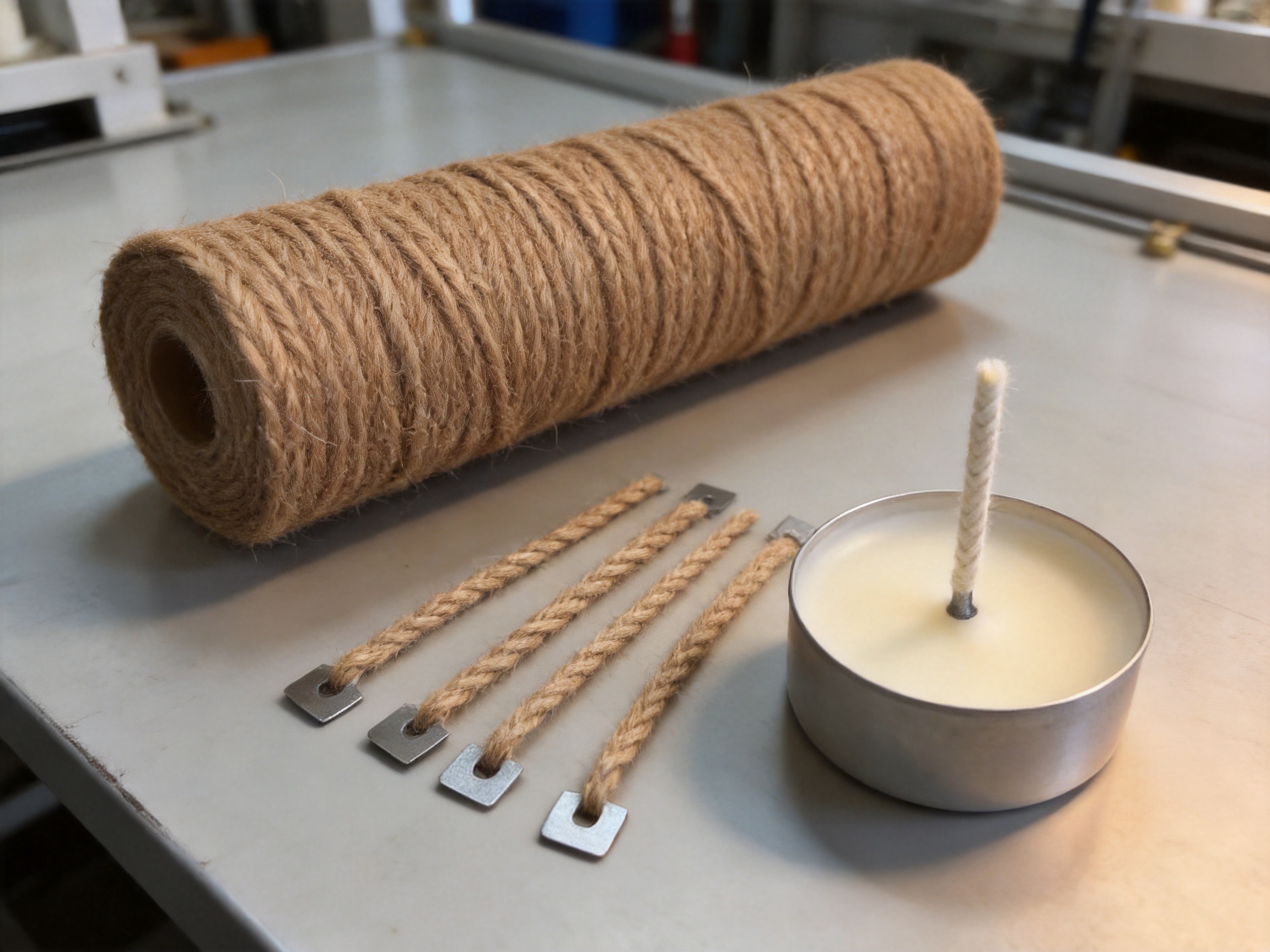
Untreated cotton wick can be useful for manufacturers with their own coating and conditioning processes. However, it requires additional preparation. The wick may need to be coated, dried, straightened, cut, and stored before it is ready for candle assembly. These steps require labor, workspace, drying time, and process controls.
A pre-waxed roll reduces those preparation requirements. The product arrives with a coating intended to improve handling, allowing the production team to focus on cutting, tabbing, centering, and pouring. For companies without dedicated wick-treatment equipment, this can simplify production and reduce the risk of inconsistent in-house coating.
Individually pre-cut wicks provide convenience but limit flexibility. A manufacturer must purchase the correct length in advance and may need to stock several lengths for different candles. If a product specification changes, unused pre-cut inventory may become difficult to use.
The continuous roll format provides greater control over length and can support several product configurations from one material specification. It is particularly advantageous for factories producing both standard and customized candles. The trade-off is that cutting and tabbing equipment or labor must be available, but many professional production environments already have these capabilities.
Loose or poorly organized fiber bundles can be more difficult to position and may not provide the same degree of dimensional consistency. Braiding helps create a defined product shape and supports mechanical handling during manufacturing. It also provides a clear basis for identifying and reproducing wick sizes.
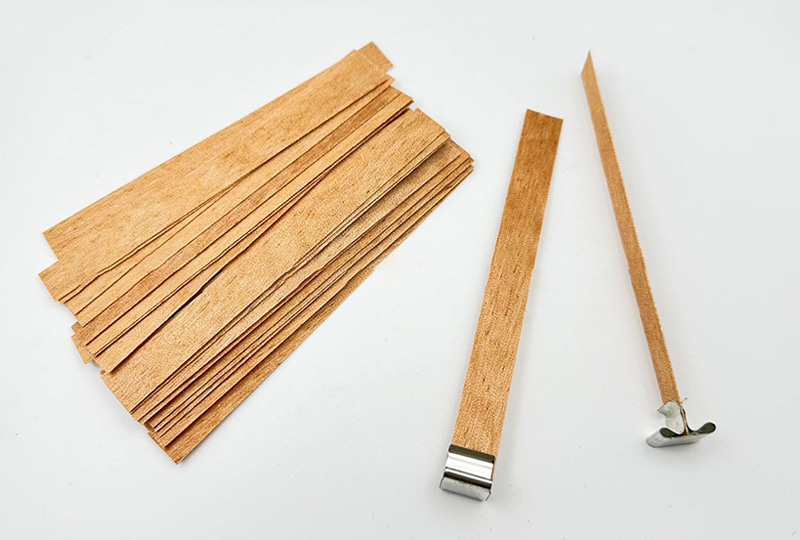
The braided structure is not automatically superior for every candle formulation. Some candle systems may require other wick constructions, such as specialty paper-core, wood, or flat-braid designs. However, for customers seeking a versatile cotton wick with a practical roll format, a consistent braid offers a strong combination of handling convenience and combustion performance.
Even a high-quality wick must be matched to the finished candle. The recommended development process begins with identifying the vessel diameter, candle height, wax type, fragrance concentration, dye level, desired burn time, and intended market use. These factors help narrow the range of wick sizes that should be tested.
The next step is to prepare representative samples using the actual production materials. The same vessel, wax, fragrance, dye, wick length, tab, and pouring process should be used whenever possible. Small changes in formulation or manufacturing temperature can influence the final result, so tests should reflect commercial conditions rather than only laboratory assumptions.
During a burn test, the manufacturer should observe flame height, flame stability, melt-pool diameter, melt-pool depth, soot, smoke, mushrooming, wax consumption, glass temperature, and the behavior of the wick after extinguishing. Testing should include multiple samples to determine whether the result is repeatable.
A wick may appear suitable during the first hour but perform differently during later burn cycles. For container candles, full testing should normally continue through multiple burns until the candle approaches the end of its usable wax content. The testing schedule should follow the buyer’s internal standards and the requirements of the target market.
Once a wick size is approved, its specification should be recorded. Useful records include the braid size, approximate diameter, roll identification, coating condition, cut length, tab size, vessel dimensions, wax formula, fragrance percentage, pouring temperature, curing period, and test observations. This information forms a reference for quality control and repeat production.
The product is suitable for customers who need more than a standard catalog component. Customization may involve wick size, roll length, packaging, tab configuration, labeling, and delivery format. Customers should provide technical drawings, samples, target vessel dimensions, or existing wick references when requesting a custom recommendation.
For OEM and ODM programs, the wick can be considered as part of a complete product-development package. The supplier supports customization across specifications, fragrance selection, labels, and packaging. This is useful for retailers, gift companies, hospitality suppliers, distributors, and private-label brands that want to create a coordinated home-fragrance collection.
Packaging customization may include individual bags, grouped rolls, cartons, printed labels, barcode information, or outer cases designed for warehouse handling. The correct packaging depends on order quantity, destination-market requirements, moisture protection, and the customer’s production process. Clear packaging identification is especially important when several braid sizes are used in the same factory.
For customers selling finished candles, the supplier can also coordinate vessels and color boxes through its manufacturing network. A single project may therefore include wick sourcing, jar selection, candle filling, inspection, and packaging development. Consolidating these activities can help reduce the time spent managing multiple vendors, although each technical specification should still be approved separately.
Small candle businesses often value flexibility because their product range changes frequently. A continuous wick roll can be cut by hand or with simple tools, allowing the producer to make different candle sizes without purchasing numerous pre-cut options. The pre-waxed structure can also make centering and insertion easier for operators who are building production procedures.
For small workshops, clear labeling and careful storage are essential. Each roll should be identified by wick size and batch information. Operators should avoid mixing similar-looking sizes, particularly when producing candles with different vessel diameters. A basic production record can help connect each finished candle with the wick used during assembly.
Medium-sized manufacturers may use a combination of manual and semi-automatic equipment. The roll can be dispensed in measured lengths, cut according to a standard, and tabbed before the wicks are transferred to the vessel-assembly line. Establishing standard operating procedures can improve production speed and reduce variation between operators.
At this scale, the main advantages are often inventory flexibility and repeatability. One approved wick specification can support several products, while different cut lengths accommodate vessel variations. The manufacturer can also establish incoming inspection procedures and retain samples from each batch for comparison.
Large OEM programs need reliable supply, predictable specifications, and coordinated logistics. A continuous roll can be incorporated into higher-volume cutting and tabbing workflows, provided the roll dimensions and packaging are compatible with the customer’s equipment. Production planning should address monthly demand, safety stock, lead times, carton configuration, and shipment scheduling.
For international buyers, export coordination is another important consideration. The company is based in Hangzhou, Zhejiang Province, with logistics access near Ningbo Port. Its experience serving customers in North America, Europe, the Middle East, and other regions supports the documentation and shipment coordination required for cross-border purchasing.
Wick rolls should be stored in a clean, dry area away from excessive humidity, direct sunlight, strong odors, and sources of heat. Storage conditions can influence the condition of the cotton and the pre-wax coating. Rolls should remain in their protective packaging until they are needed for production.
Operators should handle the roll carefully to prevent crushing, contamination, or unnecessary deformation. When dispensing the material, the roll should be supported so that it unwinds smoothly. Pulling aggressively from an unstable roll may stretch or distort the braid and make cutting less accurate.
Cut lengths should be measured according to the approved production standard. The correct length depends on the vessel height, tab position, pouring method, and finishing procedure. After cutting, the wick should be attached securely to the sustainer tab and checked for straightness before it is centered in the candle.
Wick centering is critical. A correctly sized wick may still perform poorly if it is positioned too close to one side of the vessel. Manufacturers should use suitable centering devices, guides, or fixtures to maintain a consistent position during pouring and cooling.
Finished candles should be cured according to the wax manufacturer’s recommendations before final burn testing. Fragrance distribution and wax crystallization may change during curing, and these factors can influence wick behavior. Testing immediately after pouring may not provide a complete picture of the final product’s performance.
Candle safety depends on the complete product, not the wick alone. Manufacturers must evaluate the interaction of the wick, wax, fragrance, dye, vessel, label, packaging, and consumer instructions. The wick should be selected and tested to support a controlled flame without causing unacceptable overheating, smoking, or instability.
Glass containers should be checked for thermal performance and visible defects. The manufacturer should assess the temperature of the vessel during testing and confirm that the candle remains stable on a suitable surface. Labels should include appropriate instructions for trimming the wick, keeping the candle away from flammable objects, and never leaving a burning candle unattended.
Market-specific requirements may differ. Buyers should verify the standards, testing protocols, labeling rules, and documentation applicable to their destination country or region. The supplier can support product-development and quality documentation, but the final responsibility for legal compliance and market release remains with the manufacturer or brand owner.
The main advantage of Pre-Waxed Braided Cotton Candle Wick Roll is the way several practical features work together. The braided cotton structure provides a defined and manageable form. The pre-waxed coating improves stiffness during assembly. The continuous roll supports flexible cutting and tabbing. Multiple braid sizes allow the material to be evaluated across different vessel diameters. Batch consistency supports repeat production and quality control.
These advantages are strengthened by the supplier’s broader business capabilities. The company combines international trading experience with product sourcing, customization, factory coordination, inspection, packaging development, and logistics support. Its product-development resources cover home fragrance and related household categories, making it suitable for customers building broader product collections rather than purchasing a single isolated component.
The company’s reported network of candle factories, jar partners, and color-box suppliers helps provide a more complete sourcing solution. Its in-house laboratory and quality-control focus support systematic inspection, while its flexible approach to trial orders and bulk delivery can accommodate different stages of a customer’s growth.
For established manufacturers, the product can help simplify replenishment and standardize wick inventory. For new brands, it can reduce the number of preparation steps needed to begin testing. For OEM buyers, it can serve as one component within a complete customized candle program. In each case, the final result depends on correct testing, but the supply format provides a practical foundation for efficient development and production.
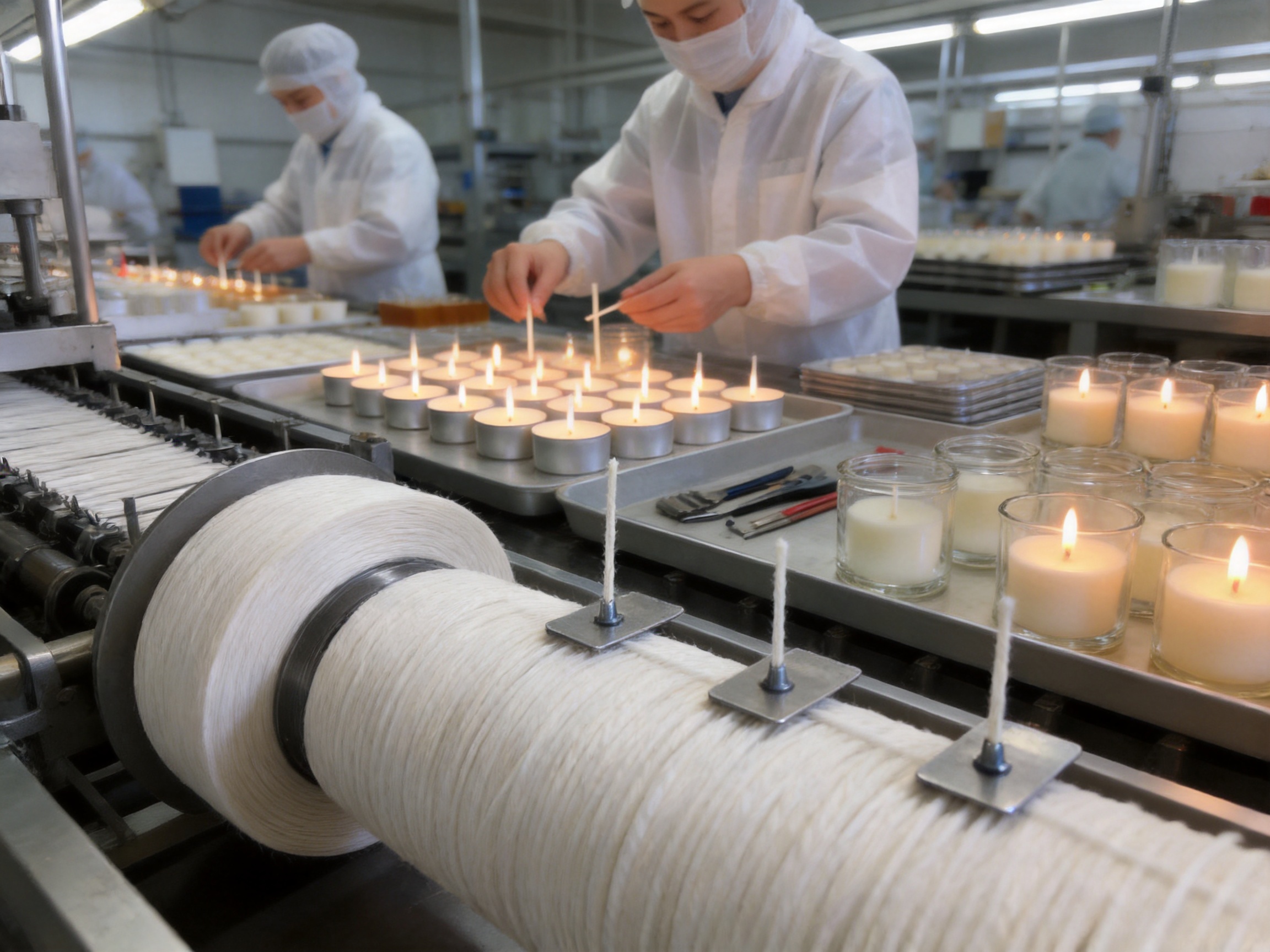
Before placing an order, buyers should identify the expected candle formats and provide as much technical information as possible. Important details include vessel diameter, vessel height, wax type, fragrance concentration, dye usage, desired burn time, estimated monthly volume, wick cut length, sustainer-tab requirements, packaging preferences, and destination market.
Buyers should request samples for testing before approving a large commercial order. Samples should represent the proposed production specification and should be evaluated in the actual candle formula. If several waxes or fragrances will be used, each important combination should be tested separately.
It is also advisable to confirm roll length, roll diameter, core or winding configuration, carton quantity, labeling information, batch identification, lead time, and acceptable tolerance. These details help ensure that the product fits the customer’s cutting equipment and warehouse procedures.
A written approval sample should be retained by both parties when possible. The sample can be used for future comparison and can help resolve questions about braid size, coating appearance, packaging, or other measurable characteristics.
It is a continuous roll of braided cotton wick with a pre-waxed coating. The material can be cut into individual lengths for candle production. Metal sustainer tabs may be supplied separately for customer-controlled tabbing or attached according to the agreed specification.
The pre-waxed coating adds slight stiffness, making the wick easier to handle, position, cut, and tab. It can also help the wick remain upright during wax pouring. The coating is designed to melt into the candle’s wax pool during burning.
No. Wick selection depends on vessel diameter, wax formulation, fragrance load, dye, candle height, and the desired burn profile. A wick size that works well in one candle may be unsuitable for another. Burn testing is necessary before final approval.
Multiple braid sizes are available for evaluation, ranging from small tea light vessels to larger jar candles and selected molded formats. The exact size should be confirmed through testing and matched to the customer’s wax and vessel combination.
Yes. The continuous format is suitable for manual, semi-automatic, and high-volume cutting and tabbing workflows, provided the roll configuration is compatible with the customer’s equipment. Production specifications should be confirmed before ordering.
Tabs may be available as a separate accessory or as a pre-attached option. Buyers should confirm the required tab diameter, finish, attachment method, and packaging configuration when requesting a quotation.
The braided construction is designed to curl gently during combustion and help manage the charred tip. However, consumers should still trim the wick according to the candle-care instructions. Self-trimming behavior does not remove the need for normal safe-use practices.
It may be suitable for soy wax, paraffin blends, beeswax blends, and other candle formulations, but performance must be tested in the actual formula. Wax viscosity, fragrance, color, additives, and curing time can all influence wick behavior.
Customization support may include braid size, roll format, cut length, tab configuration, packaging, labeling, and coordinated candle components. Customers should provide drawings, samples, vessel details, or technical requirements for evaluation.
Buyers may request the agreed wick specification, batch identification, sample approval records, inspection details, packaging information, and any available test documentation relevant to the order. The exact documents should be confirmed during the purchasing process.
Yes. The wick can be used as part of a private-label or OEM candle project. The broader supply network can also support fragrance selection, vessels, labels, packaging, and finished candle coordination, subject to the project’s requirements and order volume.
Store the roll in a clean, dry environment away from direct sunlight, excessive humidity, heat, contamination, and strong odors. Keep it in protective packaging until use and handle it carefully to prevent crushing or distortion.
Pre-Waxed Braided Cotton Candle Wick Roll is a practical component for candle manufacturers seeking a flexible and repeatable wick supply. Its braided cotton construction supports consistent capillary action and mechanical handling, while the pre-waxed coating makes the material easier to cut, tab, position, and process. The continuous-roll format provides greater control than fixed pre-cut lengths and can support a variety of candle sizes from compact tea lights to larger jar formats.
The product’s value extends beyond its basic construction. Its suitability for high-volume workflows, customizable tab options, multiple braid sizes, and batch-based quality control makes it useful for commercial production, craft businesses, private-label brands, and OEM programs. When combined with systematic burn testing and proper candle formulation, it can help manufacturers build more consistent and efficient production processes.
The supplier’s strengths in sourcing, factory coordination, product development, laboratory-supported quality control, packaging customization, and international logistics provide additional support for customers developing complete home-fragrance collections. Through flexible trial production, repeat-order management, and coordinated supply-chain services, the company can assist customers from early testing through commercial replenishment.
For the best results, buyers should define their technical requirements clearly, test the wick in the complete candle system, approve a reference sample, and maintain accurate production records. With these controls in place, a pre-waxed braided cotton wick roll can become a dependable foundation for consistent candle manufacturing and scalable product development.
1. Candle manufacturing and wick-selection principles, including capillary fuel delivery, melt-pool formation, flame stability, and burn-cycle evaluation.
2. General candle-product quality-control practices covering raw-material inspection, production-batch consistency, finished-product testing, and traceability.
3. Guidance on candle vessel selection, thermal evaluation, wick centering, consumer-use instructions, and safe-burning procedures.
4. Technical considerations for cotton-fiber wick construction, braided structures, pre-wax treatment, cutting, tabbing, and production handling.
5. Home-fragrance product-development practices for wax selection, fragrance loading, curing, packaging, private-label manufacturing, and OEM project coordination.

Room 1701, Building C1, Wangjing, Xiaoshan District, Hangzhou City, Zhejiang Province, China.

+86-15937257616

Copyright© 2026 Hangzhou Leo Home Trading Co., Ltd. All Rights Reserved.

Luxury Candles Home Fragrance Manufacturers Modern Candles Factory