 English
 Français
News
Home / Author / Sophia Lin — Product Sales Executive / Diamond-Embossed Tassel-Lid Glass Jar Candle: A Refined Home Fragrance Solution for Modern Retail
Content


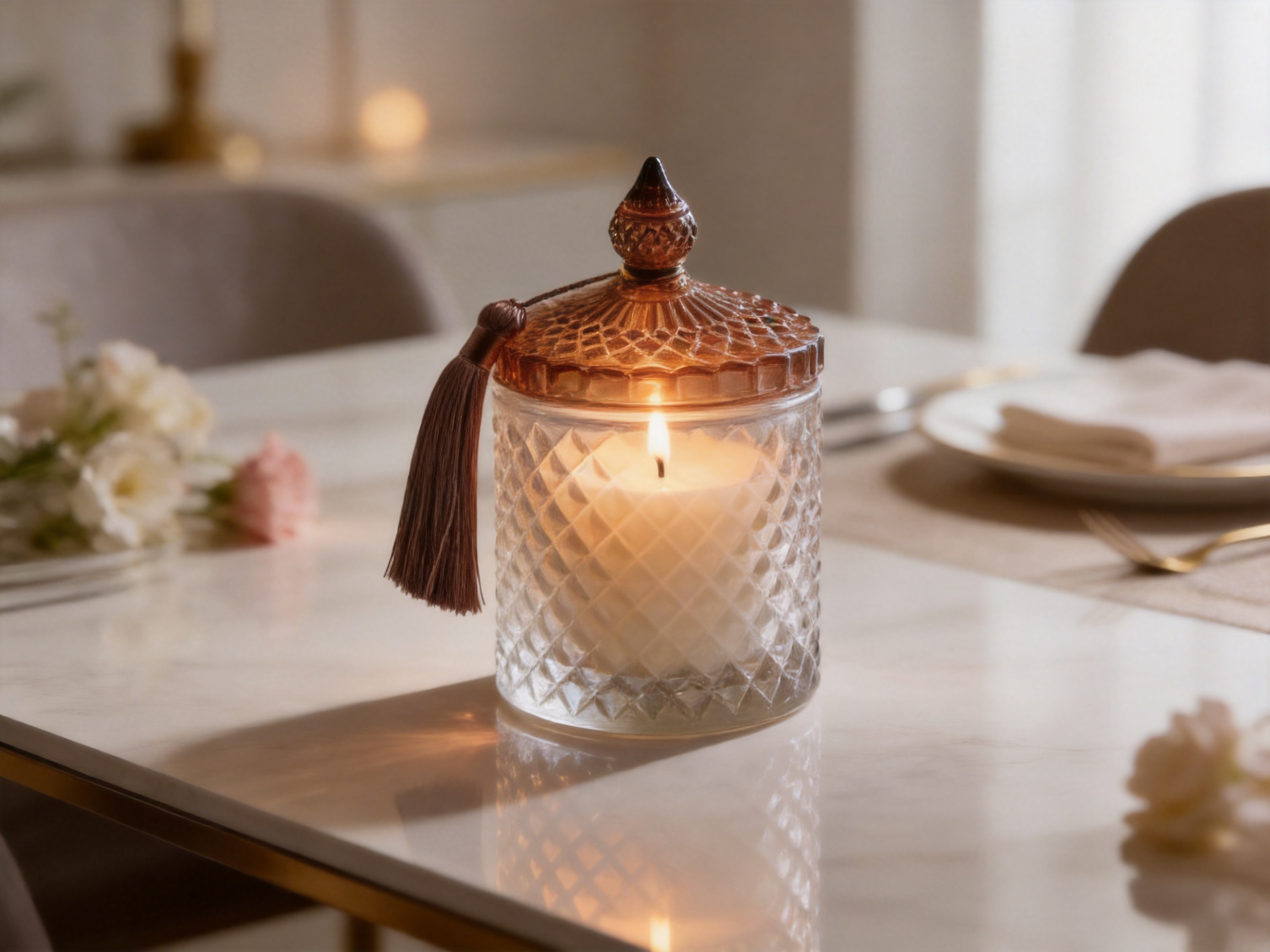

Diamond-Embossed Tassel-Lid Glass Jar Candle
Home fragrance has evolved from a functional household purchase into an important part of interior styling, gifting, hospitality, and personal wellbeing. Consumers increasingly look for products that deliver more than fragrance alone. They want attractive vessels, dependable quality, thoughtful details, and a design that remains useful after the candle has been burned. The Diamond-Embossed Tassel-Lid Glass Jar Candle responds to these expectations by combining decorative glass craftsmanship, practical protection, visible candle presentation, and post-use reusability in one coordinated product.
Its diamond-embossed glass body creates layered reflections when illuminated, allowing the flame to produce a softer and more dimensional glow. The matching tassel lid contributes a vintage-inspired decorative element while helping protect the candle from dust between uses. A semi-transparent vessel keeps the candle visible, supporting both the visual experience of burning and the presentation requirements of retailers, gift companies, hospitality businesses, and private-label brands.
Although the product has a decorative appearance, its value is not limited to aesthetics. The vessel is designed to support multiple stages of the product lifecycle: display before purchase, ambiance during use, protection between uses, and reuse after the candle has finished. This extended usefulness helps differentiate it from basic candle containers that are discarded once the wax is consumed.
For buyers seeking a reliable supply partner, the product is supported by an organized sourcing and customization structure. The supplier’s capabilities include product development, international sourcing, quality control, packaging coordination, OEM/ODM support, and export logistics. Its integrated network of candle factories, jar customization partners, and color box factories provides a foundation for developing consistent product lines rather than treating each order as an isolated transaction.
The Diamond-Embossed Tassel-Lid Glass Jar Candle belongs to the glass jar candle category and is suitable for home fragrance collections, decorative candle ranges, seasonal gift programs, and mood-lighting applications. Its design is built around a balance of visual richness and practical usability.
The principal decorative feature is the diamond embossing across the glass jar. Unlike a completely smooth vessel, an embossed surface interacts with light from several angles. When the candle is lit, the flame passes through the semi-transparent glass and meets the raised diamond pattern, creating soft reflections and subtle changes in brightness. This gives the product a more layered appearance than a plain container with a flat surface.
The visual effect is especially valuable in settings where lighting contributes to the atmosphere. On a dining table, the candle can complement tableware and flowers. In a bedroom or living room, it can support a calm and intimate environment. In a hotel, spa, restaurant, or boutique, the vessel can function as both a fragrance product and a decorative styling object.
The matching tassel lid adds another design layer. The lid helps reduce exposure to dust when the candle is not in use, while the tassel provides a soft textile accent that contrasts with the structured glass body. This combination creates a vintage-inspired character without requiring an overly complex silhouette. The result is decorative enough for gifting while remaining adaptable to different interior styles.
The semi-transparent body also provides an important product communication benefit. Shoppers can see the candle inside the vessel, which makes the product feel more tangible and helps them understand its condition before purchase. Visibility can be particularly useful for retail displays, where consumers often assess color, fill level, and overall presentation before selecting a candle.
After the fragrance and wax have been used, the jar can be cleaned and repurposed as a storage container or decorative piece. Potential secondary uses may include holding small accessories, makeup tools, craft supplies, dried flowers, or other household items, depending on the user’s needs. This reusability adds functional value and supports consumer interest in products that generate less immediate waste.
The candle market includes a wide range of products, from simple glass containers to highly styled gift candles. The Diamond-Embossed Tassel-Lid Glass Jar Candle occupies a strong position between everyday functionality and decorative premium presentation. Its advantages over more basic competitors arise from the coordinated relationship between the vessel, lid, light effect, and post-use purpose.
A plain glass jar can provide a safe-looking and practical package for a candle, but it may offer limited visual differentiation. When placed beside similar products, a smooth container often depends almost entirely on its label, fragrance name, or price to attract attention. The diamond-embossed surface gives this product an intrinsic visual identity before branding or scent communication is considered.
The embossed pattern can catch ambient light even when the candle is unlit. Once illuminated, it creates a more decorative presentation. This gives retailers an additional selling point and allows the product to remain attractive in stores, showrooms, gift displays, and online product photography.
Many candles are sold with simple flat covers or without lids. The tassel lid provides a more recognizable silhouette and strengthens the relationship between packaging and décor. It can make the candle appear more complete as a gift item and can support a higher perceived value than an uncovered or minimally packaged alternative.
The lid also serves a practical purpose. By helping protect the candle from dust, it supports a cleaner appearance during storage and between uses. For retailers, this may help preserve the presentation of displayed inventory. For consumers, it makes the candle easier to maintain after opening.
Some scented candles focus primarily on fragrance, while others emphasize decorative packaging. This product combines both directions. Its textured glass and tassel detail allow it to function as a decorative object even when it is not burning. This is valuable for consumers who want home fragrance products to fit into an existing interior rather than appear as temporary accessories.
The design can suit several sales environments, including home décor stores, gift shops, lifestyle boutiques, online marketplaces, hotel amenities, seasonal collections, and private-label fragrance programs. Its styling is distinctive without being tied to a highly specific holiday or interior trend, which can help extend its commercial relevance across different periods.
Disposable presentation is a common weakness in basic candle formats. Once the wax has been consumed, the original container may have little perceived value. The reusable glass jar changes this relationship by giving the consumer a reason to keep the vessel.
Reusability can improve the total value proposition in several ways. Consumers may perceive the product as a longer-lasting purchase, retailers may communicate a more sustainable lifestyle message, and brands may use the jar as part of a broader refill or reuse concept in the future. Even where a formal refill program is not offered, the ability to repurpose the container adds a second function to the product.
The design can be positioned in several ways depending on fragrance, labeling, packaging, and sales channel. It may serve as an accessible decorative candle, a premium home fragrance item, a seasonal gift, or part of a coordinated collection. This flexibility is useful for buyers who operate in more than one market segment.
Because the product supports OEM and ODM development, buyers can explore different commercial directions through fragrance selection, labels, specifications, and packaging. A single vessel concept may therefore be adapted to different customer groups without requiring a completely new product architecture for every project.
| Evaluation Area | Basic Smooth Jar Candle | Diamond-Embossed Tassel-Lid Glass Jar Candle | Commercial Benefit |
|---|---|---|---|
| Visual identity | Usually depends on the label | Embossed glass creates an identifiable surface pattern | Improved shelf and display differentiation |
| Light effect | Often provides a simple, uniform glow | Diamond texture creates layered reflections | Stronger ambiance and decorative appeal |
| Dust protection | May have no lid or a basic cover | Matching tassel lid adds protective coverage | Better storage and presentation between uses |
| Gift presentation | Functional but sometimes plain | Decorative lid and textured vessel support gifting | Suitable for gift sets and seasonal programs |
| Post-use value | May be discarded after burning | Jar can be reused as storage or décor | Higher perceived product lifespan |
| Customization potential | Often limited to labels | Can be developed through scent, label, specifications, and packaging | Better support for private-label product lines |
The glass vessel is central to the product’s identity. It must perform as a container, transmit light attractively, support a consistent visual presentation, and maintain a finish that meets commercial expectations. The embossed diamond design adds complexity compared with a plain smooth jar because the surface pattern must be coordinated with the form of the vessel.
A well-developed embossed glass jar depends on controlled tooling and consistent forming. The pattern needs to be sufficiently defined to create visible reflections while maintaining a balanced appearance around the jar. If the pattern is uneven, the product may look inconsistent across a shipment. If the texture is too shallow, the light effect may be weak. If it is too visually dominant, it may compete with the candle and label. Product development and sample review are therefore important stages before mass production.
Glass clarity and semi-transparency are also important. The vessel should allow the candle to remain visible while supporting the desired decorative effect. This relationship between transparency and texture helps the product communicate both its contents and its craftsmanship.
Quality control should examine the vessel for visual consistency, surface defects, pattern alignment, finish quality, and compatibility with the lid. These checks are particularly important for export orders, where the product may pass through several handling and logistics stages before reaching the final customer.
The supplier’s manufacturing coordination model is designed to support these requirements through relationships with multiple jar customization partners. Access to specialized partners can help buyers evaluate different glass options, develop samples, compare finishes, and select a suitable production route for their target market and budget.
The product’s commercial value is supported by the supplier’s broader manufacturing and supply chain organization. Rather than relying on a single narrow production capability, the company coordinates a network that includes candle factories, jar customization partners, and color box factories. This structure is particularly useful for buyers who need a finished product that includes the candle, vessel, decorative elements, and retail packaging.
The company integrates 10 candle factories within its supply network. This provides access to different production capabilities and supports the development of varied candle formats, including jar candles, shaped candles, jelly candles, and other decorative styles. For buyers building a collection, this can simplify communication and reduce the need to manage several unrelated suppliers.
A multi-factory structure can also support capacity planning. If a project requires a particular construction, fragrance direction, packaging format, or delivery schedule, the sourcing team can evaluate suitable production resources within the network. This does not eliminate the need for technical review, but it can make the development process more flexible.
Eight jar customization partners are integrated into the supply structure. This is important for a product in which the vessel is a major part of the selling proposition. Buyers may need different glass colors, textures, shapes, finishes, or dimensions for separate collections. Working with established customization partners can help move a project from concept to sample and then to production more efficiently.
For the diamond-embossed design, the coordination of glass pattern, vessel shape, and lid fit is especially important. A supplier with access to jar development resources can help manage these connected details instead of treating the glass container as a generic component.
The company also integrates eight color box factories. This allows packaging development to be considered alongside the product rather than as an afterthought. A decorative candle often depends on the relationship between the physical product and its retail box. The packaging needs to protect the glass, present the design clearly, and communicate the intended market position.
Packaging coordination can cover structural design, printed presentation, labeling, color matching, and packing arrangements. For export buyers, it may also involve carton planning and shipping considerations. A coordinated approach can reduce the risk of mismatched components, inconsistent visual quality, or delays caused by separate packaging procurement.
The company describes a quality management process that covers raw material selection, production stages, and finished goods inspection. It also operates an in-house laboratory and applies quality control at key stages. For scented candle programs, this type of process is relevant because product consistency involves several variables, including wax or candle material, fragrance integration, wick performance, glass appearance, lid fit, labeling, and packaging condition.
Quality assurance should begin before production. Samples, specifications, fragrance requirements, artwork, and packaging details need to be reviewed and confirmed. During manufacturing, inspections can help identify problems before they affect an entire batch. Finished goods inspection then provides a final assessment of appearance, quantity, packing, and conformity with the approved sample.
The purpose of this system is not simply to find defects at the end. It is to reduce variation throughout the supply chain and make the result more predictable for overseas buyers. Consistency is especially important for retailers that need repeat orders to match earlier shipments.
The reported daily capacity of up to 50,000 units supports larger orders and regular replenishment programs. At the same time, the company states that it can support smaller volumes and trial runs. This combination is valuable because many home fragrance brands begin with market testing before committing to a large-scale launch.
A trial order may help a buyer evaluate fragrance acceptance, packaging performance, retail response, and customer feedback. If the product performs well, the buyer can move toward larger production and repeat purchasing. Flexible order support can therefore reduce the initial risk associated with introducing a new candle design.
Capacity should always be confirmed according to the exact product configuration, fragrance, packaging, order quantity, and delivery schedule. Nevertheless, a network capable of supporting both trials and bulk programs provides a useful foundation for businesses at different stages of development.
The Diamond-Embossed Tassel-Lid Glass Jar Candle is suitable for customers that want more than an off-the-shelf item. OEM and ODM support allows the product to be developed according to a brand’s market position, customer profile, and sales channel.
Buyers may require adjustments to vessel appearance, candle size, packaging configuration, label application, or assortment structure. Product development support can help translate drawings, samples, or written requirements into a production specification.
Clear specifications are particularly important when the product includes multiple coordinated elements. The glass jar, tassel lid, candle fill, label, inner protection, and outer box must work together. A detailed specification can reduce ambiguity and make quality inspection more objective.
Fragrance is one of the most important purchase drivers in the home fragrance category. Different markets may prefer floral, woody, fresh, fruity, gourmand, herbal, or seasonal scent profiles. A brand may also wish to create a collection based on moods, destinations, seasons, or interior styles.
The supplier supports fragrance selection as part of its customization services. Buyers can use this support to develop a scent direction that complements the decorative character of the vessel. For example, a refined glass jar may be paired with a calm evening fragrance, a warm seasonal blend, or a sophisticated floral profile. The exact choice should be evaluated through samples and market testing rather than assumed in advance.
Labels and packaging provide the main communication platform for a private-label candle. They can explain the fragrance, establish brand identity, communicate usage information, and position the product within a particular price tier.
The embossed glass body already supplies visual interest, so packaging design can either emphasize the pattern or create a controlled contrast. Minimal labeling may highlight the vessel, while a more detailed box may be suitable for gift collections. The tassel lid can also be considered when selecting colors, typography, and packaging structure.
A single candle can become the starting point for a larger collection. Buyers may develop multiple fragrances using the same vessel, create coordinated colors for different scents, or combine the jar candle with other home fragrance products. The supplier’s broader product scope includes scented candles, LED candles, and related gift sets, creating opportunities for collection-based development.
Collection building can improve merchandising because products share a recognizable design language. It can also encourage repeat purchasing when consumers return to explore other fragrances or purchase matching gifts.
The product’s combination of fragrance, decoration, and reusability makes it adaptable to several commercial settings. Each channel may emphasize a different advantage.
Home décor stores can present the candle as an interior accent as well as a fragrance product. The diamond embossing is suitable for displays where lighting and visual texture are important. The jar can be grouped with textiles, tableware, decorative accessories, or seasonal home collections.
The tassel lid gives the candle a gift-friendly appearance. It can be included in holiday assortments, housewarming collections, wedding favors, hospitality gifts, or corporate gifting programs, subject to the buyer’s required customization. Decorative details can help a candle feel more complete without relying on excessive external packaging.
Hotels, spas, salons, restaurants, and wellness businesses often use fragrance and lighting to shape customer experience. A glass jar candle can support tablescapes, reception areas, guest rooms, treatment rooms, or retail corners. The reusable vessel may also reinforce a premium service environment.
Online retailers need products that are visually distinctive in images and easy to explain through concise content. The diamond-embossed surface, tassel lid, visible candle, and reusable jar provide several clear communication points for product listings. Buyers can present the product through lifestyle photography, close-up detail images, and information about care and reuse.
Private-label brands can use the product as a foundation for a distinctive candle range. Custom scent selection, labels, and packaging allow the same basic vessel concept to be aligned with different brand identities. The supplier’s development and sourcing services can help coordinate the components required for a finished retail product.
When evaluating a decorative glass jar candle, buyers should review more than the appearance of the sample. A complete assessment should consider the relationship between the candle, vessel, lid, packaging, and intended market.
Glass appearance should be checked for consistency, including clarity, embossing definition, color, surface finish, and visible imperfections. The lid should be assessed for fit, appearance, tassel attachment, and protection during storage. The candle itself should be reviewed according to the agreed formulation, fragrance profile, wick behavior, and visual finish.
Burn testing is another important part of product development. The exact test plan should be established according to the final candle construction and applicable market requirements. Buyers may review flame stability, wax pooling, fragrance performance, vessel temperature, soot behavior, and overall user experience. Testing should be completed using production-representative samples rather than an unrelated prototype.
Packaging tests can help determine whether the glass jar and lid remain protected during handling and transportation. This is particularly important for international shipments, where products may experience vibration, stacking, temperature changes, and multiple loading stages. The packaging should protect the product while maintaining a presentation suitable for retail.
Documentation should also be managed carefully. Product specifications, approved samples, artwork, packing instructions, inspection standards, and shipping documents should be aligned before mass production. Clear documentation helps reduce misunderstandings and supports repeat-order consistency.
A structured order process helps buyers move from concept to delivery with fewer delays. The first stage is requirement collection. The buyer communicates the target market, product category, expected quantity, fragrance direction, packaging needs, labeling requirements, and desired delivery schedule.
The next stage is product evaluation and sample development. The supplier can coordinate the vessel, candle construction, lid, fragrance, label, and packaging. Samples allow the buyer to assess visual appearance, scent, burning performance, and market suitability.
After sample approval, the parties should confirm the final specification and inspection requirements. This can include the approved glass finish, embossing appearance, color references, label placement, packaging structure, carton configuration, and acceptable quality limits.
Production planning then coordinates the relevant factories and component suppliers. Because the product involves multiple elements, scheduling should account for glass production, candle filling, lid preparation, printing, packaging assembly, and final inspection. A supply chain partner with experience in cross-border coordination can help manage these dependencies.
Before shipment, finished goods inspection verifies that the order conforms to the approved requirements. Packing and logistics arrangements are then completed, with shipping plans adapted to the destination market and order size. The company’s location in Hangzhou and logistics access near Ningbo Port support export coordination for international customers.
For overseas buyers, manufacturing capability is only one part of a successful purchasing relationship. Communication, sourcing coordination, customization, inspection, documentation, and delivery all influence the final result.
Hangzhou Leo Home Trading Co., Ltd. operates as an international trading and supply chain partner focused on household and daily necessities. Its product scope includes personal care, home and garden, daily tools, and home fragrance. This broader category knowledge can be useful for buyers developing lifestyle collections rather than a single standalone candle.
The company was founded in January 2025 and uses digital tools and supply chain management systems to support international business. Its team covers product development, sourcing, and cross-border marketing. These functions can help bridge the gap between a buyer’s commercial idea and the technical requirements of production.
The company reports deliveries to more than 10 countries and regions across North America, Europe, and the Middle East. International experience can help buyers consider market-specific packaging, product positioning, shipping requirements, and replenishment needs. Each market remains subject to its own regulations and buyer responsibilities, so final compliance requirements should be confirmed for the destination country.
The company also emphasizes three operating values that are relevant to product development. Execution supports timely handling of instructions and responsibilities. Warmth encourages cooperative communication and long-term relationships. Refinement focuses attention on details from formulation and craftsmanship to export documentation. These values align well with a product whose success depends on coordination across many small but important components.
Home fragrance buyers are increasingly interested in how products are used, packaged, and discarded. The reusable glass jar does not eliminate all environmental considerations, but it provides a practical opportunity to extend the product’s useful life.
Once the candle has finished, users may clean the jar and use it for storage or decoration. This can reduce the likelihood that the vessel is immediately discarded. The decorative form also encourages reuse because consumers may want to continue displaying it after the original function is complete.
Packaging decisions remain important. Buyers can evaluate the amount and type of packaging used, the protection required for international transport, and whether the packaging can be recycled or reused in the target market. A balance must be achieved between product protection and material efficiency, particularly because glass requires careful handling during shipment.
Brands may also communicate reuse suggestions as part of the product experience. Clear guidance can help consumers understand how to clean the vessel safely and identify suitable secondary uses. Any instructions should be developed according to the final product construction and safety considerations.
The product can be presented through several complementary selling messages. The first is the light experience: the diamond texture transforms the flame into a soft pattern of reflections. The second is the decorative detail: the tassel lid gives the jar a more complete and giftable appearance. The third is the practical benefit: the lid supports dust protection and the jar remains reusable after the candle is finished.
Retail displays should allow the texture of the glass to be seen. Side lighting or warm display lighting may emphasize the embossed surface, while a clear product image can show the relationship between the jar, flame, and lid. In online listings, close-up images can help customers understand the surface detail that may not be obvious in a distant product photograph.
Packaging copy should remain accurate and avoid unsupported technical claims. It can focus on the decorative glass, ambient glow, protective lid, visible candle presentation, fragrance experience, and reuse potential. If specific performance claims are made, they should be supported by the final product’s testing and documentation.
For collection development, buyers may create a consistent visual system across fragrances. Variations can be introduced through label colors, scent names, box artwork, or coordinated accessories while retaining the recognizable diamond-embossed vessel. This approach can help consumers identify the range and encourage multiple-item purchases.
Compared with a basic smooth jar, the product offers greater decorative differentiation and a more expressive light effect. Compared with a shaped candle, it provides the practical advantages of a protective container and a reusable vessel. Compared with a candle sold without a lid, it offers better storage presentation between uses. Compared with a purely decorative object, it retains the functional value of fragrance and ambient lighting.
These comparisons do not mean that one format is universally better than another. The right choice depends on the buyer’s target audience, price point, fragrance strategy, packaging budget, and sales channel. The strength of the Diamond-Embossed Tassel-Lid Glass Jar Candle is its balance. It combines several desirable attributes without relying on a highly complicated structure.
For buyers who want a product that can support both everyday sales and gifting, this balance can be commercially useful. It makes the product suitable for consumers purchasing for themselves as well as those searching for a decorative present.
The main visual feature is the diamond-embossed glass jar. Its textured surface interacts with the candle flame and surrounding light to create layered reflections and a softer, more dimensional glow.
The tassel lid helps protect the candle from dust when it is not being used. It also adds a decorative, vintage-inspired element that supports the product’s gift and home décor appeal.
Yes. OEM and ODM services support customization based on drawings, samples, or written requirements. Development may include specifications, fragrance selection, labels, and packaging, subject to project confirmation.
Yes. After the candle has been properly finished and the jar has been cleaned, it can be reused as a storage container or decorative piece. The specific reuse method should be selected according to the user’s needs and safety considerations.
Potential buyers include home décor retailers, lifestyle stores, gift companies, online sellers, hospitality businesses, spas, private-label fragrance brands, and importers serving North American, European, Middle Eastern, and other international markets.
The company states that it supports smaller volumes and trial runs in addition to larger bulk orders. The available quantity, lead time, and customization options should be confirmed according to the specific project.
The supply network integrates 10 candle factories, eight jar customization partners, and eight color box factories. This structure supports coordination across the candle, glass vessel, lid, and retail packaging.
Quality control covers key stages from raw material selection to finished goods inspection. The company also operates an in-house laboratory and coordinates checks intended to support consistent product quality.
Yes. The vessel can serve as a common design platform for different fragrances, labels, colors, and packaging concepts. It may also be combined with related scented candles, LED candles, or gift-set products.
Buyers should confirm the final vessel design, glass finish, candle specifications, fragrance, lid details, label artwork, packaging, order quantity, inspection standards, shipping terms, and destination-market requirements. Production should proceed against an approved sample and documented specification.
No. The tassel lid gives the product a vintage-inspired accent, but the glass jar can also work in modern, classic, boutique, hospitality, and transitional interiors. Label and packaging customization can further adjust its market presentation.
Online listings can emphasize the embossed surface, illuminated reflection effect, tassel lid, semi-transparent glass, fragrance experience, and reusable jar. High-quality images should show both the unlit product and the candle in use.
The Diamond-Embossed Tassel-Lid Glass Jar Candle offers a well-balanced solution for the modern home fragrance market. Its diamond-textured glass provides a distinctive light effect, while the tassel lid adds protection and decorative value. The semi-transparent vessel allows the candle to remain visible, and the reusable jar gives the product an extended role beyond its original burning function.
Its competitive advantage comes from the combination of these features rather than from any single detail. A basic candle may provide fragrance, but this product also contributes to interior presentation. A decorative vessel may look attractive, but this product retains practical use. A gift candle may have appealing packaging, but the coordinated jar and lid provide value before, during, and after use.
For international buyers, the supplier’s broader strengths are equally important. Its network of candle factories, jar customization partners, and color box factories supports coordinated product development. Its in-house laboratory, quality control process, OEM/ODM services, flexible order support, and export-oriented supply chain provide a foundation for both trial projects and larger product programs.
With suitable fragrance development, packaging, labeling, and market positioning, the candle can serve as a versatile addition to home fragrance collections. It is appropriate for brands seeking a decorative private-label product, retailers looking for a visually differentiated candle, and buyers who value a supply partner capable of managing multiple manufacturing stages.
Ultimately, the product represents a practical interpretation of refined home fragrance: an item that combines atmosphere, ornament, protection, and reuse in a single glass jar. Its design supports the emotional appeal of candlelight while its manufacturing and customization structure supports the commercial requirements of international sourcing.
1. Hangzhou Leo Home Trading Co., Ltd. Company Profile and Product Development Information. Internal corporate material supplied for this article.
2. Hangzhou Leo Home Trading Co., Ltd. Home Fragrance Product and OEM/ODM Capability Summary. Internal corporate material supplied for this article.
3. Product Description: Diamond-Embossed Tassel-Lid Glass Jar Candle. Product information supplied for this article.
4. General principles of glass container design, candle presentation, packaging coordination, and home fragrance merchandising. Industry reference framework.
5. General considerations for quality control, sample approval, burn testing, packaging inspection, and international supply chain management in candle production.

Room 1701, Building C1, Wangjing, Xiaoshan District, Hangzhou City, Zhejiang Province, China.

+86-15937257616

Copyright© 2026 Hangzhou Leo Home Trading Co., Ltd. All Rights Reserved.

Luxury Candles Home Fragrance Manufacturers Modern Candles Factory