 English
 Français
News
Home / Author / Sophia Lin — Product Sales Executive / Ethereal Botanical Bloom Flower Series Handmade Candle: Craftsmanship, Customization, and Competitive Value
Content
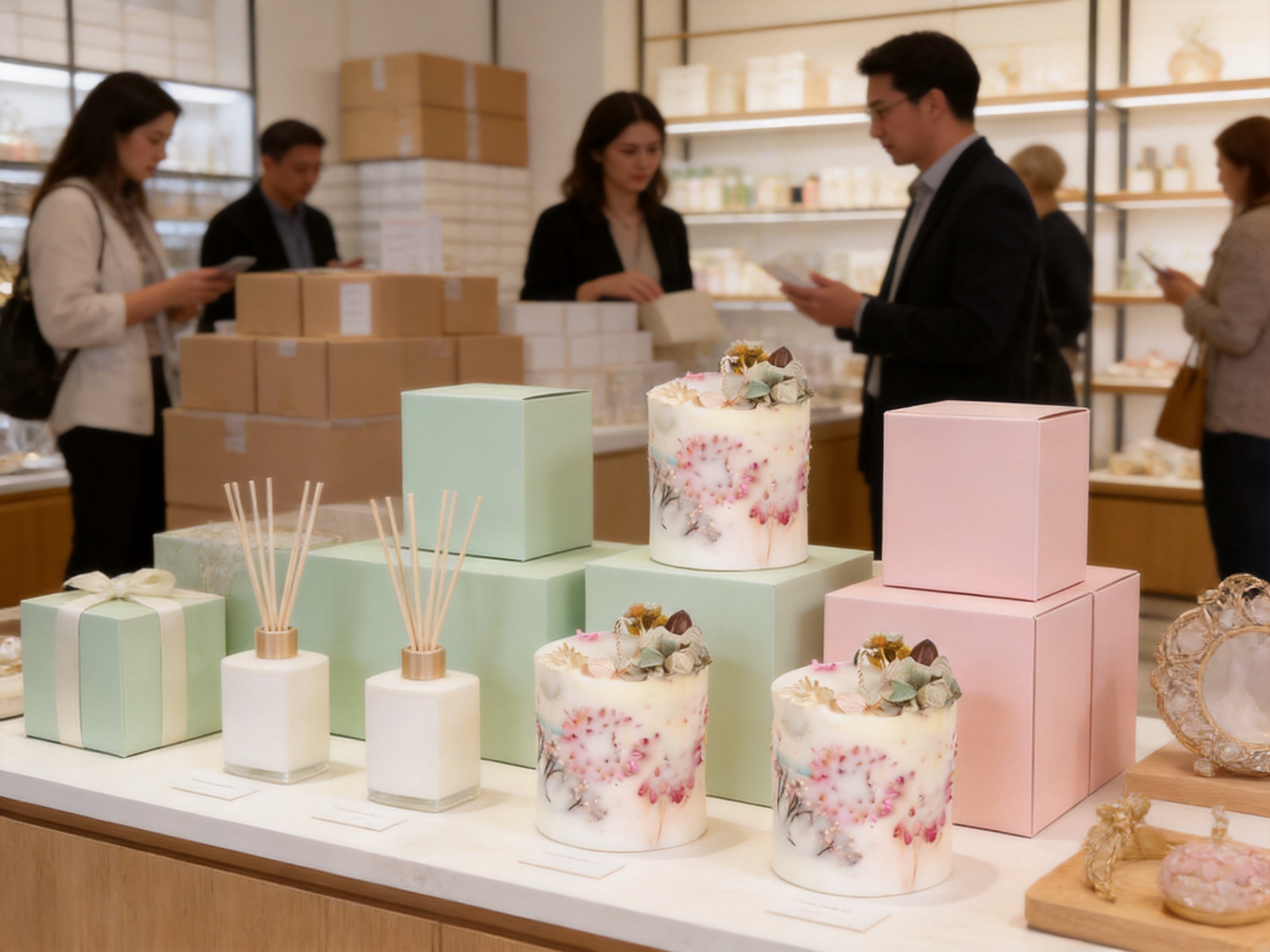
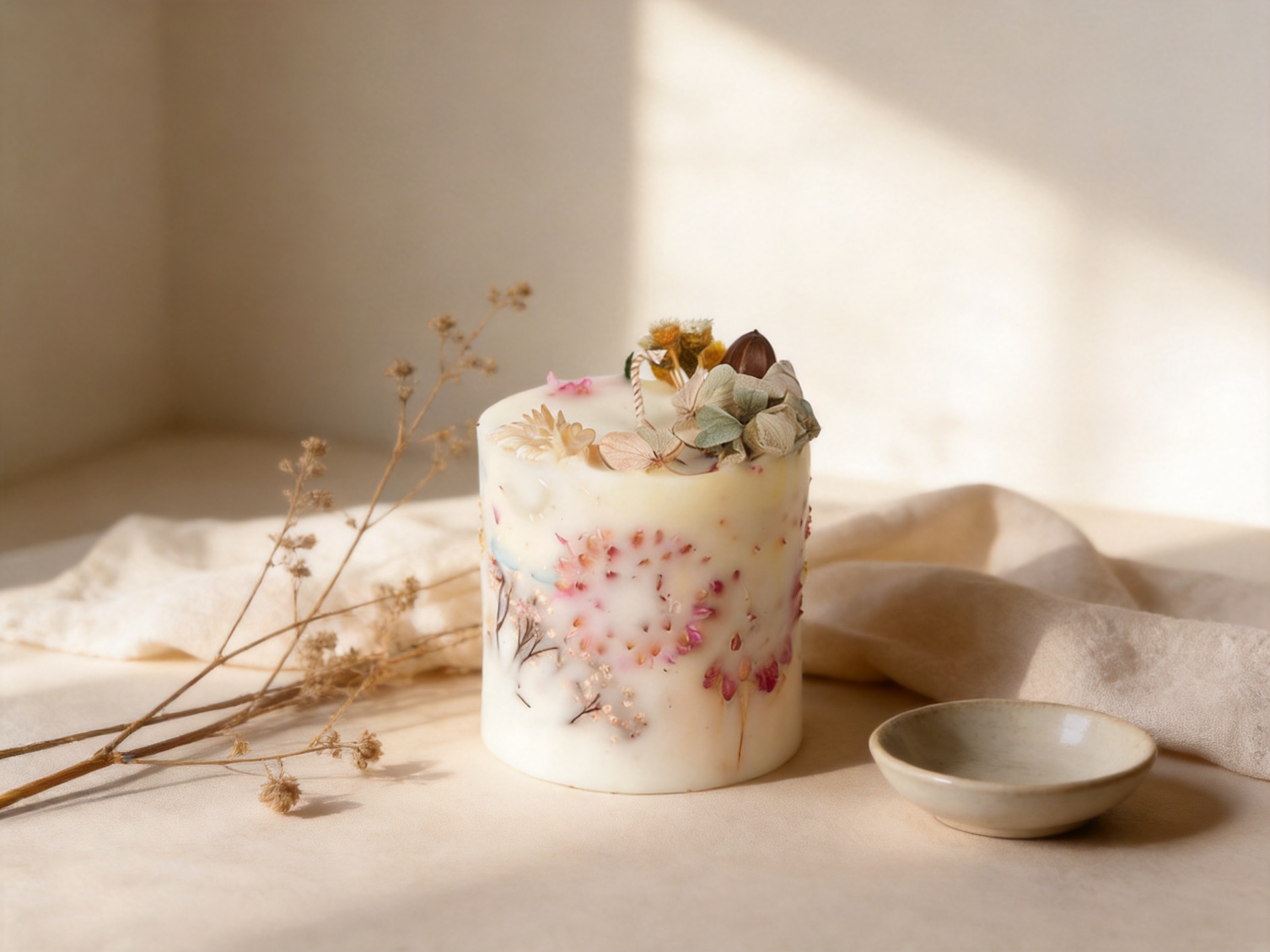
The Ethereal Botanical Bloom Flower Series Handmade Candle is designed for customers who want more from a candle than a simple source of fragrance or light. It combines the visual character of a botanical ornament with the familiar warmth of a handmade candle, creating a product that can serve as both a home-fragrance item and a decorative interior accessory. Its creamy wax body, embedded dried flowers, soft pastel details, and gentle marbling create an appearance inspired by preserved garden scenery.
In a crowded home-fragrance market, visual differentiation is increasingly important. Many standard candles compete primarily through scent, vessel design, or packaging. This flower series takes a different approach by making botanical composition a central part of the product experience. The dried petals and natural decorative elements are positioned within the wax so that each piece has an individual appearance. This quality gives the candle a crafted, artistic identity that is difficult to reproduce through fully automated mass production.
Behind the product is Hangzhou Leo Home Trading Co., Ltd., a Hangzhou-based international trading and supply chain company specializing in household and daily-use products. The company supports product development, international sourcing, customization, quality control, packaging coordination, and cross-border delivery. Its home-fragrance portfolio includes scented candles, LED candles, gift sets, candle components, and related products, allowing buyers to develop coordinated collections rather than purchasing a single isolated item.
This article examines the product’s design advantages, manufacturing considerations, customization potential, quality-control strengths, market applications, and competitive position. It also explains why the candle is suitable for importers, retailers, gift companies, hospitality buyers, private-label brands, and distributors seeking decorative home-fragrance products with a handcrafted appearance.
The Ethereal Botanical Bloom Flower Series Handmade Candle is built around a simple but effective design idea: bring the visual language of flowers and preserved botanicals into a functional wax product. Instead of using a plain surface, the candle presents delicate dried flowers and petals as part of the visible composition. The flowers appear suspended within or across the creamy wax body, giving the product depth and a sense of quiet natural beauty.
The ivory-toned wax provides a neutral foundation for the botanical details. This color choice is commercially useful because it is compatible with many interior styles, packaging themes, and seasonal merchandising programs. Soft ivory can complement minimalist rooms, romantic décor, rustic displays, Scandinavian interiors, natural-lifestyle stores, and contemporary gift collections. It also allows the subtle colors of dried petals to remain visible without creating an overly strong or artificial visual effect.
The product’s design language is intentionally gentle rather than dramatic. Its appeal comes from restrained color, organic texture, and careful arrangement. This makes it suitable for consumers who prefer calm decorative products over highly saturated or heavily embellished designs. The candle can be positioned as a refined home accent, a thoughtful gift, a seasonal decoration, or part of a wider collection of botanical lifestyle products.
Each handmade candle may display slight differences in the placement, shape, and color of the dried flowers. These variations should not be viewed as defects when they remain within agreed quality standards. Instead, they reinforce the perception that the product has been individually crafted. In a marketplace filled with identical factory-made goods, controlled variation can improve perceived authenticity and help retailers tell a stronger product story.
The decorative character also extends the candle’s potential use. A conventional candle may be purchased primarily for burning, while a botanical handmade candle can attract customers even before it is lit. It can be displayed on a bedside table, coffee table, dresser, open shelf, reception desk, boutique counter, or gift presentation. This dual role increases the number of merchandising opportunities available to retailers.

Ethereal Botanical Bloom Flower Series Handmade Candle
Many conventional candles use a plain wax surface, a standard glass jar, or a printed label as their main visual feature. Although these formats remain popular, they can be difficult to differentiate when displayed beside similar products. The Ethereal Botanical Bloom candle uses embedded botanical elements as a core design feature. This gives it an immediate point of recognition and makes it more likely to attract attention in a retail environment.
The floral composition creates a layered surface effect. The combination of wax, dried petals, subtle marbling, and natural textures produces visual depth that is not easily achieved with a simple monochrome candle. This can be especially valuable for online retailers, where product images must communicate the product’s emotional and decorative value quickly.
Automated products offer consistency, but they can sometimes appear impersonal. The handmade nature of this flower series gives every piece a slightly individual character. Botanical elements can differ in shape and position, creating a product experience that feels more personal and artisanal.
For gift and lifestyle retailers, this individuality can support premium positioning. Customers are often willing to pay more for products that appear carefully made, thoughtfully selected, and distinct from mass-market alternatives. A handmade appearance can also strengthen storytelling around nature, creativity, craftsmanship, and mindful living.
The product offers two connected forms of value. First, it functions as a candle and can contribute to a warm and inviting atmosphere when used appropriately. Second, it functions as a decorative object, even when it is not burning. This combination helps retailers market the product to both home-fragrance customers and décor-oriented customers.
Competitors that rely only on fragrance may lose relevance after the scent has been experienced. A decorative botanical candle can remain visually useful as part of a room arrangement or gift display. Its aesthetic value may therefore support longer product engagement and encourage customers to purchase additional pieces for different rooms, occasions, or seasons.
The soft botanical appearance allows the candle to fit across multiple style categories. It can be included in collections associated with wellness, nature, self-care, romantic gifts, home decoration, spring and summer merchandising, wedding favors, and boutique lifestyle products. This flexibility is an advantage over candles with highly specific themes or colors that may appeal to only a narrow audience.
Retailers can also combine the candle with ceramic trays, dried-flower arrangements, reed diffusers, room sprays, gift boxes, and other home-fragrance products. Its neutral base and organic details make it easier to create coordinated displays without requiring a complete change in store design.
The product’s basic design can be adapted for different markets through fragrance selection, color adjustment, flower selection, packaging, labels, and collection development. This makes it suitable for private-label buyers that want an identifiable product without developing an entirely new manufacturing concept from the beginning.
Customization can help a buyer create a product that reflects a particular brand identity. For example, a retailer may prefer subdued colors and minimalist packaging, while a gift company may choose romantic floral colors and a decorative box. A hospitality client may require coordinated labeling and a smaller format, while a seasonal retailer may request a special botanical arrangement for a limited collection.
The visual quality of a botanical candle depends heavily on the relationship between the wax body and the decorative elements. The creamy wax base must provide enough visual clarity and contrast for the dried flowers to remain visible, while also creating a stable and attractive surface. The choice of botanical materials affects color, texture, durability, and the overall design language.
Dried flowers and petals are naturally variable. Their size, thickness, color, and shape can differ from one batch to another. A professional production process therefore requires material screening and preparation before the decorative elements are used. Pieces that are excessively fragile, discolored, damp, or unsuitable for the intended composition should be separated during inspection.
Material selection also requires attention to cleanliness and storage. Botanical components should be kept dry and protected from excessive humidity. They need to be handled in a controlled environment to reduce the risk of contamination or unnecessary damage. Proper storage helps preserve the visual quality of the flowers and supports a more consistent final product.
The wax body is equally important. Its color, texture, hardness, melting behavior, and compatibility with fragrance all influence the finished candle. A suitable formulation should support an attractive appearance while also allowing the product to perform as a candle under its intended usage conditions. The final formulation may vary according to candle size, shape, fragrance profile, climate, packaging requirements, and target market expectations.
For customized orders, buyers can discuss the preferred visual balance between wax and botanical elements. Some markets may favor a dense floral composition that creates an obvious decorative statement. Others may prefer a more minimalist design with only a few delicate petals. This flexibility enables the same basic product concept to serve different customer groups without losing its central identity.
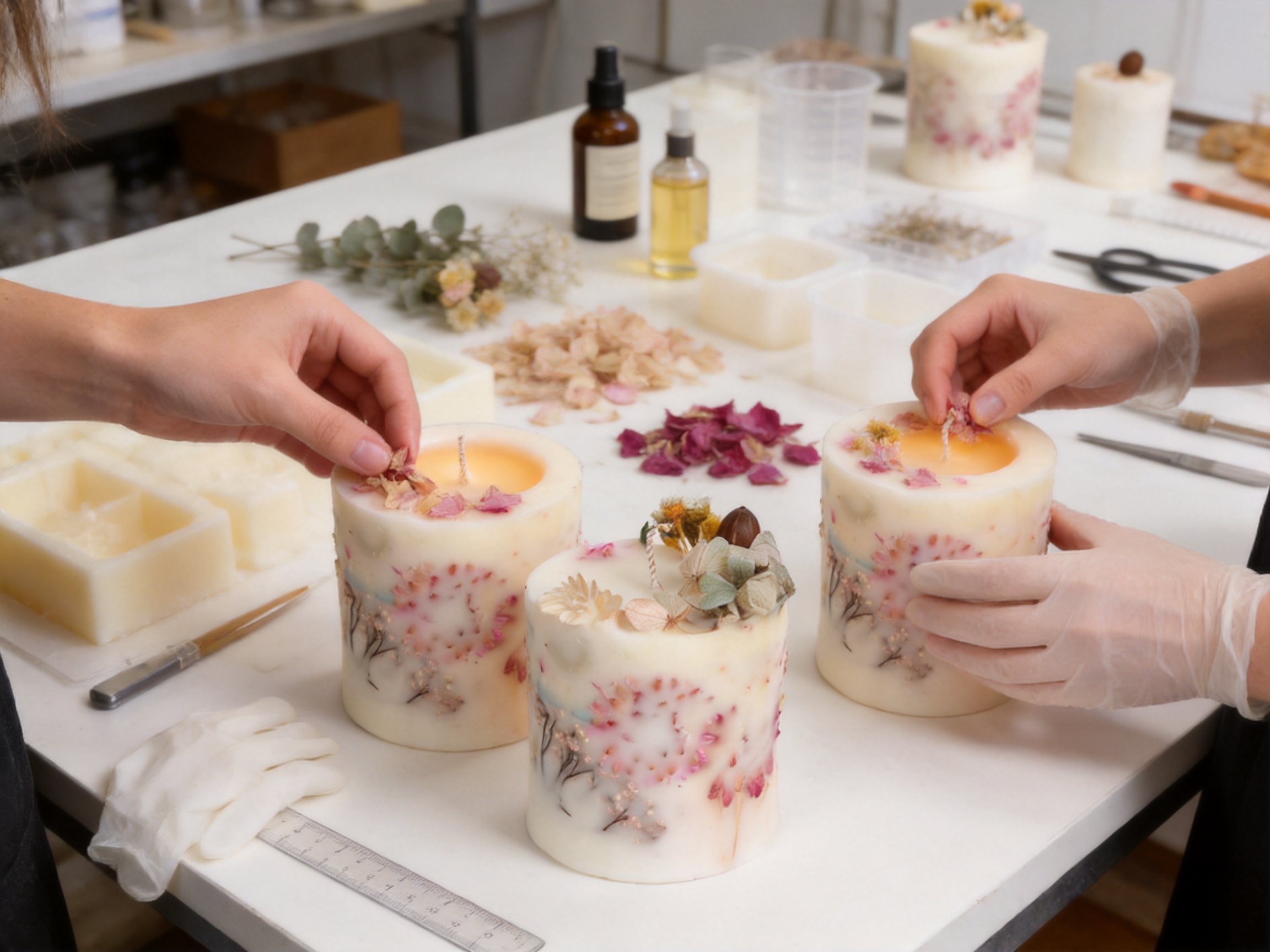
The manufacturing process for a handmade botanical candle combines material preparation, wax handling, design placement, molding or shaping, finishing, inspection, and packaging. Although the product has an artisanal appearance, reliable production still requires structured procedures. Craftsmanship and process control must work together to ensure that the final goods are attractive, stable, and commercially consistent.
Production normally begins with a product-development stage. The buyer’s desired size, shape, color, decorative density, fragrance direction, packaging format, and target price are reviewed. If the customer provides drawings, reference images, or physical samples, the development team can use these materials to refine the product concept.
Samples are important because visual terms such as “soft,” “natural,” “luxurious,” or “minimalist” can be interpreted differently by different parties. A physical sample allows the buyer and supplier to confirm the actual color, floral arrangement, surface effect, proportions, and packaging presentation before bulk production begins.
At this stage, the company’s product-development and sourcing capabilities can help coordinate materials and production resources. Hangzhou Leo Home works with a network that includes candle factories, jar customization partners, and color-box factories. This integrated approach can reduce communication gaps between separate suppliers and support the development of a more coherent finished product.
Selected dried flowers and petals are inspected before production. The inspection may consider appearance, dryness, shape, color, cleanliness, and suitability for the planned design. Materials are then sorted and prepared for efficient placement.
Because natural elements can be delicate, handling should be gentle and organized. The production team needs to maintain the desired visual composition while avoiding unnecessary breakage. For a collection with a specific color theme, materials may also be grouped according to tone or size to help artisans maintain a consistent design direction.
Wax preparation is a critical stage. The wax must be heated and handled in a way that supports proper pouring, surface appearance, and integration with the decorative elements. Temperature control influences fluidity, setting behavior, surface smoothness, and the final position of the flowers.
An experienced production team monitors the process rather than relying only on a fixed routine. Environmental conditions, candle size, mold design, fragrance addition, and wax formulation can affect the result. Controlled handling helps reduce problems such as uneven surfaces, unwanted air pockets, excessive marbling, or displacement of the botanical elements.
The placement of dried flowers is one of the most distinctive craftsmanship stages. The decorative elements must be arranged to create balance while preserving the natural, organic appearance of the product. Too much uniformity may make the candle look artificial, while excessive irregularity can weaken the design.
Artisans consider the visible side of the candle, the distribution of colors, the relationship between large and small petals, and the way the elements interact with the wax surface. The goal is not necessarily to make every candle identical. Instead, the process aims to keep the product within an agreed visual standard while allowing controlled handmade variation.
After the wax and botanical elements have been combined, the candle is allowed to set under appropriate conditions. Cooling must be managed carefully because rapid or uneven cooling may affect the surface and internal structure. Once the candle has formed, finishing work may include surface inspection, edge refinement, removal of loose material, and preparation for labeling or packaging.
Finishing is especially important for decorative candles because customers examine them from multiple angles. A clean silhouette, stable base, attractive surface, and careful presentation help communicate quality. Even small details, such as the neatness of the wick area or the consistency of the outer finish, can influence buyer perception.
Finished candles are checked before packing. Inspection can cover appearance, dimensions, weight, surface condition, decorative placement, packaging fit, and labeling requirements. Products that do not meet the agreed standard should be corrected, reworked, or removed from the shipment according to the quality-control procedure.
Packaging must protect the candle from dust, impact, deformation, and unnecessary movement during transportation. It should also support the product’s premium visual positioning. Depending on the buyer’s needs, packaging may include individual boxes, protective inserts, printed labels, color boxes, gift packaging, or coordinated collection packaging.
For international buyers, product quality includes more than appearance. It also includes consistency, communication, documentation, packing reliability, delivery coordination, and the ability to solve issues efficiently. Hangzhou Leo Home describes a quality-control system that covers key stages from raw-material selection to finished-goods inspection.
The company’s in-house laboratory and quality-control procedures provide a foundation for monitoring product development and production. Laboratory involvement is valuable because it supports more systematic evaluation of materials and product performance than visual inspection alone. The exact testing program can be aligned with the product category, buyer requirements, destination-market regulations, and agreed specifications.
Quality assurance for a botanical candle may involve several checkpoints. Incoming materials can be reviewed before use. Wax and fragrance components can be checked against approved samples. Decorative elements can be screened for suitability. During production, the team can monitor appearance and process stability. Finished goods can then be inspected for visual consistency, packing condition, and order compliance.
A documented approval process is particularly useful for customized orders. Buyers should confirm the approved sample, color references, packaging artwork, label details, product dimensions, and acceptable variation range. Once these points are agreed, they become a practical reference for bulk production and inspection.
Strict quality management does not mean eliminating every natural variation. For a handmade botanical product, the objective is to distinguish acceptable artisanal differences from unacceptable defects. A slightly different petal position may be part of the product’s character, while contamination, structural damage, severe color deviation, or poor packaging should not be accepted.
The company’s ability to coordinate multiple manufacturing partners also contributes to supply-chain control. Its network includes 10 candle factories, 8 jar customization partners, and 8 color-box factories. This structure can offer buyers more options for product development and packaging while helping manage cost and production capacity.
Customization is one of the strongest commercial advantages of the product. Many buyers do not want to sell an entirely generic candle. They want a product that fits their brand, market positioning, sales channel, and customer expectations. The flower series provides a flexible foundation for this type of development.
Fragrance selection can significantly influence the market position of a candle. A floral composition may be paired with soft floral fragrances, clean cotton notes, green botanical accords, fresh citrus, woody scents, vanilla, or other directions depending on the target audience. Fragrance development should consider the intended emotional effect, seasonal demand, regional preferences, and compatibility with the product concept.
For a premium collection, the fragrance may be presented as subtle and refined. For a gift-oriented line, it may be designed to feel familiar and accessible. Buyers can work with the supplier to evaluate fragrance samples and select a profile that supports the visual identity of the candle.
The ivory base can be adapted to different color themes within suitable formulation and production limits. Buyers may request warmer cream, pale blush, soft green, lavender, or another restrained tone. Botanical components can also be selected to create a seasonal or brand-specific appearance.
Spring collections may use light floral tones, while autumn programs may favor muted beige, amber, or dried-grass colors. Wedding and event buyers may request specific colors that coordinate with invitations, table settings, or ceremony décor. A retailer specializing in natural products may prefer a more neutral botanical composition that emphasizes organic simplicity.
The product can potentially be developed in different shapes and sizes according to the buyer’s requirements. Compact formats may be suitable for gift sets, trial collections, hotel amenities, or event favors. Larger formats may be used as statement décor or premium home-fragrance products.
Shape customization should be evaluated alongside stability, packaging, shipping protection, wick placement, and production efficiency. A new shape may require a new mold or revised forming process. The development stage allows these technical and commercial factors to be reviewed before the buyer commits to bulk production.
Packaging is essential to the customer’s first impression. A well-designed box can protect the candle while communicating the intended price level and brand personality. Hangzhou Leo Home supports OEM and ODM services covering labels and packaging, allowing buyers to develop a more complete product presentation.
Minimalist brands may choose an uncoated paper box with restrained typography and botanical illustrations. Gift brands may prefer a more decorative color box with ribbon details or an insert card. Retail chains may require standardized labels, barcode information, multilingual instructions, and specific carton markings. These requirements can be discussed during order planning.
Rather than offering only one candle, a buyer can develop a complete botanical home-fragrance collection. The flower series may be paired with reed diffusers, scented sets, room fragrance products, candle accessories, or other decorative candles. A collection approach improves shelf presentation and gives customers more opportunities to purchase complementary products.
For online stores, collection development can support product bundles and higher average order values. For physical retailers, coordinated products can create a stronger visual display. For distributors, a wider product range may help serve different channels and price points without abandoning a common design theme.
Stable supply is a major concern for importers and retail buyers. A product may have strong design potential, but inconsistent replenishment can create stock shortages, missed seasonal opportunities, and customer dissatisfaction. Hangzhou Leo Home emphasizes supply-chain integration, flexible delivery, and access to production resources.
The company reports daily capacity of up to 50,000 units for stable bulk delivery and replenishment. This capacity is relevant for larger orders, promotional campaigns, seasonal launches, and established retail programs. At the same time, the company also supports smaller volumes and trial runs, which can reduce the risk for buyers testing a new design or entering a new market.
Flexible order planning is particularly valuable for decorative handmade products. A new customer may wish to begin with a sample order or limited launch before making a larger commitment. Once sales performance has been evaluated, the buyer can increase volumes, adjust fragrance selection, or develop additional designs.
The company’s location in Hangzhou provides access to a developed manufacturing and logistics environment. Its proximity to Ningbo Port supports export coordination and can contribute to efficient shipping arrangements. For international buyers, port access is one part of a broader delivery process that also includes carton planning, export documentation, production scheduling, and communication between all parties.
With experience in international trade and deliveries to more than 10 countries and regions across North America, Europe, and the Middle East, the company understands that overseas orders require more than factory production. Different markets may have different expectations for packaging, labeling, product information, documentation, and shipping preparation. Early clarification of these requirements can help avoid delays and reduce the likelihood of corrections after production.
The home-fragrance market contains several major product groups, including jar candles, pillar candles, shaped candles, jelly candles, LED candles, reed diffusers, scented sets, and decorative accessories. Each category has different advantages. The Ethereal Botanical Bloom candle competes most directly with decorative handmade candles and premium gift-oriented home-fragrance products.
Its competitive position is based on design, perceived craftsmanship, customization, and supply-chain support rather than on low price alone. A low-cost plain candle may be cheaper to produce, but it may not deliver the same visual impact or gift appeal. A highly specialized artisan product may offer strong craftsmanship but lack the production capacity, packaging coordination, or export support required by larger retail buyers.
This product aims to occupy a practical middle position: it offers a handcrafted and artistic appearance while being supported by organized production resources and international supply-chain capabilities. That combination can be attractive to buyers that need a distinctive product but also require reliable commercial execution.
| Competitive Factor | Standard Plain Candle | Highly Specialized Artisan Candle | Botanical Flower Series Candle |
|---|---|---|---|
| Visual differentiation | Usually limited to color, vessel, or label | Often very high, but may be difficult to scale | High because of embedded flowers, petals, and layered texture |
| Decorative value | Moderate | High | High, with a nature-inspired appearance suitable for interior displays |
| Customization potential | Often available through standard options | May depend heavily on individual artisans | Can include fragrance, color, botanical elements, shape, labels, and packaging |
| Bulk supply potential | Usually strong | May be limited | Supported by coordinated factory and supply-chain resources |
| Gift suitability | Depends on packaging and presentation | Usually strong | Strong because of its decorative and handcrafted character |
| Collection development | Possible but may look generic | Possible but may require separate artisan coordination | Can be developed with matching candles, diffusers, sets, and accessories |
The product should not be presented as universally superior to every candle. Its strengths are most relevant to specific buyers: those seeking botanical aesthetics, decorative value, handmade appeal, private-label flexibility, and coordinated sourcing. A buyer focused only on the lowest unit cost may select a simpler format. However, a buyer seeking stronger differentiation and a more premium visual story may find this product more commercially attractive.
Boutique stores often look for products that can create an emotional response at the point of sale. The flower series can contribute to a calm, natural, and carefully curated store environment. It can be displayed individually or grouped with ceramics, textiles, botanical décor, and other home-fragrance products.
Online shoppers depend heavily on product photography and descriptions. The candle’s visible botanical composition gives retailers a strong visual subject for product pages, social media content, seasonal campaigns, and gift guides. Its story can focus on nature, handmade detail, decoration, comfort, and personal space.
Online sellers should provide clear information about dimensions, fragrance, packaging, handling, and appropriate candle use. Because the product contains delicate botanical elements, accurate presentation and protective packaging are important for customer satisfaction.
The candle can be considered for corporate gifts, wedding favors, event merchandise, hospitality welcome gifts, and seasonal appreciation programs. Custom labels, coordinated packaging, and selected color themes can help align the product with a company, event, or campaign identity.
For larger gifting programs, buyers should confirm production schedules early. Handmade decorative work may require additional preparation compared with standard candles, especially when a custom botanical composition or printed packaging is involved.
Hotels, spas, salons, and wellness businesses often use fragrance and décor to create an atmosphere. A botanical candle can support a natural and relaxing visual identity in reception areas, treatment rooms, guest rooms, or retail corners. Buyers in these sectors may prefer subtle fragrance, restrained packaging, and coordinated products such as reed diffusers or scented sets.
The product can be adapted for spring, Mother’s Day, Valentine’s Day, wedding season, housewarming gifts, and other occasions associated with flowers or nature. A controlled update to the botanical palette, label, or packaging can create a seasonal edition without changing the entire product structure.
Clear communication is important for decorative candles because customers may interpret them differently from ordinary candles. Product information should explain that the candle contains dried botanical elements and should provide appropriate use and care guidance. Buyers should follow the final approved safety instructions and destination-market requirements.
Retail descriptions should distinguish between decorative appearance and burning performance. The botanical elements contribute primarily to the product’s visual character, while the candle’s burning behavior depends on the wax formulation, wick, size, fragrance, and other technical factors. These details should be confirmed through product testing and communicated accurately.
Packaging may include instructions regarding placement, supervision, wick trimming, heat-resistant surfaces, and keeping the product away from flammable materials. The exact wording should be reviewed for the intended market. Importers and brand owners remain responsible for ensuring that the final product information complies with the laws and standards applicable to their sales regions.
Responsible communication also means avoiding exaggerated claims. The product can reasonably be presented as handmade, botanical, decorative, customizable, and suitable for home-fragrance collections. Claims about safety, environmental performance, burn time, fragrance strength, or material composition should be supported by appropriate product information and testing.
A successful product program begins with a clear commercial brief. Buyers should define the target customer, expected retail price, preferred fragrance direction, sales channel, packaging level, launch date, and anticipated order volume. A clear brief allows the supplier to recommend suitable options and identify possible production limitations early.
The next step is sample review. Buyers should examine the sample under normal lighting and from different viewing angles. They should assess the wax color, botanical placement, surface finish, proportions, packaging, label clarity, and overall shelf appeal. If fragrance is included, it should be evaluated both before burning and during appropriate product testing.
It is also useful to define acceptable variation. Handmade products should not be judged by the same standard as perfectly identical industrial items. The buyer and supplier can agree on which differences are acceptable and which conditions require rejection or rework. This prevents misunderstanding during bulk production.
Packaging testing is another important step. A decorative candle may look excellent at the factory but arrive damaged if the box, insert, or outer carton does not provide enough protection. Buyers should consider vibration, stacking, temperature changes, handling, and the expected shipping route.
For a first launch, a limited trial order can provide valuable market information. Sales data can show which fragrances, colors, sizes, and packaging styles perform best. The buyer can then use this information to refine the next order. This approach is especially useful for online brands and boutique retailers that want to test demand without overcommitting to inventory.
Hangzhou Leo Home Trading Co., Ltd. was founded in January 2025 and is based in Hangzhou, China. The company focuses on international trading and supply-chain solutions for household and daily necessities. Its product scope includes personal care, home and garden, daily tools, and home-fragrance products.
Although the company is relatively young as a corporate entity, its operating model is built around product development, international sourcing, cross-border marketing, quality control, and delivery support. This model is relevant to overseas buyers that prefer working with a partner capable of coordinating multiple aspects of a product program rather than communicating separately with several factories.
The company’s home-fragrance focus includes scented candles, LED candles, related gift sets, and associated products. This broader category knowledge can help buyers compare formats and create a balanced product range. A buyer interested in botanical candles may also need matching diffusers, accessories, or gift sets. Access to related categories can simplify collection planning.
Leo Home identifies six major strengths: customization, supply-chain integration, quality assurance, diverse styles, flexible delivery, and international market experience. These strengths complement the visual advantages of the flower series. A beautiful product requires dependable development and production support if it is to succeed in competitive retail channels.
The company also emphasizes core values of execution, warmth, and refinement. In practical terms, these values relate to following buyer instructions, maintaining responsive cooperation, and paying attention to details from formulation and craftsmanship through export documentation. For an international order, these operational qualities can be as important as the product concept itself.
The candle uses dried flowers and petals as visible decorative elements within a creamy wax body. Its botanical composition, subtle marbling, and handmade appearance give it stronger decorative and gift value than a plain candle with a simple surface or label.
Because the product is handmade and includes natural dried botanical elements, slight differences in flower placement, shape, and color may occur. These variations contribute to the individual character of each piece. Buyers can establish an acceptable variation range during sample approval.
OEM and ODM support includes fragrance selection and development. Buyers can discuss fragrance direction, market preferences, seasonal requirements, and the desired relationship between scent and botanical appearance.
Customization may be available for wax color, botanical selection, decorative density, and overall visual theme. The exact options depend on the requested design, material availability, production process, and order quantity.
Yes. The product can be developed with customized labels, packaging, and collection presentation. Buyers should provide brand requirements and approve artwork and samples before bulk production.
Custom packaging is supported through the company’s packaging resources, including color-box partners. Packaging can be developed for boutique retail, gifting, seasonal programs, hospitality use, or online sales.
Yes. Its decorative appearance makes it suitable for gift sets that may include reed diffusers, scented products, accessories, or complementary home items. Coordinated packaging can improve the presentation of the complete set.
The company supports smaller volumes and trial runs in addition to bulk production. Trial quantities allow buyers to evaluate customer response, fragrance preferences, packaging performance, and sales potential before scaling up.
Quality management covers raw-material selection, production monitoring, finished-product inspection, packaging review, and order compliance. The company also describes an in-house laboratory and strict quality control across key stages.
Potential buyers include home and lifestyle retailers, gift companies, online brands, boutique stores, distributors, hotels, spas, event planners, corporate-gifting businesses, and private-label home-fragrance brands.
Yes. The candle can be combined with scented candles in other shapes, reed diffusers, LED candles, scented sets, candle accessories, and related home-fragrance products. A coordinated collection can create stronger merchandising opportunities.
Buyers should confirm the approved sample, dimensions, weight, wax color, fragrance, botanical composition, acceptable variation, wick specifications, labels, packaging, carton details, production schedule, inspection requirements, and destination-market information.
The Ethereal Botanical Bloom Flower Series Handmade Candle offers a distinctive combination of botanical beauty, handcrafted character, decorative value, and home-fragrance functionality. Its soft ivory wax body and embedded dried flowers create a calm, artistic appearance that can stand apart from conventional plain candles and highly standardized mass-market designs.
Its strongest competitive advantages are visual differentiation, controlled handmade individuality, broad interior compatibility, private-label potential, and suitability for gift and lifestyle retail. These qualities make it more than a basic consumable fragrance item. It can function as a decorative object, a seasonal product, a premium gift, and a foundation for a larger home-fragrance collection.
The product’s commercial value is strengthened by Hangzhou Leo Home Trading Co., Ltd.’s supply-chain resources and international service capabilities. The company supports product customization, fragrance selection, packaging development, quality assurance, flexible order quantities, and coordinated delivery. Its network of candle factories, jar customization partners, and packaging factories gives buyers access to broader development options while helping manage production and sourcing requirements.
For buyers seeking an artistic candle with scalable commercial potential, the flower series provides a balanced proposition. It delivers the emotional and visual appeal of a handmade botanical product while benefiting from structured production management and OEM/ODM support. With careful sample approval, accurate product communication, suitable packaging, and a clear market strategy, it can become an attractive addition to modern home-fragrance, gift, décor, and lifestyle collections.
1. Hangzhou Leo Home Trading Co., Ltd. Company Profile and Product Information, supplied for product-content development.
2. General principles of candle material selection, wick coordination, fragrance integration, and finished-goods inspection in the home-fragrance industry.
3. General practices for dried-flower preparation, storage, handling, and decorative incorporation in handcrafted lifestyle products.
4. General international sourcing and supply-chain management practices for household and home-fragrance products.
5. General retail merchandising principles for candles, gift products, home décor, and botanical lifestyle collections.

Room 1701, Building C1, Wangjing, Xiaoshan District, Hangzhou City, Zhejiang Province, China.

+86-15937257616

Copyright© 2026 Hangzhou Leo Home Trading Co., Ltd. All Rights Reserved.

Luxury Candles Home Fragrance Manufacturers Modern Candles Factory