
 English
 Français
News
Home / Author / Sophia Lin — Product Sales Executive / Black Stainless Steel Candle Wick Trimmer with Debris Tray: A Professional Guide to Cleaner, Safer Candle Care
Content

A well-made candle can transform an ordinary room into a warm, inviting environment, but even the finest candle needs regular care to perform at its best. One of the most important candle-care practices is wick trimming. A wick that becomes too long can produce a large, unstable flame, excess smoke, soot, and uneven melting. A wick that is trimmed with an unsuitable tool may leave fragments on the wax, damage the candle surface, or make it difficult to reach the bottom of a deep container. The Black Stainless Steel Candle Wick Trimmer with Debris Tray is designed to address these everyday problems with a purpose-built form, durable construction, and a cleaner trimming process.
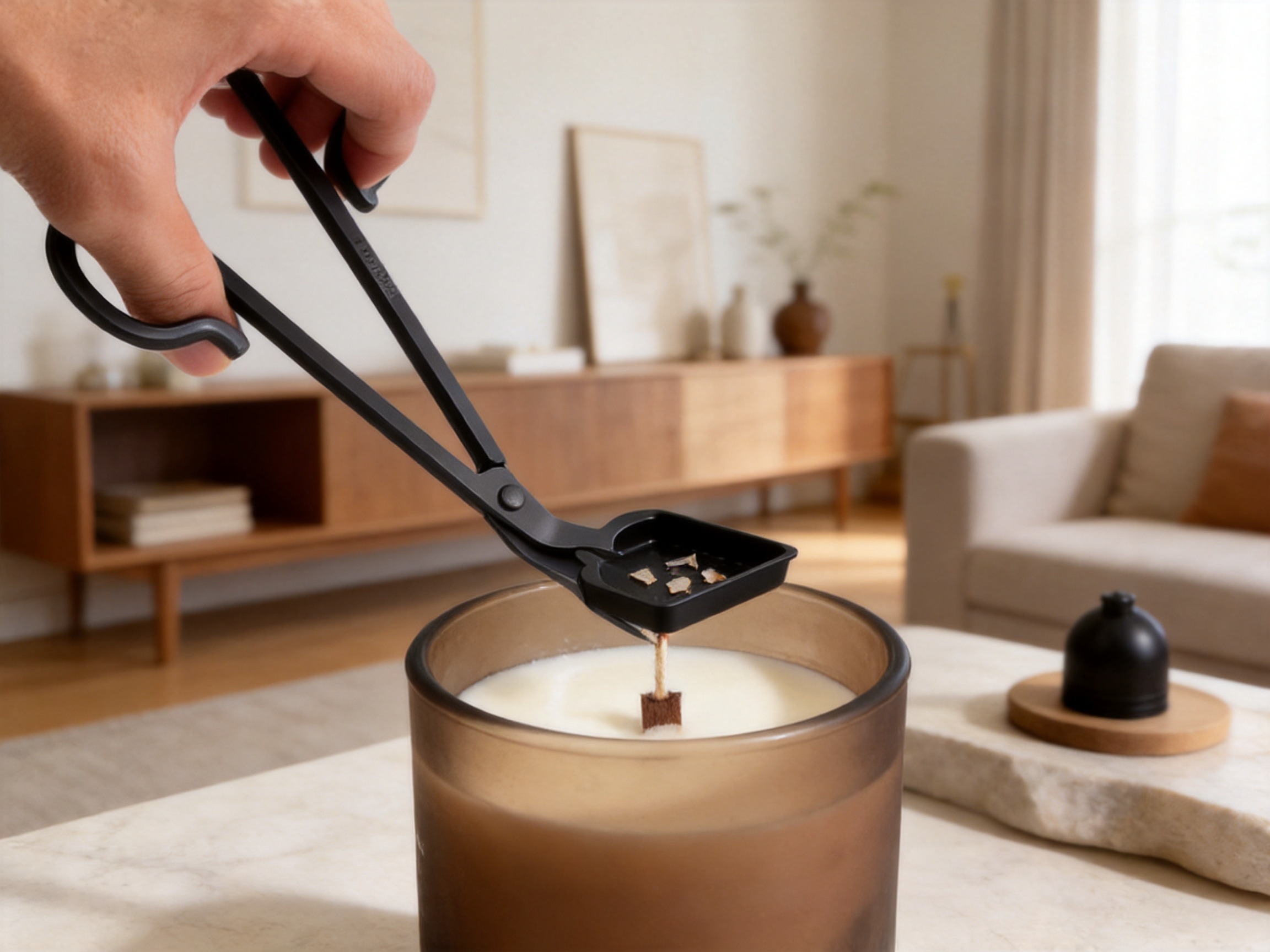
Unlike ordinary scissors, this wick trimmer combines a long handle, an angled cutting head, and an integrated debris tray. These features allow users to reach into jar candles and other containers while keeping their hands away from the wax and flame area. The cutting head is positioned to make contact with the wick at a practical angle, and the small tray helps collect the trimmed wick instead of allowing it to fall onto the candle surface. This simple combination creates a more controlled and convenient candle-maintenance routine.
The product is suitable for private consumers, gift-box developers, candle retailers, hospitality businesses, spas, interior stores, and brands seeking dependable OEM or ODM candle accessories. Its black stainless-steel appearance gives it a modern, understated character, while the design remains functional rather than decorative only. With appropriate quality control, packaging customization, and supply-chain support, it can be developed as a standalone accessory or included in a larger home-fragrance collection.
A candle wick is engineered to draw liquid wax upward through capillary action. The wax travels toward the flame, where it vaporizes and burns. When the wick is maintained at an appropriate length, the flame can consume the fuel at a relatively balanced rate. This supports a steadier flame, a more predictable melt pool, and a cleaner overall burn.
As a candle is used, the wick may become longer, mushroom-shaped, carbonized, or slightly bent. A long or damaged wick can create a flame that is larger than necessary. This may lead to increased flickering, higher heat, dark smoke, and soot on the inside of a container. It can also make the candle burn too quickly, reducing the number of hours of enjoyment that the candle provides.
Trimming the wick before each burn, especially after the candle has cooled, helps keep the flame under control. The exact trimming length depends on the candle formulation, container size, wick construction, and manufacturer’s instructions. In general, users should remove excess carbonized material and maintain a short, even wick rather than cutting aggressively into the base. A dedicated wick trimmer makes this task easier because it is designed for the geometry of candle containers.
The Black Stainless Steel Candle Wick Trimmer with Debris Tray belongs to the Wick Trimmer category within a broader home-fragrance and candle-accessory product range. It is identified by item number A#668865166484 and has a listed weight of approximately 200 grams. The supplied product information identifies the construction as 420 stainless steel and describes a selection of related finishes and configurations, including sandblasted and blackened options. The featured product is presented with a black stainless-steel finish, while the general attribute information also lists silver as a color option. This makes finish confirmation important when preparing a purchase order, product listing, or customized packaging specification.
| Product Attribute | Details |
|---|---|
| Product name | Black Stainless Steel Candle Wick Trimmer with Debris Tray |
| Category | Wick Trimmer |
| Primary material | 420 stainless steel |
| Featured finish | Black stainless steel |
| Listed color option | Silver |
| Approximate weight | 200 grams |
| Item number | A#668865166484 |
| Patent status | No |
| Private-label support | Available |
| Processing and customization | Available |
The product’s value comes from the relationship between its components. The long handle helps the user reach into a deep vessel. The angled cutting head improves access to the wick without requiring the user to tilt or turn the candle excessively. The debris tray catches cut material, helping protect the wax surface from loose wick fragments. Together, these features make the tool more practical than a standard household pair of scissors.

Black Stainless Steel Candle Wick Trimmer with Debris Tray
Many jar candles have narrow openings and deep interiors. Ordinary scissors may not reach the wick comfortably, especially when the candle has burned down close to the bottom. Users may need to place their fingers near the wax or approach the wick from an awkward direction. A dedicated long-handle trimmer reduces this difficulty and makes the cutting motion more controlled.
The extended handle also helps keep the user’s hand away from the candle container. Although wick trimming should always be performed only after the flame has been extinguished and the wax has cooled sufficiently, a longer tool still provides better separation between the hand and the interior of the vessel. This is a useful ergonomic benefit for both home users and professional staff who maintain multiple candles each day.
The angled head is one of the most important functional differences between a wick trimmer and general-purpose scissors. Instead of requiring the user to insert straight blades into the candle, the angled head can approach the wick from above and from the side. This geometry is particularly useful in glass jars, ceramic containers, metal tins, and other candle vessels with limited access.
An angled head can also help the user trim the wick while keeping the cutting area visible. Better visibility supports greater consistency, which is important when candles are used in hospitality settings or sold as premium products. A clean, repeatable trimming process reduces the risk of leaving the wick uneven or cutting it at an unsuitable angle.
Loose wick fragments are small, but they can affect the appearance and performance of a candle. A fragment left on the wax may burn unexpectedly, create an unpleasant dark mark, or become mixed into the melt pool. Removing such fragments by hand can be inconvenient, particularly when the wax is soft or the vessel opening is narrow.
The integrated debris tray is designed to catch the material as it is cut. This creates a more orderly process and helps keep the candle surface presentable. The tray is especially valuable for users who maintain decorative candles in bedrooms, living rooms, restaurants, hotels, salons, and retail displays. A cleaner surface contributes to a better visual impression and supports the perception of careful product care.
Ordinary scissors are designed for paper, fabric, thread, or general household tasks. A candle wick trimmer is designed around a different set of requirements: reaching into a vessel, cutting a relatively rigid carbonized wick, and collecting the removed material. The purpose-built form reduces the need for improvised tools and makes candle maintenance more intuitive for the user.
For retailers, this specialized design also communicates value. A candle accessory that visibly solves a specific problem can be easier to merchandise alongside scented candles, gift sets, and home-fragrance collections. It can be sold as an individual care tool, a premium add-on, or part of a coordinated candle-care set.
The product information identifies 420 stainless steel as the primary material. This material is commonly selected for applications requiring a combination of hardness, strength, wear resistance, and corrosion resistance. In a wick trimmer, these characteristics are relevant because the cutting edges must remain functional through repeated use, while the tool may occasionally be exposed to wax residue, fragrance oils, and normal household humidity.
Stainless steel also supports a durable product impression. Compared with lightweight plastic tools, a steel trimmer can feel more stable in the hand and more appropriate for premium candle collections. The approximately 200-gram product weight provides a substantial feel without making the tool unnecessarily difficult to handle. For packaging and shipping, the weight remains manageable for retail sets and bulk orders.
Material selection alone does not determine final quality. The performance of the finished tool depends on steel consistency, forming, cutting-edge preparation, joining, surface treatment, inspection, and packaging. These stages must work together to produce a trimmer that opens and closes smoothly, maintains alignment, and presents an even finish.
420 stainless steel offers useful resistance to corrosion under normal indoor conditions. This is appropriate for candle-care accessories stored in bedrooms, bathrooms, living spaces, retail displays, and hospitality environments. Users should still wipe away wax and oils after use and store the tool in a dry location. No stainless-steel product should be treated as completely immune to staining or corrosion, particularly when exposed to harsh chemicals, salt, or prolonged moisture.
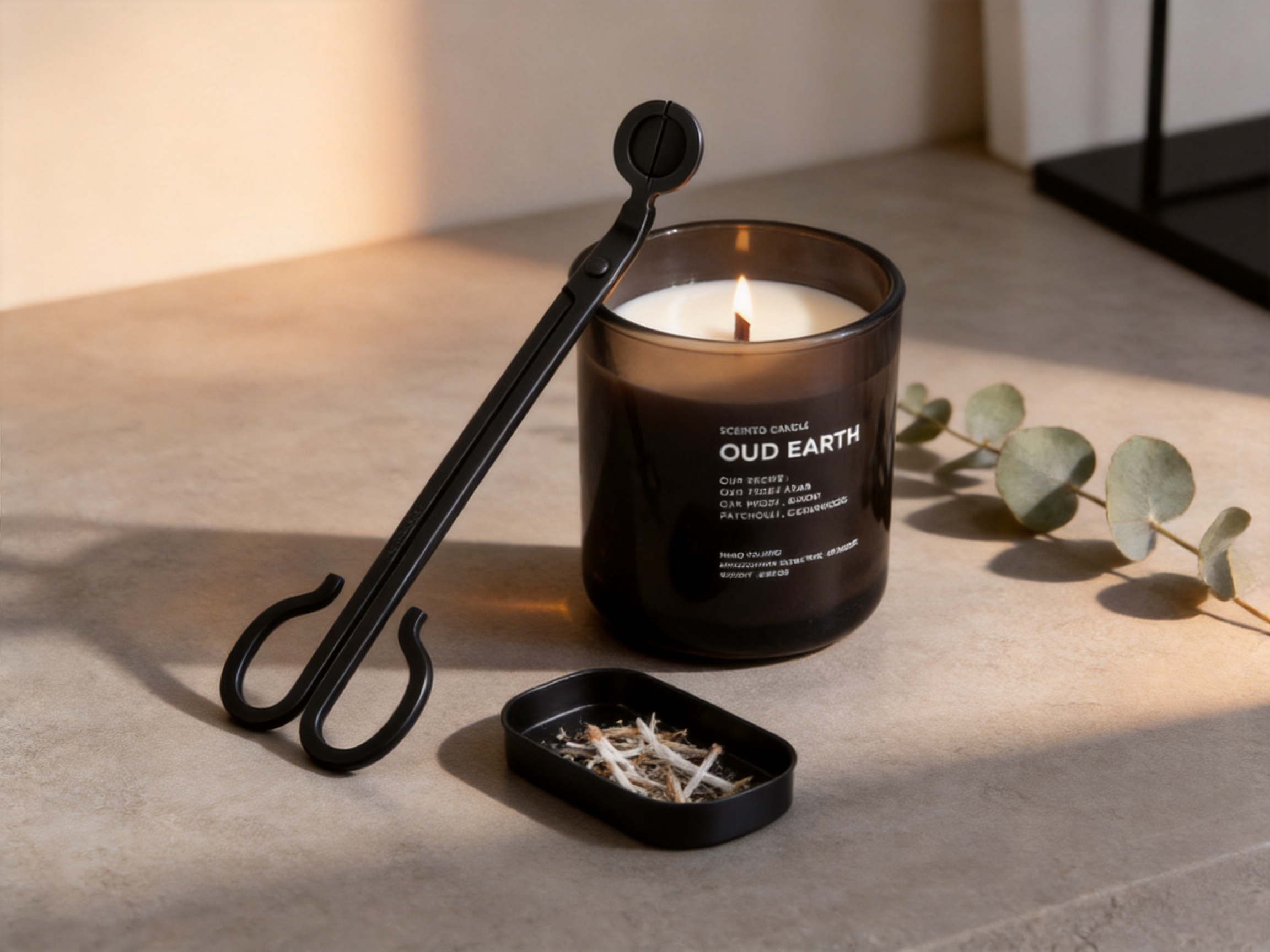
The black finish gives the featured model a contemporary appearance that can complement modern interiors. A dark finish may coordinate naturally with black candle jars, smoked glass, matte packaging, or minimalist home décor. The supplied specifications also refer to sandblasted and blackened versions, which suggests that different surface treatments can be considered for product-line development. Depending on the market, brands may request a polished, brushed, sandblasted, or blackened appearance.
Surface treatment should be evaluated not only for appearance but also for consistency. Buyers should establish acceptable standards for color uniformity, edge coverage, visible marks, fingerprints, scratches, and packaging protection. Consistent appearance is particularly important when the trimmer is sold as part of a coordinated set with candle lids, snuffers, trays, or other accessories.
A wick trimmer cannot change the formulation of a candle, but it can help the user maintain the wick in a condition that supports better burning. A properly trimmed wick generally produces a more controlled flame than an overgrown wick. This may help reduce excessive flickering, limit soot formation, and slow unnecessary fuel consumption.
Regular maintenance can also contribute to a more even candle experience. When a wick is too long or heavily carbonized, one side of the flame may burn more strongly than the other. This can encourage uneven melting and may leave wax along the sides of a container. A suitable wick length supports a more balanced flame and may help the candle develop a more consistent melt pool over repeated burns.
Users should follow the candle maker’s specific care instructions because different waxes and wick constructions behave differently. As a general routine, the candle should be fully extinguished and cooled before trimming. The user can then center the trimmer over the wick, make a controlled cut, lift the tool carefully, and empty or wipe the debris tray. The tool should not be used on a lit candle, and the candle should never be left unattended during burning.
Good candle accessories should make correct care easy. If a tool is uncomfortable or difficult to position, users may avoid trimming altogether. The long handle of this trimmer is intended to reduce awkward bending and reaching. The angled head allows the tool to enter a jar in a more natural position, while the cutting mechanism helps the user complete the task with one deliberate movement.
The design can also benefit users with limited dexterity. A dedicated handle may be easier to control than small scissors, particularly when the candle vessel is deep. The larger overall form provides a clearer grip and reduces the need to place fingers close to the opening. For professional environments, these ergonomic advantages can save time when staff members maintain a collection of display candles.
Weight distribution is another important consideration. A trimmer that is too light may feel unstable, while one that is too heavy may cause fatigue during repeated use. The listed 200-gram weight suggests a middle ground suitable for occasional domestic care and routine commercial maintenance. Final ergonomics should still be verified through sample testing, especially when buyers are developing a custom size or packaging configuration.
The supplier’s company profile describes a structured approach to product development, sourcing, quality control, and international delivery. Its home-fragrance focus includes scented candles, LED candles, related gift sets, and practical accessories. This category experience is valuable because a wick trimmer is most effective when developed with an understanding of candle vessels, wax behavior, packaging requirements, and retail presentation.
The stated quality process covers key stages from raw-material selection to finished-goods inspection. For a metal candle accessory, this process should include checks on material, dimensions, cutting performance, handle alignment, surface finish, tray formation, and packaging condition. Such controls help reduce defects that may not be obvious in a product photograph but become important during repeated use.
Material inspection is the foundation of a reliable trimmer. The supplier can verify the intended stainless-steel grade, thickness, component dimensions, and visual condition before production proceeds. Consistent incoming material supports more predictable forming and finishing results.
Component inspection should also confirm that the cutting head, handle, and debris tray are properly shaped. Misalignment may reduce cutting performance or make the tool feel rough when opened and closed. A repeatable inspection method is especially important for private-label orders, where customers expect every unit to match an approved sample.
Manufacturing control should follow the product through forming, cutting, joining, polishing or blasting, blackening or other surface treatment, assembly, and final inspection. Each stage offers an opportunity to identify and correct problems before they are multiplied across a production batch.
For example, cutting-edge quality affects function, while surface treatment affects appearance and resistance to handling marks. Assembly alignment affects the smoothness of operation. Packaging affects whether the finished surface arrives without scratches. A reliable supplier treats these stages as an integrated system rather than as separate tasks.
The company profile reports access to an in-house laboratory and a broader network that includes candle factories, jar-customization partners, and color-box factories. This network supports coordinated product development. A buyer sourcing a candle collection and a matching wick trimmer may be able to manage fragrance, vessel, accessory, and packaging development through one supply-chain partner.
The reported network includes 10 candle factories, 8 jar customization partners, and 8 color-box factories. These resources can help support multiple styles, packaging formats, and production requirements. They may also help reduce the communication burden associated with coordinating several unrelated suppliers. For brands developing seasonal collections, this type of integration can make it easier to align product launches across candles and accessories.
The company profile states that daily production capacity across its supply network can reach up to 50,000 units, while smaller volumes and trial runs are also supported. For buyers, the ability to handle both samples and bulk replenishment is important. A product may first require a small market test before a large seasonal order is placed.
Flexible order support can be especially useful for boutique retailers, online brands, hotel groups, and promotional buyers. They may need a modest quantity for an initial launch, followed by larger orders once customer response is confirmed. Buyers should still confirm minimum order quantities, lead times, inspection standards, carton dimensions, and production schedules for the specific trimmer configuration.
The supplied information indicates that licensable private-label support and processing customization are available. This creates several opportunities for brands that want the functional advantages of a dedicated wick trimmer while presenting it under their own product identity.
Potential branding locations may include the handle, an accessory sleeve, an inner tray, a gift box, or an instruction card. The selected method depends on the surface treatment, order quantity, logo complexity, and desired retail price. A subtle logo on a black finish can support a premium minimalist presentation, while a larger printed package may be better for mass-market shelf visibility.
Color and surface finish can be coordinated with the rest of a candle collection. A brand may choose black for a modern monochrome line, silver for a classic metallic appearance, or a sandblasted texture for a softer matte effect. Any customized finish should be tested for adhesion, abrasion resistance, visual consistency, and compatibility with the selected packaging.
Packaging is an important part of the product experience. The trimmer may be placed in a small color box, a molded insert, a drawer-style package, a gift set, or a larger candle-care kit. Packaging can include usage instructions, care warnings, brand information, barcode labeling, and multilingual content for different markets.
Because the trimmer has a long profile and a working head, the internal insert should prevent movement during transit. The package should protect the cutting head and finish while remaining easy to open. Buyers should request packaging samples before mass production to verify fit, print quality, drop resistance, and visual presentation.
The listed specification references scissors, covers, hooks, and a blackened three-piece set. This suggests that the trimmer can be positioned within a broader candle-care assortment. A set could include a wick trimmer, candle snuffer, wick-dipping tool, candle hook, lid, or decorative tray, depending on the target market.
Accessory sets increase perceived value and can support gift sales. They also allow retailers to create a consistent visual theme across several products. For corporate gifting, wedding favors, hospitality amenities, and seasonal promotions, a coordinated set may be more attractive than a single tool.
The product competes in a category where buyers often compare appearance, reach, durability, ease of use, packaging, and price. Its strongest advantages are its dedicated geometry, debris-collection feature, stainless-steel construction, and customization potential.
| Evaluation Point | Dedicated Wick Trimmer | Ordinary Scissors | Basic Short Trimmer |
|---|---|---|---|
| Access to deep jars | Long handle and angled head | Often limited | May be limited |
| Collection of cut debris | Integrated debris tray | Not normally included | May not be included |
| Purpose-built for candle wicks | Yes | No | Usually yes |
| Material impression | 420 stainless steel | Varies widely | Varies by supplier |
| Premium visual potential | Black, silver, or customized finish | Usually general-purpose appearance | Depends on model |
| Private-label development | Available according to supplied information | Usually not relevant | Depends on supplier |
Compared with ordinary scissors, this trimmer provides better access and cleaner collection. Compared with a basic short trimmer, its long handle and angled head may offer a more practical solution for deeper containers. Compared with plastic candle-care tools, stainless steel can create a stronger quality impression and may deliver better durability when properly manufactured.
Competitive advantage should not be judged only by the lowest unit price. A tool that is easier to use, less likely to damage the candle, and more attractive in a gift set can produce greater value for retailers and end customers. Consistent supply, customization support, inspection, and logistics also influence the total cost of ownership.
For individual candle owners, the trimmer provides a simple way to maintain scented candles between burns. It can be stored in a drawer, displayed beside a favorite candle, or included in a home-fragrance arrangement. The sleek finish helps it look like part of the décor rather than an improvised household tool.
Candle brands can use the trimmer as an accessory that reinforces responsible candle care. Including it in a premium gift box can help educate customers about wick maintenance and encourage more consistent use of the candle. The tool can also support repeat purchases by creating a recognizable accessory line around the candle brand.
Hotels, restaurants, event venues, and spas often use candles to create atmosphere. Staff members may need to maintain multiple vessels in a short period. A long-handled tool with a debris tray can make routine maintenance more efficient and help keep display candles clean and presentable.
The product is suitable for specialty home stores, lifestyle retailers, online shops, department stores, and seasonal gift programs. Its compact format makes it suitable for cross-merchandising beside scented candles, reed diffusers, candle holders, and home-fragrance gift sets.
Customized candle-care accessories can be included in corporate gift boxes, real-estate closing gifts, hospitality welcome packages, and seasonal appreciation programs. A practical item with a refined appearance is more likely to be retained and used than a purely decorative promotional object.
Allow the candle to cool completely before trimming. The wax should be firm enough that the tool will not drag across the surface or become coated unnecessarily.
Position the angled cutting head above the wick. Keep the tool centered and avoid pressing the head against the glass, ceramic, or metal container.
Trim the wick according to the candle maker’s instructions. Remove the blackened or overlong portion without cutting so deeply that the wick becomes difficult to light.
Lift the tool vertically and check that no fragments remain on the wax. The debris tray is designed to assist with collection, but the user should still inspect the candle surface before lighting.
Empty the tray after use. Wipe away wax residue with a soft cloth. Avoid aggressive scraping that could damage the surface finish.
Store the trimmer in a dry place away from children and open flames. It is a candle-maintenance tool, not a substitute for safe candle-burning practices.
Wick trimming should always take place when the candle is unlit and sufficiently cool. The tool should not be placed into a burning candle or used to manipulate a flame. Users should follow all warning labels supplied with the candle, including instructions about burn time, container temperature, placement, and supervision.
The trimmer should be handled carefully because its cutting head is functional and may have sharp edges. It should be kept away from children and stored in a location where it will not be mistaken for a toy or general household accessory.
Users should inspect the candle container before each use. Cracked glass, damaged ceramic, exposed metal, or other structural problems may create a safety risk that wick trimming cannot solve. Proper trimming is one part of candle care and should be combined with responsible burning habits.
Buyers should request a physical sample before confirming a large order. The sample should be evaluated for handle comfort, head alignment, cutting action, tray capacity, surface finish, and ease of cleaning. It should also be tested in the actual candle vessels used by the buyer, including narrow-neck jars and containers with different depths.
Material documentation should be reviewed when required by the buyer’s quality system. The purchase specification should identify the stainless-steel grade, finish, color, logo method, packaging format, and acceptable tolerance. If the product information lists multiple finishes or colors, the selected version should be stated clearly on the quotation and purchase order.
Functional testing should include repeated opening and closing, wick cutting across representative candle types, debris collection, and inspection for loose components. Surface testing may include scratch resistance, wipe testing, and examination after exposure to ordinary fragrance oils. Packaging testing should confirm that the cutting head does not puncture or mark the box during transportation.
For international shipments, buyers should confirm carton size, gross weight, net weight, labeling, documentation, destination requirements, and shipping schedule. The company profile emphasizes logistics support near Ningbo Port and experience serving North American, European, and Middle Eastern markets. These capabilities can support export planning, but order-specific logistics should always be confirmed in writing.
Hangzhou Leo Home Trading Co., Ltd. is based in Hangzhou, China, and focuses on international trading and supply-chain solutions for household and daily-use products. According to the supplied company profile, the business was founded in January 2025 and uses digital tools, product-development resources, international sourcing, and cross-border marketing to support overseas customers.
The company’s product scope includes personal care, home and garden, daily tools, and home-fragrance products. This category coverage allows it to understand both functional goods and lifestyle presentation. For buyers sourcing a wick trimmer alongside candles, reed diffusers, diffusers, accessories, or scented sets, a wider product perspective can help create a more coherent assortment.
The company reports sales coverage in more than 10 countries and regions across North America, Europe, and the Middle East. It also describes experience with OEM and ODM development, including specifications, fragrance selection, labels, and packaging. These capabilities are relevant to buyers who want to develop a complete home-fragrance program rather than purchase an unbranded accessory.
Its stated core values include execution, warmth, and refinement. In practical terms, execution means converting instructions into measurable production outcomes. Warmth reflects attention to customer relationships and team cooperation. Refinement emphasizes detail in materials, craftsmanship, documentation, and presentation. These values are particularly relevant to small metal accessories, where small defects in alignment or finish can affect the customer’s perception of the entire product line.
A premium candle collection is judged through multiple senses and touchpoints. Fragrance is important, but so are the vessel, label, packaging, flame behavior, and care experience. A wick trimmer extends the collection beyond the candle itself and gives the customer a practical way to participate in maintaining the product.
The black finish can create a coordinated look with dark glass, neutral labels, natural wood, stone, or metallic accents. In a modern collection, the trimmer may be displayed beside the candle on a tray. In a gift set, it can be placed in a dedicated compartment beside fragrance cards, matches, or a candle lid. The result is a more complete ritual rather than a single-use purchase.
For retailers, this broader experience may support higher average order values. Customers who purchase a candle may also be interested in a care accessory, especially when the accessory is presented as an essential part of responsible use. For brands, the accessory can create additional opportunities for logo placement, packaging storytelling, seasonal colors, and repeat sales.
Durable accessories can support a more practical consumption model because they are intended for repeated use rather than immediate disposal. A stainless-steel tool may remain useful across many candles, reducing the need for disposable trimming solutions. Its compact size also allows efficient storage and shipping compared with larger household products.
Packaging design should be considered carefully. Buyers can evaluate whether the box uses recyclable paperboard, minimizes unnecessary plastic, and protects the product without excessive material. A clear care card can help users extend candle life through correct trimming and safe burning, adding educational value without significantly increasing packaging complexity.
Environmental claims should be made carefully and supported by appropriate evidence. The product’s durable material and reusable design may be presented as practical characteristics, but buyers should assess the complete product life cycle, including raw materials, surface treatments, packaging, transportation, and end-of-life options.
Its primary purpose is to shorten an overlong or carbonized candle wick before the next burn. The long handle and angled head help the user reach into candle jars, while the debris tray helps collect the removed wick material.
It is designed specifically for candle vessels. Ordinary scissors may not reach deep jars and usually do not include a tray for collecting cut fragments. The dedicated shape makes the trimming process more controlled and convenient.
The tray is designed to catch the cut material, but users should still inspect the candle surface after trimming. Small fragments can occasionally move during handling, so the candle should be checked before lighting.
The supplied information identifies 420 stainless steel. This material offers a useful combination of strength, hardness, wear resistance, and corrosion resistance for a reusable candle-care accessory.
The product title and description identify the featured model as black stainless steel. The general information also lists silver as a color option and references several surface-treatment configurations. Buyers should confirm the exact finish and color before placing an order.
Yes. The supplied information states that private-label support and processing customization are available. Possible development areas may include branding, finish, packaging, specifications, and coordinated accessory sets, subject to quotation and sample approval.
Yes. The long handle and angled cutting head are intended to improve access to deep or narrow candle containers. Buyers should test samples in their own vessels to confirm suitability for specific jar dimensions.
Many candle-care instructions recommend checking and trimming the wick before each burn, but the correct practice depends on the candle design. Users should follow the candle manufacturer’s instructions and trim only when the candle is unlit and cool.
No. The candle should be extinguished and allowed to cool before trimming. The tool should never be inserted into an active flame or used as a substitute for safe candle supervision.
Yes. Its practical function, refined appearance, and compact format make it suitable for candle-care sets, home-fragrance gifts, hospitality packages, and seasonal collections. Customized boxes and inserts can help create a coordinated presentation.
Bulk buyers should inspect material, dimensions, cutting alignment, handle movement, debris-tray performance, surface finish, logo quality, packaging protection, and carton information. A production sample and written specification should be approved before mass manufacturing.
The company profile describes international sourcing, OEM and ODM customization, quality-control support, access to candle and packaging partners, flexible order sizes, and export logistics experience. Exact services, lead times, quantities, and shipping arrangements should be confirmed for each project.
The Black Stainless Steel Candle Wick Trimmer with Debris Tray is a practical accessory designed around the real challenges of candle maintenance. Its long handle improves access to deep containers, the angled cutting head supports controlled trimming, and the integrated tray helps keep the wax surface clean. The 420 stainless-steel construction provides a durable foundation, while the black finish gives the tool a contemporary appearance suitable for modern home-fragrance collections.
Its advantages over ordinary scissors are functional as well as visual. It is easier to position inside a jar, better suited to removing carbonized wick material, and more appropriate for a premium candle-care presentation. For brands and distributors, the product also offers opportunities for private labeling, customized finishes, packaging development, and inclusion in broader accessory sets.
The supplier’s stated strengths in quality control, product development, partner-factory coordination, international sourcing, customization, and logistics create a useful foundation for buyers seeking more than a basic off-the-shelf tool. By combining a purpose-built product with structured manufacturing and supply-chain support, the trimmer can serve both everyday candle users and commercial home-fragrance programs.
With correct use, regular care, and appropriate packaging, this accessory can help customers maintain cleaner-burning candles while strengthening the overall quality and professionalism of a candle brand’s product experience.
1. Product specification and technical information supplied for the Black Stainless Steel Candle Wick Trimmer with Debris Tray.
2. Supplier company profile and stated manufacturing, customization, quality-assurance, and logistics capabilities.
3. General candle-care guidance concerning wick trimming, flame control, soot reduction, and safe burning practices.
4. General stainless-steel material principles relating to hardness, durability, wear resistance, and corrosion resistance.
5. General retail and packaging principles for home-fragrance accessories, private-label products, and gift-set development.

Room 1701, Building C1, Wangjing, Xiaoshan District, Hangzhou City, Zhejiang Province, China.

+86-15937257616

Copyright© 2026 Hangzhou Leo Home Trading Co., Ltd. All Rights Reserved.

Luxury Candles Home Fragrance Manufacturers Modern Candles Factory