 English
 Français
News
Home / Author / Marina Zhao — Senior Product Sales Manager / White Gypsum Roman Column Relief Marble Jar Candle: Sculptural Fragrance for Luxury Interiors
Content
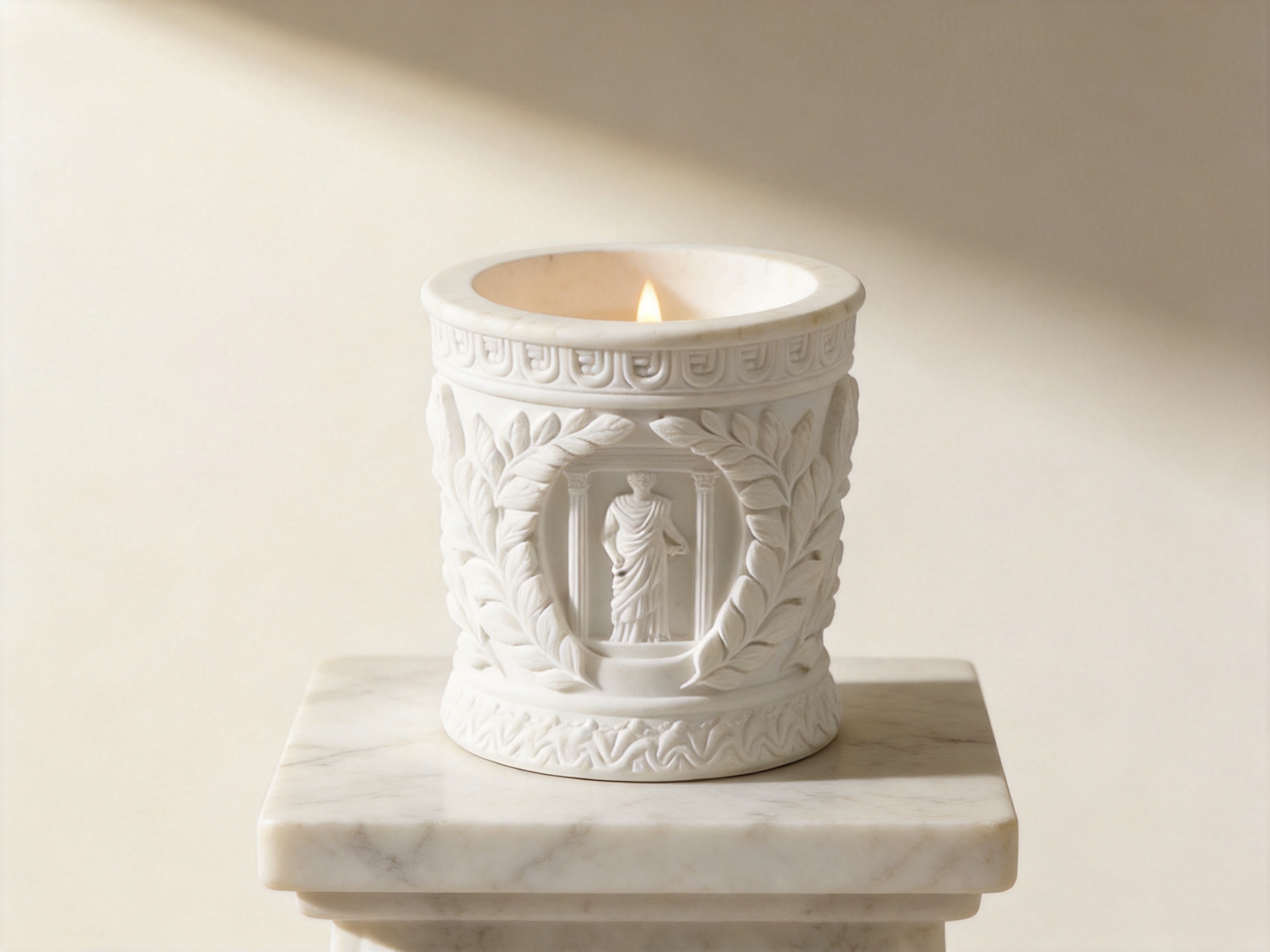
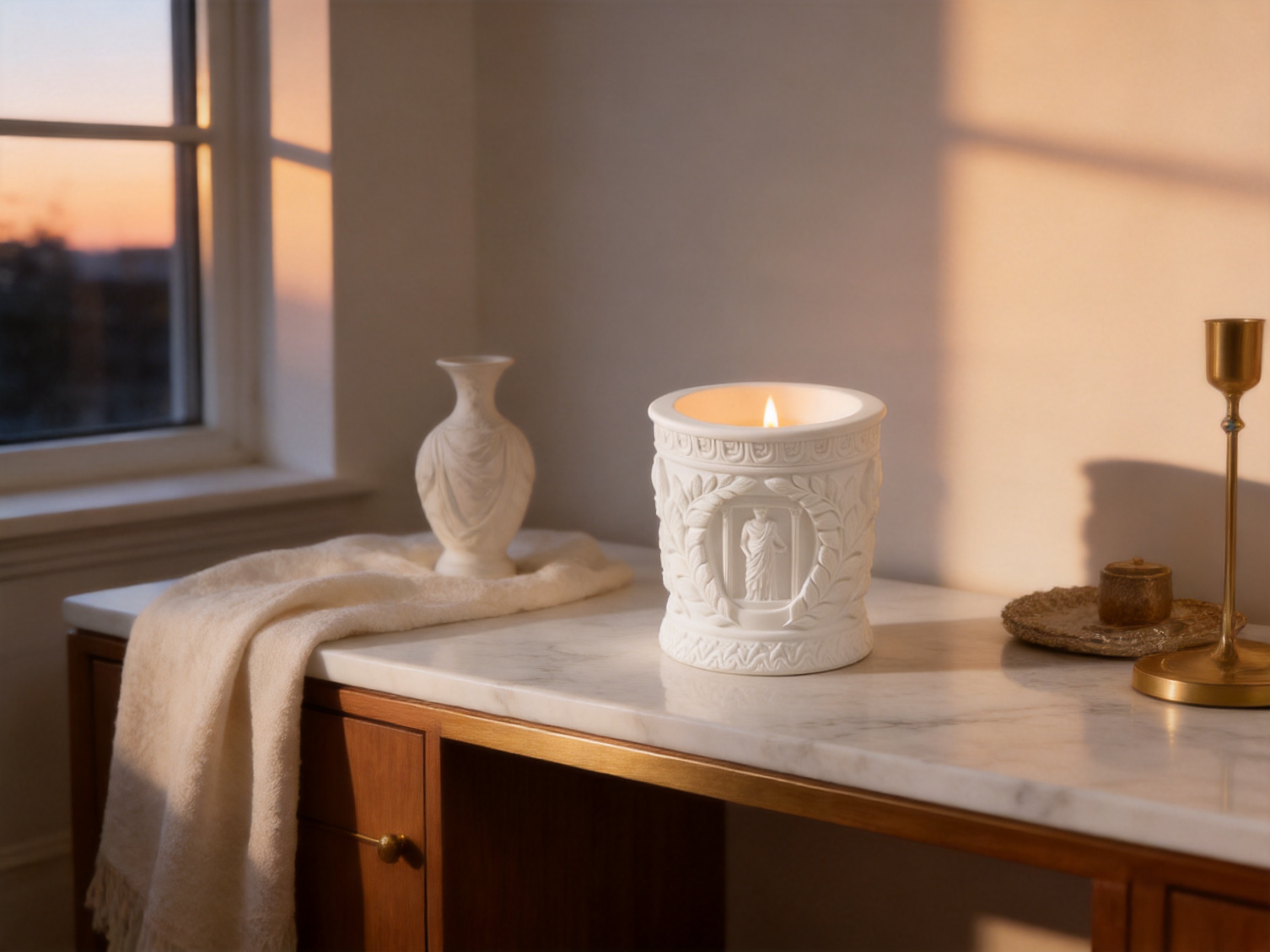
Home fragrance has developed far beyond the traditional idea of a candle as a simple source of light. Today, a candle can serve as an atmospheric fragrance product, a decorative object, a gift, and a defining element within an interior. The White Gypsum Roman Column Relief Marble Jar Candle brings these roles together in one carefully designed vessel. Its cylindrical body is finished in smooth white gypsum and surrounded by classical Roman-style relief carvings featuring draped figures, architectural columns, and laurel-inspired motifs. The result is a product that combines fragrance, craftsmanship, and decorative presence in a form suitable for luxury gifting, hospitality spaces, home décor collections, and heritage-inspired lifestyle brands.
Unlike ordinary glass jar candles that often depend mainly on label design or color for visual appeal, this candle uses the vessel itself as the primary expression of value. The raised relief is integrated into the full circumference of the jar, allowing the product to remain visually engaging from every angle. Its all-white finish creates a refined, gallery-like appearance, while the sculptural surface gives the candle a distinctive identity even before it is lit. When the flame is burning, the vessel becomes part of the lighting experience, with illumination interacting with the open top and the textured interior to create a soft, elegant atmosphere.
The product is also well suited to OEM and ODM development. Fragrance, logo application, packaging, and other presentation details can be customized for specific markets and brand positioning. Through a coordinated supply chain, quality control procedures, and access to specialized partners for candle production, jar customization, and color-box manufacturing, Hangzhou Leo Home Trading Co., Ltd. supports buyers seeking a reliable source for distinctive home fragrance products.

White Gypsum Roman Column Relief Marble Jar Candle
The most important characteristic of the White Gypsum Roman Column Relief Marble Jar Candle is its ability to function as both a candle and a decorative object. Many candles are visually attractive only while they remain in their original packaging. Once the packaging is removed, the consumer is left with a plain container that may have limited value after the wax has been consumed. This product takes a different approach. Its vessel is designed to retain decorative appeal throughout the candle’s life and potentially continue as a keepsake container after use.
The cylindrical silhouette provides a balanced foundation for the classical relief. Cylinders are naturally versatile in interior design because they do not require a specific viewing angle. They can be placed on a coffee table, console, bedside table, bathroom shelf, reception desk, or open display unit without appearing visually incomplete from the side or rear. The continuous relief pattern reinforces this advantage by encircling the entire body instead of concentrating decoration on a single front-facing panel.
The white gypsum finish supports a wide range of interior styles. It can complement contemporary minimalist spaces, where the absence of color allows the form and texture to take center stage. It can also suit traditional interiors, boutique hotels, classical residences, and Mediterranean or European-inspired settings. The neutral color makes the candle easy to coordinate with marble, natural wood, brushed metal, linen, ceramic, and other common interior materials.
Rather than relying on bright colors or excessive ornamentation, the vessel communicates quality through proportion, surface detail, and material character. This understated approach is particularly valuable for premium fragrance collections that seek a refined appearance. It allows the product to act as a quiet focal point instead of competing with the surrounding décor.
Roman-style decorative references continue to influence architecture, furniture, fashion, packaging, and interior design because they convey permanence, culture, and craftsmanship. Draped figures, columns, and laurel motifs are associated with historical ornament, ceremonial spaces, and the visual language of European heritage. In this candle design, these references are translated into a compact home fragrance format that feels suitable for modern retail and gifting.
The product does not need to reproduce an entire architectural structure to express this connection. The relief pattern creates a concentrated impression of classical design around the vessel. This makes the candle accessible to consumers who appreciate historical aesthetics but prefer objects that remain practical and adaptable to contemporary homes.
The all-white treatment is especially effective because it prevents the relief from becoming visually heavy. A multicolored or highly distressed finish could make the candle appear themed or limited to a particular decorative style. White gypsum, by contrast, emphasizes the shadows and contours created by the raised carvings. The result is a cleaner and more versatile presentation with a strong premium character.
Gypsum offers a distinctive alternative to more common candle containers such as clear glass, ceramic, metal, or plastic. Its castable nature makes it suitable for creating sculptural forms and crisp surface details. This is important for a product whose identity depends on the quality of its relief pattern. Fine lines, recessed areas, columns, and ornamental transitions need to remain legible if the vessel is to communicate its intended level of craftsmanship.
The dense cast structure helps preserve the visual definition of the carved pattern. As the candle is used, the outer surface remains a permanent part of the decorative object. Unlike printed graphics, which can fade, scratch, or lose relevance, the relief is physically built into the vessel. This gives the product a stronger tactile presence and can improve perceived value when it is handled by consumers or presented as a gift.
The smooth white surface also provides a clean background for optional branding. A subtle logo, emblem, label, or printed mark can be positioned without creating excessive visual clutter. For brands that prefer a discreet identity, the plain surface may be sufficient for a small mark on the base, lid, box, or accompanying card. For more commercial collections, the vessel can be paired with a customized label or packaging system.
Gypsum is naturally associated with insulating properties, and the material is selected for a candle vessel that is intended to offer a comfortable exterior experience during normal burning. The product description identifies the gypsum body as helping keep the exterior cool to the touch while concentrating fragrance release through the open top. As with any candle, safe use depends on correct wick selection, suitable wax formulation, proper burning time, and adherence to safety instructions.
The wide open top accommodates a centered wick and allows the wax pool to develop evenly around the flame. A centered wick is important for balanced burning because it helps distribute heat through the wax rather than directing it toward one side of the vessel. The open design also enables fragrance to disperse naturally into the surrounding room as the wax warms.
From a visual perspective, the open top creates a clear contrast with the detailed exterior. The candle combines a smooth, functional upper area with a richly textured body. During burning, light can reflect against the pale gypsum interior and soften the appearance of the flame. This interaction gives the candle a warmer and more dimensional presence than an untextured container.
Consumers should still treat the product as a functional burning candle rather than as an ordinary decorative ornament. The vessel should be placed on a stable, heat-resistant surface and kept away from curtains, paper, children, pets, and drafts. After burning, the container should be allowed to cool completely before it is moved.
The home fragrance market includes a wide range of candle vessels, but each material has different strengths. Glass is widely used because it is familiar, transparent, and easy to decorate. Ceramic offers a broad variety of colors and finishes. Metal can provide a lightweight and industrial appearance, while plastic is often selected for cost-sensitive applications. The White Gypsum Roman Column Relief Marble Jar Candle competes by offering a more sculptural and architectural experience.
| Feature | White Gypsum Relief Vessel | Standard Glass Jar | Typical Ceramic Jar |
|---|---|---|---|
| Primary visual strength | Three-dimensional classical relief and sculptural form | Transparency, label presentation, and color visibility | Glaze color, shape, and surface finish |
| Decoration method | Integrated cast relief across the vessel body | Labels, printing, coatings, or external decoration | Glazing, printing, molding, or decals |
| Interior style compatibility | Luxury, heritage, minimalist, classical, and gallery-inspired spaces | Modern, commercial, casual, and broadly adaptable spaces | Traditional, artisanal, colorful, or lifestyle-oriented spaces |
| Tactile character | Textured, architectural, and substantial | Smooth and cool, with limited surface texture | Variable, depending on glaze and molding |
| Brand differentiation | Strong vessel identity beyond the label | Often dependent on graphic design and packaging | Dependent on form, glaze, and decoration |
| Gift presentation potential | High, especially when paired with a matching gift box | High when supported by premium packaging | High for artisanal and decorative collections |
The comparison does not mean that one material is appropriate for every product line. Glass remains valuable for collections that want consumers to see the wax color or remaining fill level. Ceramic is suitable for brands seeking a broad palette of glazes and handcrafted variation. Gypsum is particularly competitive when the objective is to make the container itself a major part of the product story.
This distinction can be important in crowded retail environments. Many jar candles have similar proportions and depend on fragrance names, labels, and packaging to stand apart. A relief vessel can attract attention from a distance through its silhouette and shadow pattern. It can also encourage tactile engagement when shoppers pick it up or explore the texture of the body.
The following features summarize the design and commercial value of the candle:
These features give buyers multiple ways to position the product. It can be marketed as a high-end scented candle, a decorative jar candle, a seasonal gift, a hotel amenity upgrade, or part of a broader classical home collection. The same basic vessel can be adapted through fragrance, labeling, packaging, and collection naming to reach different customer segments.
Although the vessel is the most visible feature, fragrance remains central to the product experience. A well-designed candle should create a connection between visual appearance and scent profile. The Roman-inspired design may pair naturally with fragrances built around woods, herbs, resins, florals, spices, or mineral notes. However, the product is not limited to one fragrance direction. Custom scent development allows buyers to align the candle with their own brand identity and target market.
A classical vessel could support a warm amber and cedar fragrance for an evening collection, a clean white musk profile for minimalist interiors, or an herbal laurel-inspired composition for a heritage-themed line. Citrus, fig, rose, sandalwood, incense, vanilla, and Mediterranean botanical notes may also be considered depending on the intended positioning. The important point is that the container provides a stable visual foundation while the fragrance creates a separate emotional and sensory story.
For OEM and ODM customers, scent customization can include fragrance selection, strength, seasonal variation, and collection coordination. A buyer may request a single signature fragrance for a flagship product or develop several scents using the same vessel for a coordinated range. This approach can simplify visual merchandising because the relief jar remains consistent while fragrance names and packaging colors distinguish each variation.
Fragrance customization should be evaluated together with wax type, wick dimensions, fill weight, burn behavior, and safety testing. A fragrance oil that performs well in one wax system may behave differently in another. Likewise, the size and shape of the vessel influence melt-pool development and scent diffusion. A structured development process is therefore important to ensure that the final product performs as well as it looks.
The matching gift box adds another layer of commercial flexibility. Premium candles are frequently purchased for birthdays, holidays, housewarming occasions, weddings, corporate gifting, hospitality welcome packages, and personal self-care. A coordinated box allows the product to be presented as a complete gift rather than as an individual jar that requires additional wrapping.
Packaging can be customized in several directions. A luxury line may use rigid board, restrained typography, embossed details, and a neutral palette. A heritage collection may use historical references, ornamental borders, or archival-inspired graphics. A contemporary line may adopt a clean box with minimal text and a single accent color. The box can also carry fragrance information, care instructions, regulatory details, and brand storytelling while protecting the relief surface during transport.
For international buyers, packaging development should take into account language requirements, product information, barcode placement, carton strength, and destination-market expectations. A coordinated process between product development and packaging suppliers helps reduce inconsistencies between the jar, inner protection, gift box, and shipping carton.
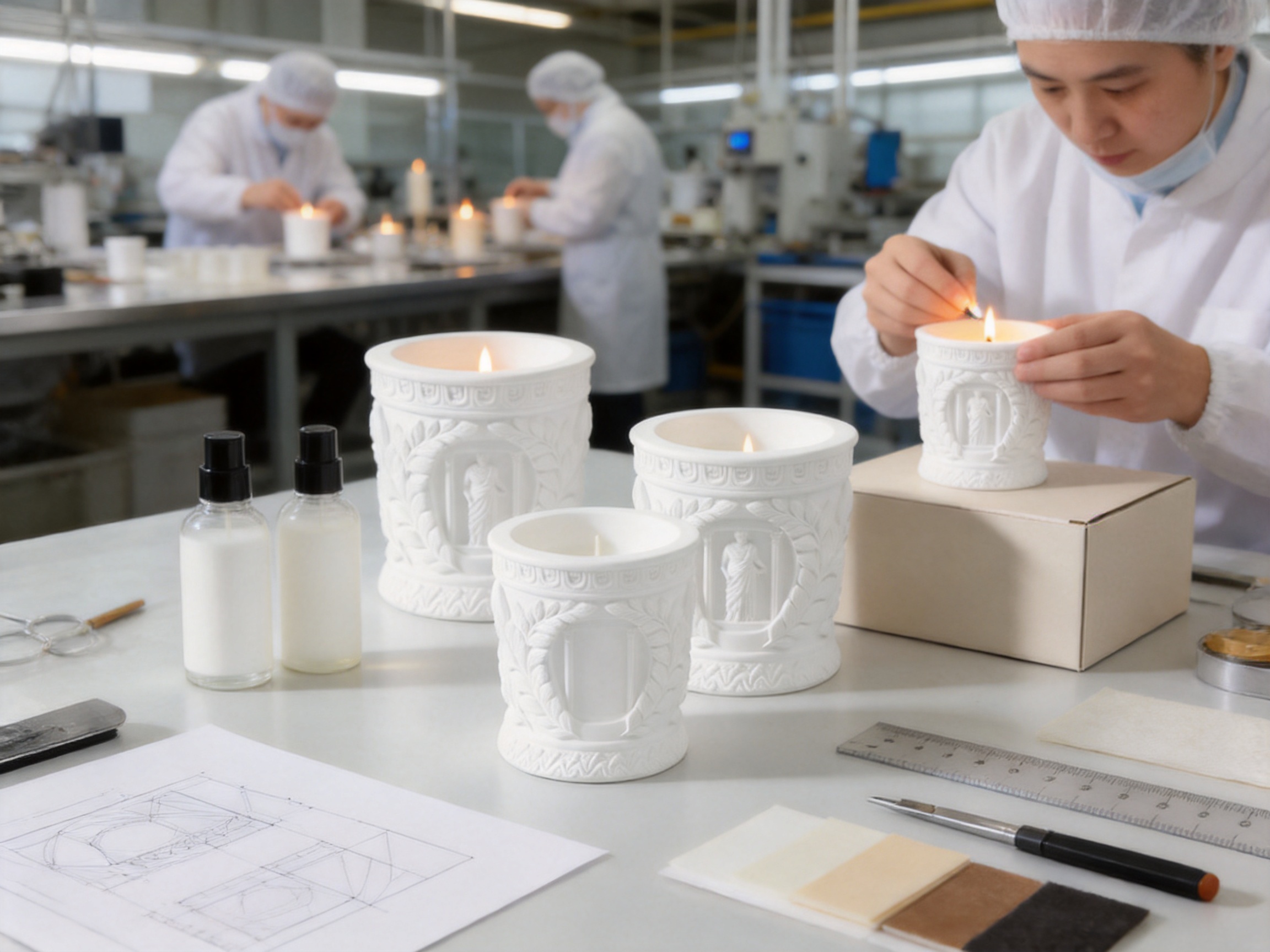
Behind a decorative product such as this is a manufacturing process that requires coordination across materials, casting, finishing, wax filling, wick placement, fragrance blending, inspection, packaging, and export preparation. Hangzhou Leo Home Trading Co., Ltd. operates as an international trading and supply chain partner with a focus on sourcing, customization, and delivery support for overseas clients.
The company was founded in January 2025 and operates from Hangzhou, China. Its business model connects product development, international sourcing, cross-border marketing, and supply chain management. Within the home fragrance category, its product scope includes scented candles, LED candles, and related gift sets. This broader category knowledge is useful when buyers are developing collections rather than ordering only one isolated product.
The company reports access to a network that includes 10 candle factories, 8 jar customization partners, and 8 color box factories. Such a network can provide flexibility when a project requires different combinations of vessel shape, wax formulation, fragrance, packaging, or order volume. It also allows the sourcing team to compare production capabilities and identify suitable partners for a particular specification.
Customization often begins with a drawing, reference image, physical sample, or written specification. For a relief candle vessel, development may involve reviewing the overall height and diameter, wall thickness, relief depth, base stability, top opening, wick position, surface finish, and packaging dimensions. A professional development process translates the buyer’s concept into a manufacturable structure.
Working from drawings or samples can also help refine the balance between visual detail and production efficiency. Relief that is too shallow may lose definition after finishing, while relief that is too deep may increase material use or create packaging challenges. The development team must consider draft angles, mold release, surface consistency, and protection during handling. These factors directly affect the final appearance and the cost of production.
Sampling allows buyers to evaluate the vessel before committing to a larger run. It can be used to inspect the white finish, relief sharpness, wick alignment, wax appearance, fragrance performance, box fit, and overall presentation. Feedback from the sample stage can then be incorporated into production specifications.
A candle project may involve more than one production location or specialized supplier. The jar may be produced by a partner experienced in gypsum casting and finishing, while another facility handles wax filling and fragrance processing. A separate color-box factory may manufacture the retail packaging. Coordinating these stages is one of the major responsibilities of an experienced trading and supply chain company.
Effective coordination helps maintain consistency between components. The finished candle must fit securely inside the gift box, the box must fit the shipping carton, and the carton must withstand normal export handling. Product labels, fragrance names, carton markings, and inspection records must also match the approved specifications.
The reported supply network gives Leo Home the ability to support different order strategies. Some buyers may require an initial trial run to test consumer response. Others may require a larger replenishment program with consistent delivery. A flexible partner network can help accommodate both approaches while maintaining attention to quality and documentation.
Quality assurance is especially important for a candle with a decorative vessel because customers judge both the burning performance and the physical appearance. A defect in the relief, an uneven finish, a tilted wick, an unsuitable fragrance load, or a damaged gift box can affect the entire product experience. Leo Home describes a quality control process that covers raw material selection, production stages, and finished goods inspection.
The reported in-house laboratory supports evaluation of materials and product performance. In a typical candle development program, laboratory and inspection work may include checking wax appearance, fragrance compatibility, wick behavior, burn characteristics, vessel condition, and packaging integrity. Specific tests and acceptance standards should be agreed upon with the buyer according to the product design and destination market.
For the gypsum vessel, visual inspection can focus on casting completeness, relief definition, surface smoothness, color consistency, base flatness, edge condition, and the absence of unwanted cracks or chips. Because the design depends on architectural detail, inspection should pay particular attention to areas where fine elements might be less clear.
For the candle itself, wick centering is a key control point. The wick should be positioned consistently so that the flame remains appropriately located within the vessel. Wax filling should be controlled for weight, surface finish, and visible defects. Fragrance should be mixed according to the approved formula, and finished units should be inspected for label accuracy and overall appearance.
Packaging inspection should confirm that the gift box protects the vessel, closes correctly, presents the candle attractively, and carries the approved information. Export cartons should be checked for strength, labeling, quantity, and stacking suitability. These controls help reduce avoidable problems after shipment.
For buyers building a retail collection, reliable delivery is as important as product design. A candle may be planned for a seasonal launch, promotional campaign, hotel opening, or holiday gifting period. Delays can result in missed sales windows and additional logistics costs. Leo Home reports daily capacity of up to 50,000 units through its production network, while also supporting smaller volumes and trial runs.
Capacity figures should always be confirmed for the exact product specification, since a highly detailed gypsum vessel with custom packaging may require a different schedule from a standard jar candle. Even so, access to a scalable network provides an advantage for buyers that want to begin with a controlled quantity and expand after market validation.
Small trial orders can help a new fragrance brand evaluate customer response, test retail pricing, and collect feedback on the vessel. Once the product proves successful, repeat orders can be organized around approved samples and documented standards. This staged approach reduces the risk of developing a large inventory before the market has been tested.
The company’s location in Hangzhou, together with logistics access near Ningbo Port, supports export planning for international customers. Shipping arrangements still depend on order size, destination, season, transport mode, and packaging requirements, but proximity to established logistics channels can support more efficient coordination.
The White Gypsum Roman Column Relief Marble Jar Candle can be positioned in several commercial environments. In luxury retail, it can serve as a statement product within a home fragrance collection. Its sculptural appearance may justify a higher price point than a basic printed jar, particularly when supported by high-quality fragrance and packaging.
In home décor stores, the candle can be displayed alongside vases, trays, sculptures, books, and decorative objects. Its neutral color makes it easy to integrate into seasonal merchandising without requiring a complete change in the surrounding color story. The classical relief gives the display a sense of depth and historical character.
In hospitality, the candle may be suitable for boutique hotels, restaurants, private clubs, spas, and event venues. It can be used in guest rooms, lounges, reception areas, dining spaces, or gift shops. A customized logo and fragrance can help create a consistent sensory identity for the property.
For corporate and ceremonial gifting, the combination of a sculptural container and gift box creates a presentation with lasting value. A company may choose a custom logo, a signature scent, and a refined packaging design for client gifts, anniversary programs, seasonal campaigns, or executive events.
The product may also fit heritage-style fragrance collections that draw inspiration from architecture, museums, classical art, historical gardens, or European travel. The relief design provides a strong starting point for storytelling without requiring excessive graphics on the package.
Consumers increasingly consider what happens to a product after its primary use. A candle vessel with a strong decorative identity may have a better opportunity for reuse than a plain container that is immediately discarded. After the wax has been fully consumed and the vessel has been cleaned according to appropriate instructions, the jar may be used for small decorative purposes, provided that its condition and material suitability are carefully considered.
The reusable potential should not be overstated. Gypsum is not identical to glass or ceramic, and the vessel may be more sensitive to impact, moisture, or unsuitable cleaning methods. Buyers should provide clear care guidance and avoid presenting reuse as a guarantee. Nevertheless, the durable visual design encourages consumers to see the product as more than a temporary fragrance package.
Responsible product planning can also involve selecting suitable packaging dimensions, reducing unnecessary empty space, optimizing carton quantities, and choosing materials that protect the product efficiently. The company’s supply chain coordination can help buyers review these decisions during development. Efficient packaging may reduce damage rates and improve shipping utilization, although final environmental performance depends on the complete product and logistics system.
For brands with specific sustainability requirements, material declarations, packaging preferences, production standards, and testing expectations should be discussed before sampling. Transparent communication helps align the finished product with the buyer’s claims and market obligations.
A single relief candle can serve as a centerpiece, but the concept can also be expanded into a coordinated range. Buyers may retain the same vessel while introducing several fragrances, seasonal sleeves, different box colors, or complementary accessories. Alternatively, the Roman relief can act as the first product in a larger collection of sculptural vessels with related historical or architectural themes.
Collection planning should begin with a clear positioning statement. Is the line intended to feel like luxury home décor, modern heritage, boutique hospitality, premium gifting, or artisanal fragrance? The answer will influence scent selection, typography, packaging, price architecture, and sales channels.
Fragrance naming can reinforce the visual concept. Names inspired by gardens, marble halls, cedar libraries, laurel courtyards, sunlit terraces, or evening salons may create an atmosphere around the product. The names should remain clear and appropriate for the target market, while the scent descriptions should accurately communicate the fragrance experience.
Color strategy is another consideration. The vessel itself remains white, but packaging can introduce muted green, stone gray, deep blue, burgundy, soft gold, or warm beige. These accents can distinguish fragrances without changing the central design. A restrained palette generally supports the premium character of the relief jar.
Pricing should account for the vessel, wax, fragrance, wick, finishing, gift box, inspection, logistics, and customization. The product’s competitive advantage is not simply low cost. Its value comes from the combination of sculptural design, material character, customization potential, and coordinated supply support. Buyers should communicate these benefits clearly through product photography, retail displays, and descriptions.
The first stage is to confirm the intended market, target price, order quantity, fragrance direction, packaging level, logo requirements, and delivery schedule. Buyers should also identify whether the product will be sold as a candle, gift set, decorative object, hospitality item, or part of a broader collection.
The buyer and supplier can review the relief design, dimensions, white finish, top opening, wick position, wax fill, and gift box structure. If a logo or visual adjustment is required, its position and production method should be agreed upon at this stage.
Fragrance samples should be evaluated in the proposed wax system and vessel. Buyers can assess cold throw, hot throw, scent character, wax appearance, flame behavior, and overall performance. Several fragrance options may be compared before selecting the final formula.
Packaging artwork should be checked for dimensions, colors, typography, product information, warning text, barcode placement, and language requirements. Structural samples can confirm that the relief surface is protected and that the box provides an appropriate unboxing experience.
Before mass production, the approved sample should be documented with photographs, measurements, material details, fragrance information, and packaging specifications. This reference helps production and inspection teams maintain consistency.
Inspection should review appearance, wick centering, fill weight, fragrance, labeling, box condition, carton quantity, and shipping marks. Any agreed testing or documentation should be completed before dispatch.
After launch, sales feedback can guide future orders. Buyers may adjust fragrance selection, refine packaging, add seasonal editions, or expand into related candle styles and gift sets. A coordinated supply partner can support these changes while maintaining the established visual identity.
For the best consumer experience, the candle should be displayed on a stable, level, heat-resistant surface. The surrounding area should remain clear of flammable objects and strong drafts. Before each use, the wick should be trimmed according to standard candle-care guidance, and the candle should not be burned for excessive periods without supervision.
The first burn is particularly important because the wax should be allowed to form a reasonably even melt pool without overheating the vessel. Consumers should follow the safety instructions supplied with the finished product, since recommended burn times depend on the final wax, wick, fill, and vessel specifications.
After extinguishing the candle, the vessel should cool naturally. Water or cold liquid should not be introduced into a hot container. The relief surface can be kept attractive by handling the jar carefully and avoiding abrasive tools or harsh cleaning methods. These simple instructions help preserve both the functional and decorative value of the product.
The product’s strongest advantage is its integrated design. The relief is not a temporary graphic placed on a standard container; it is the central physical feature of the vessel. This gives the candle a recognizable identity and helps it stand apart in a category where many products share similar glass shapes.
Its second advantage is versatility. The white cylindrical form can support luxury, classical, minimalist, hospitality, and gifting applications. Buyers do not need to create a completely different container for every channel. They can adapt the product through fragrance, logo, packaging, and collection storytelling.
The third advantage is the combination of decorative appeal and functional fragrance use. The candle can contribute to a room even when it is not burning, while the fragrance and flame create an additional sensory experience during use. This multi-purpose value can support stronger merchandising and a more persuasive product story.
The fourth advantage comes from the supplier’s coordinated development and sourcing capabilities. Access to candle factories, jar customization partners, color-box factories, quality-control resources, and export logistics allows buyers to manage several project requirements through one supply relationship. This can reduce communication complexity and support more consistent results.
The fifth advantage is scalability. Trial orders can help buyers test the concept, while larger production capacity can support successful products after launch. This is particularly useful for emerging brands and distributors that want to control initial risk without limiting future growth.
The vessel is made from white gypsum and features a continuous Roman-style relief around the full cylindrical body. Its architectural decoration gives it a sculptural presence that goes beyond a printed label or plain container. It is designed to function as both a scented candle and a decorative object.
The relief includes classical-inspired elements such as draped figures, columns, and laurel motifs. These details create a European architectural and heritage-oriented appearance while remaining suitable for contemporary interiors.
Yes. Fragrance customization is available for OEM and ODM programs. Buyers can discuss fragrance direction, scent profile, strength, seasonal variations, wax compatibility, and collection development with the supplier.
Yes. Logo application and packaging can be adapted to the buyer’s brand identity. The matching gift box may be developed with customized colors, artwork, typography, product information, and structural protection.
Gypsum is selected for its castability, surface character, and ability to support detailed relief decoration. The product description also identifies its insulating qualities. As with all candles, the final safety performance depends on the complete combination of vessel, wax, wick, fragrance, manufacturing controls, and correct consumer use.
Yes. The sculptural vessel and matching gift box make it suitable for luxury gifting, corporate gifts, seasonal programs, weddings, housewarming occasions, and hospitality presentations.
Potential buyers include home fragrance brands, private-label retailers, décor stores, hospitality groups, gift distributors, event planners, and heritage-inspired lifestyle companies.
The company reports support for smaller volumes and trial runs as well as larger production programs. Exact minimum order quantities and sampling arrangements should be confirmed according to the requested customization.
Relevant controls may include raw material review, relief and surface inspection, color consistency, wick centering, wax fill, fragrance performance, vessel stability, packaging fit, label accuracy, finished goods inspection, and carton condition.
The company provides customization support based on drawings or samples. Buyers can use this process to discuss specifications, scents, logos, packaging, and other details required for a target market.
Yes. Its neutral white finish, classical relief, and customization potential make it suitable for boutique hotels, restaurants, spas, clubs, reception areas, and hospitality gift programs.
Buyers can use the same vessel with multiple fragrances, seasonal packaging, different label systems, or coordinated gift sets. They may also combine it with other jar, shaped, or jelly candle styles to create a broader home fragrance assortment.
The White Gypsum Roman Column Relief Marble Jar Candle represents a strong direction for premium home fragrance because it unites scent, light, material, and decoration in one product. Its full-body classical relief gives it a recognizable visual identity, while the white gypsum finish provides versatility across luxury, contemporary, heritage, hospitality, and gifting environments.
Its competitive value comes from more than appearance. The sculptural vessel creates a stronger presence than many conventional containers, the open top supports an inviting candle experience, and the matching gift box enhances presentation. Fragrance, logo, and packaging customization allow the product to be adapted for different brands and markets.
For international buyers, the product is supported by Hangzhou Leo Home Trading Co., Ltd.’s development resources, production network, quality-control approach, OEM and ODM capabilities, and export-oriented supply chain. Access to candle factories, jar customization partners, color-box factories, laboratory support, flexible order planning, and logistics coordination creates a practical foundation for both trial programs and larger commercial launches.
In a crowded home fragrance category, products that offer a clear story and a memorable physical experience have an important advantage. This candle’s connection to classical architecture, its tactile relief, its neutral finish, and its customizable fragrance platform give buyers multiple ways to communicate value. Whether presented as an elegant gift, a decorative interior accent, or the centerpiece of a refined fragrance collection, it offers a considered alternative to ordinary jar candle formats.
1. General principles of candle design, wick selection, wax formulation, fragrance loading, and safe burning practices.
2. Material and product-development considerations for cast decorative vessels used in home fragrance applications.
3. Common quality-control procedures for scented candles, including visual inspection, wick alignment, burn evaluation, fragrance consistency, and packaging review.
4. Packaging-development principles for luxury gift products, including structural protection, retail presentation, labeling, and export-carton planning.
5. Supplier-provided product information for the White Gypsum Roman Column Relief Marble Jar Candle, including vessel design, customization options, gift packaging, and intended applications.
6. Supplier-provided company information concerning OEM and ODM support, production partners, quality assurance, supply-chain coordination, delivery capacity, and international market service.

Room 1701, Building C1, Wangjing, Xiaoshan District, Hangzhou City, Zhejiang Province, China.

+86-15937257616

Copyright© 2026 Hangzhou Leo Home Trading Co., Ltd. All Rights Reserved.

Luxury Candles Home Fragrance Manufacturers Modern Candles Factory