 English
 Français
News
Home / Author / Marina Zhao — Senior Product Sales Manager / Grade A White Beeswax Candle Wax: A Bright, Reliable Base for Decorative and Custom Candle Production
Content
In the candle-making industry, the wax base determines much more than a product’s ability to burn. It influences appearance, fragrance performance, surface quality, hardness, flexibility, molding behavior, compatibility with other ingredients, and the overall impression of the finished candle. For artisans, gift companies, private-label brands, and manufacturers, selecting the right wax is therefore one of the most important formulation decisions.
Grade A White Beeswax Candle Wax is a refined granular wax developed for candle makers who need a bright white appearance, dependable processing characteristics, and broad formulation flexibility. Positioned just below pure natural beeswax in purity, it offers a practical balance between visual refinement and functional performance. Its 60°C melting point allows efficient melting, while a suggested pouring range of 80–85°C supports suitable incorporation into candle formulas. The wax can tolerate up to 10% fragrance oil, making it appropriate for scented candles, decorative candles, hand-rolled designs, carved pieces, and blended wax systems.
Its most noticeable advantage is its whiteness. Compared with standard refined beeswax, Grade A White Beeswax provides a cleaner and brighter base for products where color presentation matters. White wax is especially valuable in modern candle collections, sculptural candle designs, seasonal decorations, wedding favors, luxury gift sets, and formulations that require a neutral foundation for pigments or visual accents.
At the same time, the material retains a degree of flexibility associated with beeswax-based products. It is not intended to replace highly flexible specialty waxes in every application, and it may become brittle or crack in colder conditions. However, when used in appropriate designs and processed under suitable conditions, it offers a strong combination of appearance, workability, fragrance capacity, and blending potential.
This article examines the material in detail, explains its technical and commercial advantages, and explores how professional sourcing, quality control, customization, and supply chain coordination can support reliable candle production.
Grade A White Beeswax Candle Wax
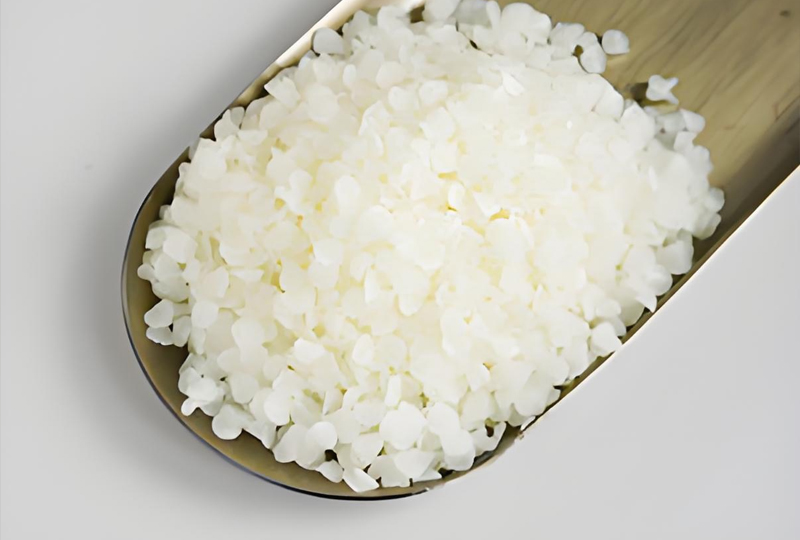
Grade A White Beeswax Candle Wax is a granular candle-making raw material with a high level of refinement. Its position just below pure natural beeswax makes it suitable for manufacturers and artisans looking for a cleaner and more consistent appearance than ordinary refined beeswax while maintaining useful beeswax characteristics.
The granular format is convenient for production. Compared with large blocks, granules can be weighed, portioned, and melted more efficiently. This is useful in both small-batch studios and larger production environments because accurate dosing contributes to batch consistency. Granular wax also makes it easier to combine the material with other waxes, additives, colors, and fragrance oils.
The material has a melting point of approximately 60°C. This means that it can be melted without the extremely high temperatures required by some harder wax systems. Nevertheless, professional candle makers should always use controlled heating equipment, monitor the wax temperature, and avoid prolonged overheating. A suggested pouring temperature of 80–85°C offers a practical working range for filling molds, containers, or decorative forms after the wax has been fully melted and prepared.
The wax tolerates up to 10% fragrance oil, although the ideal fragrance load depends on the fragrance composition, wick selection, candle format, desired throw, and testing conditions. Fragrance oils differ significantly in density, volatility, polarity, and compatibility with wax. For this reason, a responsible formulation process should begin with a smaller fragrance percentage and increase gradually through controlled testing.
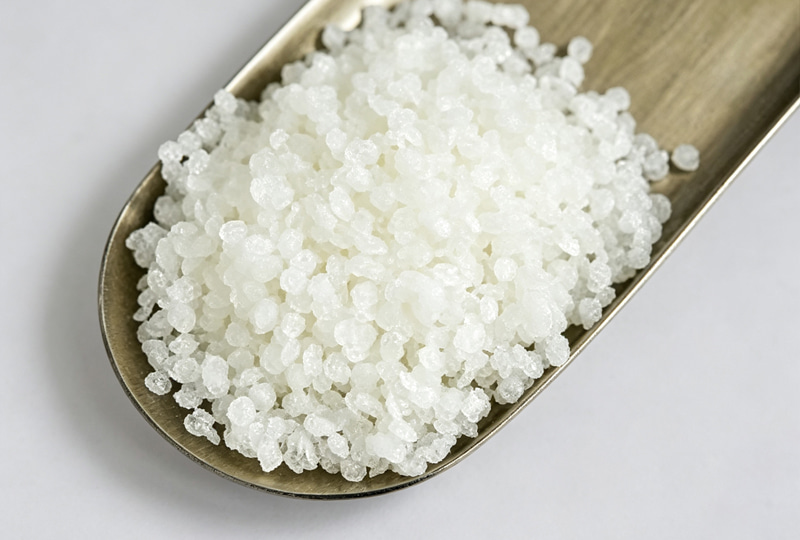
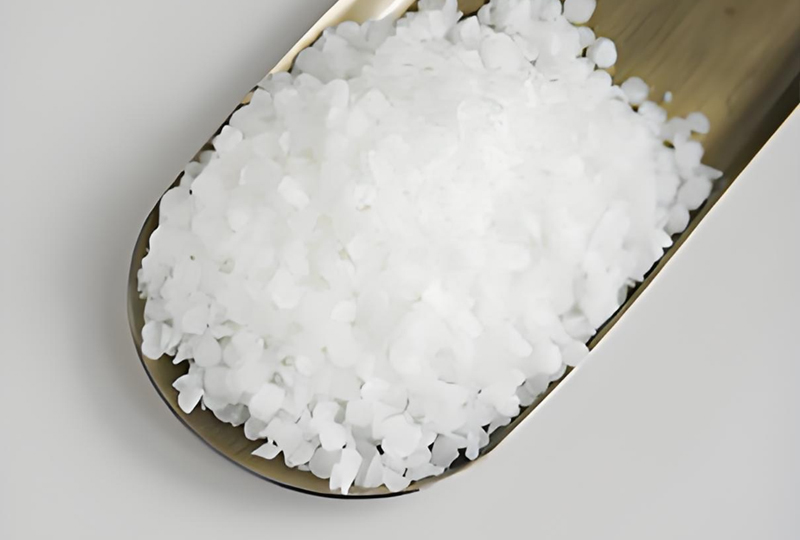
Its white appearance is one of its defining characteristics. A bright wax base can help create a clean, premium visual identity. It can also make subtle colors easier to control because the formulator begins with a neutral background rather than a naturally yellow or darker wax tone.
| Property | General Characteristic | Production Significance |
|---|---|---|
| Material type | High-purity granular white beeswax | Convenient handling, weighing, melting, and blending |
| Melting point | Approximately 60°C | Supports efficient controlled melting |
| Suggested pour temperature | Approximately 80–85°C | Provides a practical range for filling molds and containers |
| Fragrance tolerance | Up to 10% fragrance oil | Suitable for scented candle development when properly tested |
| Appearance | Bright white | Useful for premium, decorative, minimalist, and colored candles |
| Flexibility | Moderate; may become brittle in cold conditions | Best suited to appropriate designs and controlled storage conditions |
| Blending ability | Readily blends with other wax types | Supports custom formulas and application-specific performance |
Color is a major part of the candle buying experience. Consumers often judge a product before lighting it, based on the container, label, surface finish, shape, and color. White candles communicate cleanliness, simplicity, modernity, and refinement. They can fit a wide range of interior styles and are often suitable for hospitality, wedding, spa, wellness, and gift applications.
Grade A White Beeswax offers a brighter appearance than standard refined beeswax. This advantage is especially relevant when the finished candle is not hidden inside an opaque container. Pillar candles, taper candles, hand-rolled candles, carved candles, shaped candles, and sculptural pieces all display the wax directly. In these products, the base color becomes part of the design.
A white base also improves color development. When a manufacturer adds a small amount of pigment, the result can be more predictable because the wax does not strongly influence the final shade. Pastel colors, soft neutrals, light blue, pale pink, ivory, sage, and other delicate tones can be developed more easily from a bright foundation.
For luxury collections, a clean white surface can support a high-end visual language. A smooth white candle with precise edges may look more sophisticated than a candle with uneven coloration or visible raw-wax variation. For minimalist products, the wax itself can become a design statement, reducing the need for heavy decoration or complex packaging.
Whiteness is also useful for seasonal products. Snow-inspired winter candles, white holiday pillars, wedding candles, baptism candles, memorial candles, and spa-themed products all benefit from a bright and neutral appearance. A single white wax base can support multiple designs, helping manufacturers simplify their raw-material portfolio.
Standard refined beeswax remains a useful candle material, but it may not provide the same degree of whiteness or visual consistency required for certain product categories. Grade A White Beeswax is designed for applications where a cleaner appearance is a significant selling point.
The clearest advantage is its brighter white color. This allows finished candles to appear cleaner and more uniform, particularly when the product is sold as a decorative object. A consistent white tone can reduce the visual variation that sometimes occurs with less-refined materials.
Many contemporary candle collections emphasize geometric shapes, architectural forms, clean lines, and neutral colors. A bright wax base complements this design direction. It works well for abstract sculptures, ribbed pillars, twisted candles, bubble candles, floral shapes, animal forms, and other decorative products.
The material offers a degree of flexibility while retaining enough structure for decorative and formed products. This balance is useful for hand-rolled candles and carved designs, where the wax must be workable but should not lose its form too easily.
Manufacturers rarely rely on one wax for every product. Different formulas may require adjustments to hardness, surface finish, burn rate, fragrance retention, release from molds, and resistance to heat. Grade A White Beeswax can be blended with other wax types to create custom formulations. This makes it more adaptable than a raw material used only in one narrow application.
A versatile white wax can support several product categories at the same time. A manufacturer may use it for scented jars, decorative pillars, shaped candles, hand-rolled pieces, gift sets, and seasonal collections. This reduces the need to source a completely different base for each product family and can simplify production planning.
Hand-rolled candles depend on the ability of the wax sheet or prepared material to form around a wick while maintaining an attractive surface. Grade A White Beeswax is suitable for traditional hand-rolled designs where a bright finish is desired. The whiteness can give the finished candle a clean, artisanal appearance, while the material’s moderate flexibility supports careful shaping.
For hand-rolled production, room temperature and working temperature are important. If the environment is too cold, the wax may become less flexible and more likely to crack. If it is too warm, the material may soften excessively and lose edge definition. Controlled workshop conditions can improve the consistency of the final products.
Carved candles require a wax that can hold decorative cuts, layered surfaces, and intentional patterns. The bright color of Grade A White Beeswax helps highlight shadows and contours in carved designs. It is particularly effective for floral details, geometric cuts, relief patterns, and ornamental candle surfaces.
Carving should be performed with suitable tools and at an appropriate temperature. Excessive force or working the wax in cold conditions may cause chips or cracks. Trial production is recommended before moving into large-volume manufacturing, especially when the design contains thin projections or sharp decorative elements.
Sculptural candles have become important in home décor and gift markets. Their value often comes from shape rather than extended burning time. Grade A White Beeswax is well suited to these products because a bright, clean material can make the form more visible and visually appealing.
Potential applications include abstract sculptures, twisted forms, molded flowers, figurines, columns, shells, arches, and novelty shapes. For highly detailed designs, the manufacturer should evaluate mold release, shrinkage, surface texture, and structural strength. Blending with another wax may further improve the specific properties required by a complex mold.
The material can also be used as part of a scented container candle formula. Its fragrance tolerance of up to 10% provides room for developing products with noticeable aroma, although the final fragrance load should always be established through testing.
Container candles require careful evaluation of adhesion, wet spots, frosting, sinkholes, wick performance, and hot throw. A wax that looks excellent in a mold may behave differently in a glass jar. A professional development process should test the complete system, including wax, fragrance, wick, vessel, dye, cure time, and filling temperature.
White decorative candles can be combined with reed diffusers, fragrance accessories, candle components, or other home fragrance products to form coordinated gift sets. Their neutral appearance makes them easy to match with different packaging themes and seasonal color palettes.
For gift products, visual consistency is especially important. Customers may compare several items in one box or display. A uniform white wax finish can support a more cohesive presentation and reinforce the perception of quality.

Fragrance is central to the modern candle market. A candle’s success depends not only on its appearance but also on how effectively it delivers scent before lighting and during burning. Grade A White Beeswax can tolerate up to 10% fragrance oil, giving formulators flexibility in developing different fragrance intensities.
However, fragrance loading should not be treated as a fixed recipe. The maximum stated tolerance is a reference point, not a universal instruction. A high fragrance percentage can affect hardness, setting time, surface appearance, wick behavior, and burn safety. Some fragrances may cause sweating, separation, discoloration, or poor adhesion if the formula is not balanced.
A systematic development process should include the following steps:
First, select a fragrance oil intended for candle use and confirm its technical documentation. The fragrance supplier’s recommended usage rate, safety information, and compatibility guidance should be reviewed before production.
Second, create small test batches at several fragrance levels. For example, a manufacturer may compare low, medium, and higher fragrance percentages rather than moving directly to the maximum loading.
Third, monitor the wax during mixing. Fragrance should be added at a suitable temperature that supports proper incorporation without unnecessarily exposing the oil to excessive heat.
Fourth, evaluate the finished candle after an appropriate curing period. Immediate testing may not represent the final result because the wax and fragrance need time to stabilize.
Finally, conduct burn testing with the selected wick and vessel. A formula that delivers strong cold throw may not provide the desired hot throw, and a formula with excellent fragrance performance may require a different wick size.
Wax, fragrance, and wick operate as a system. Changing one element can affect the others. A fragrance-rich formula may require a larger wick, while a harder blend may need a different wick profile. The vessel diameter, candle height, ambient temperature, and intended burn time also influence performance.
For this reason, Grade A White Beeswax should be evaluated as part of the complete finished product rather than judged only as an isolated raw material. Its ability to blend with other waxes allows manufacturers to adjust the formula when additional hardness, flexibility, opacity, or fragrance retention is required.
One of the material’s strongest advantages is its ability to blend readily with other wax types. This is important because different candle categories often require different performance profiles.
A decorative pillar may need more rigidity and sharper mold definition. A hand-rolled candle may need improved flexibility. A container candle may require better adhesion and a controlled melt pool. A sculptural candle may need a balance between surface detail and resistance to breakage. A custom blend can help target these requirements more precisely than a single wax used without modification.
When developing a blend, manufacturers may assess the following characteristics:
Hardness: The formula must be strong enough to maintain its shape during handling, packaging, transport, and display.
Flexibility: The formula should resist unnecessary cracking during forming, carving, and normal temperature changes.
Surface finish: The finished candle should have an attractive appearance with acceptable smoothness, texture, and color consistency.
Mold release: The wax should separate cleanly from the mold without damaging fine details or leaving excessive residue.
Fragrance retention: The formula should hold the selected fragrance adequately and provide an effective scent experience.
Burn performance: The candle should burn in a controlled manner when paired with a suitable wick.
Storage stability: The product should remain acceptable under the expected transportation and warehouse conditions.
Grade A White Beeswax can serve as a bright foundation in these experiments. Its neutral appearance is especially useful when the final formula must remain white or support light colors.
Although the material is straightforward to process, good manufacturing discipline is essential for consistent results. Raw wax should be stored in a clean, dry environment away from direct sunlight, strong odors, and excessive temperature fluctuations. Packaging should remain sealed until the material is ready for use.
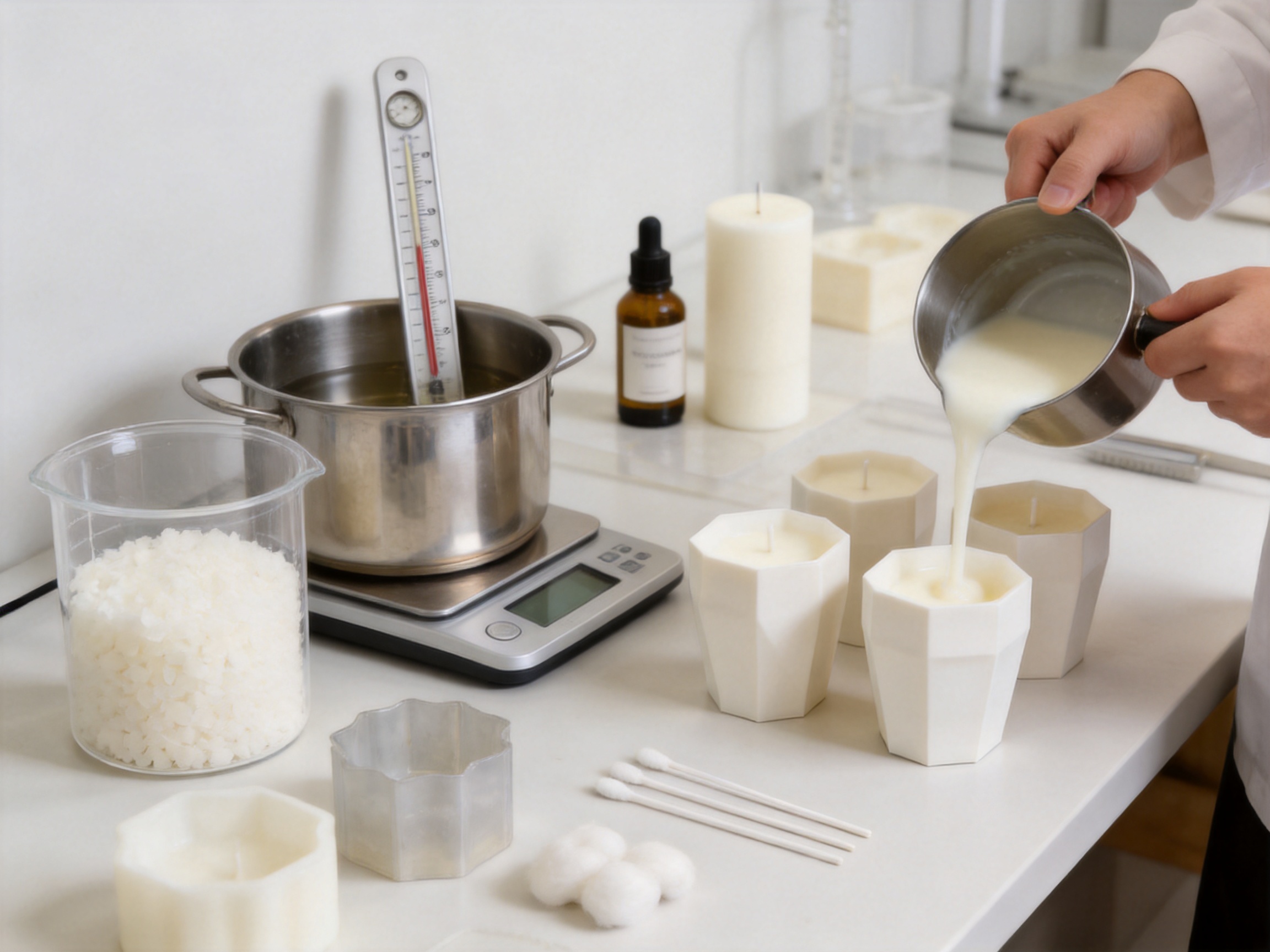
The wax should be melted gradually using a suitable double boiler, wax melter, or controlled industrial heating system. Direct exposure to an uncontrolled heat source can create hot spots and may degrade the material or create unnecessary safety risks.
Because the melting point is approximately 60°C, the operator should avoid overheating the wax. Once the material is fully liquid, the temperature can be adjusted for fragrance addition, color incorporation, and pouring. A calibrated thermometer should be used rather than relying on visual estimation.
Mixing should be gentle but thorough. Excessive agitation can introduce air bubbles, while insufficient mixing can produce uneven fragrance or color distribution. When the wax is blended with other materials, the order of addition and mixing duration should be recorded so that the process can be repeated accurately.
The suggested pour temperature is approximately 80–85°C. This range can serve as a starting point, but the best temperature may vary according to the mold, vessel, ambient conditions, formula, and desired surface finish. Test pours should be used to identify the most reliable production setting.
Pouring too quickly may create air pockets or uneven surfaces. Pouring at an unsuitable temperature may increase shrinkage, frosting, cracking, or poor adhesion. Professional production should therefore control not only the wax temperature but also the temperature of the mold or container.
Cooling should take place in a stable environment. Rapid temperature changes can increase the risk of surface defects or cracking, particularly in products with thick sections or intricate shapes. The candle should remain undisturbed until it has fully set.
Cold environments require special attention because the material may become brittle and crack. This does not make the wax unsuitable; rather, it indicates that production, storage, and transportation conditions should be considered during product development.
Reliable candle production depends on quality control at every stage. A professional supplier should evaluate raw-material consistency, production conditions, packaging integrity, and finished-product performance.
For Grade A White Beeswax, incoming inspection may include checking the granule appearance, color, odor, packaging condition, and batch documentation. Any unusual discoloration, contamination, moisture exposure, or foreign material should be investigated before production.
During processing, operators should record batch weights, heating temperatures, fragrance percentages, mixing times, pouring temperatures, and cooling conditions. These records help identify the cause of any variation and make successful formulas easier to reproduce.
Finished candles may be inspected for surface smoothness, color consistency, shape accuracy, cracks, air pockets, incomplete filling, wick position, label alignment, and packaging appearance. Burn testing should be performed when the product is intended for regular use rather than purely decorative display.
The company supporting this product operates an in-house laboratory and applies quality control across key stages, from material selection to finished goods inspection. This structure is valuable because candle quality cannot be guaranteed by checking only the final box. Strong quality systems connect raw-material evaluation with production control and pre-shipment inspection.
Consistency is one of the most important differences between informal sourcing and professional supply. Buyers need each shipment to match the approved sample as closely as possible. Variations in color, melting behavior, fragrance compatibility, or granule quality can create manufacturing delays and customer complaints.
A supplier with documented processes, laboratory support, partner-factory coordination, and inspection procedures can reduce these risks. This is particularly important for brands selling through multiple channels, where product reviews and repeat purchases depend on stable quality.

The product is supplied by Hangzhou Leo Home Trading Co., Ltd., a China-based international trading and supply chain company specializing in household and daily-use products. The company was founded in January 2025 and combines product development, international sourcing, cross-border marketing, and logistics coordination.
Its business model is designed to connect overseas buyers with manufacturing resources while simplifying communication and order management. For candle buyers, this can be valuable when a project includes more than one finished product or requires coordinated packaging and customization.
The company integrates 10 candle factories, 8 jar customization partners, and 8 color box factories. This network provides access to multiple production resources rather than depending on a single manufacturing line. It can support different candle formats, packaging requirements, order sizes, and product styles.
A broader factory network also helps buyers compare capabilities. One factory may be stronger in shaped candles, another in container candles, and another in decorative or seasonal products. Coordinating these resources through one supply partner can reduce the burden on overseas buyers who would otherwise need to manage several independent vendors.
The company provides OEM and ODM services covering specifications, fragrance selection, labels, and packaging. This is relevant to Grade A White Beeswax because the raw material can be developed into different finished product concepts.
Customization may involve selecting a candle shape, adjusting the wax formula, defining a fragrance profile, choosing a vessel, developing a color direction, preparing label artwork, or designing a gift box. Professional R&D support can also assist with refinement based on drawings or samples.
For a private-label customer, this means the product does not have to remain a generic raw-material purchase. It can become part of a complete collection designed for a particular market, retail channel, seasonal campaign, or brand identity.
An in-house laboratory can support practical product development and quality evaluation. Testing may focus on raw-material characteristics, formula behavior, fragrance incorporation, surface appearance, and finished-candle performance.
Laboratory support is particularly useful when a buyer requests a new formula or changes an existing product. Instead of relying only on trial and error at the final production stage, the supplier can organize a more structured development process.
The company reports daily capacity of up to 50,000 units for stable bulk delivery and replenishment. This capability is important for established brands that require regular inventory. At the same time, the company supports smaller volumes and trial runs, allowing new customers to test products before committing to large orders.
This combination of bulk capacity and flexible trial support is a competitive advantage. New product development often involves uncertainty. Buyers may need to validate fragrance acceptance, packaging performance, retail pricing, and customer response before placing a major order.
The company’s location in Zhejiang Province provides access to logistics resources near Ningbo Port. Convenient port access can help streamline export arrangements, especially for international orders involving candles, jars, boxes, accessories, and other household products.
Efficient logistics coordination matters because finished candles can be sensitive to temperature, impact, and packaging pressure. Proper carton design, inner protection, palletization, documentation, and shipping planning all contribute to reducing transit damage.
International buyers often need more than a technically suitable wax. They also need reliable communication, clear specifications, sample approval, packaging coordination, quality control, and export support. A supply partner that combines these functions can reduce the complexity of sourcing.
Hangzhou Leo Home has delivered products to more than 10 countries and regions across North America, Europe, and the Middle East. This international experience can help the company understand different market expectations, packaging preferences, product styles, and logistical requirements.
For buyers of Grade A White Beeswax Candle Wax, the practical advantages may include:
One-stop sourcing: Buyers can discuss raw wax, finished candles, jars, gift sets, and packaging through one supply contact.
Product development: The company can support the transition from a material requirement to a finished product specification.
Customization: Buyers can request specific fragrances, labels, packaging, colors, shapes, and collection concepts.
Quality coordination: Raw materials and finished goods can be managed through documented inspection procedures.
Flexible order planning: Trial runs and larger replenishment programs can be supported within the same supply relationship.
International logistics: Export coordination and shipping arrangements can be managed with attention to overseas delivery requirements.
White beeswax-based candles can serve multiple market segments. In the home décor sector, sculptural white candles are often purchased as display objects. In the gift market, white candles can communicate elegance and universality. In the hospitality and wellness sectors, neutral candles can complement spas, hotels, restaurants, and event settings.
Minimalist packaging can highlight the natural visual character of the wax. Alternatively, the same raw material can support colorful packaging, metallic accents, embossed boxes, or seasonal graphics. Its flexibility as a visual foundation makes it suitable for both understated and highly themed collections.
The product can also support tiered product strategies. A brand may use the wax for entry-level decorative candles, premium scented candles, and limited-edition gift sets, adjusting the fragrance, vessel, shape, and packaging while maintaining a consistent material story.
For online retailers, visual brightness can improve product photography. White products require careful lighting and background control, but a clean wax surface can produce attractive images when properly photographed. For physical retailers, white candles can coordinate easily with different displays and interior environments.
The material’s tendency to become brittle and crack in colder conditions should be considered during storage and transport. This characteristic is important for both manufacturers and distributors.
Raw wax should be protected from excessive cold, sharp temperature changes, moisture, and pressure that may damage the packaging. Finished candles should be packed with suitable protective materials, especially when they contain thin edges, delicate carved details, or projecting shapes.
During winter shipping or storage in cold climates, product testing should reflect realistic conditions. A sample may be placed under controlled cold exposure and then inspected for cracks, breakage, surface changes, and structural weakness. This type of test helps determine whether the formula, packaging, and shipping method are suitable for the target market.
Where greater cold resistance is required, blending with another wax type may be considered. The correct blend depends on the intended application and should be verified through testing rather than assumed from a general formula.
A professional project using Grade A White Beeswax can follow a staged development process.
Stage one is requirement definition. The buyer should specify the product type, dimensions, shape, fragrance direction, color, packaging, target market, order quantity, and expected delivery schedule.
Stage two is raw-material and formula evaluation. The supplier and buyer can determine whether the white beeswax will be used alone or blended with other waxes. Fragrance tolerance, hardness, flexibility, and surface requirements should be discussed at this stage.
Stage three is sample development. Small samples can be produced in the intended vessel or mold. The buyer should evaluate appearance, scent, packaging, and overall product positioning.
Stage four is performance testing. The finished candle should be checked for burning behavior, scent release, stability, surface quality, and resistance to handling. Products intended for decorative use should still be reviewed for structural integrity and safe presentation.
Stage five is packaging confirmation. Box dimensions, protective inserts, labels, cartons, barcodes, and shipping marks should be approved before mass production.
Stage six is pre-production approval. A final sample or golden sample should be confirmed as the standard for production. Any changes after approval should be documented.
Stage seven is mass production and inspection. Production should follow the approved formula and specifications, with quality checks performed at appropriate stages.
Stage eight is shipment and replenishment planning. Buyers should coordinate delivery schedules, inventory levels, and potential repeat orders to avoid supply interruptions.
It is a bright white granular wax with a high level of refinement, ranking just below pure natural beeswax in purity. It is developed for candle-making applications that require a clean appearance and useful processing performance.
The melting point is approximately 60°C. Controlled heating is recommended to melt the material evenly and prevent overheating.
The suggested pouring temperature is approximately 80–85°C. The final working temperature should be confirmed through testing because mold type, vessel material, formula, and ambient conditions can affect results.
The wax can tolerate up to 10% fragrance oil. The correct fragrance percentage depends on the specific oil and finished-candle design, so small-batch testing is recommended before production.
Yes. It can be used in scented candle formulations, provided the fragrance is compatible and the complete wax-fragrance-wick system is tested for stability and burn performance.
Yes. It is well suited to traditional hand-rolled candles, especially when a bright white appearance is required. Working temperature and room temperature should be controlled to reduce the risk of cracking.
Yes. Its bright color can emphasize carved details, patterns, and contours. Thin or complex designs should be tested carefully because the wax may become brittle in colder conditions.
Yes. It blends readily with other wax types and can serve as a foundation for custom formulas. Blending may help adjust flexibility, hardness, surface finish, mold release, or cold-temperature performance.
It can be used in container candle formulas, but the complete system must be tested. Vessel adhesion, wick selection, fragrance load, cure time, and burn behavior should all be evaluated.
Its main advantage is its brighter whiteness. This makes it especially valuable for decorative, sculptural, minimalist, premium, and light-colored candle products.
Yes. The material can be developed into customized candles with selected fragrances, shapes, labels, packaging, and gift-set configurations. The supplier also supports OEM and ODM services.
The company operates an in-house laboratory and applies quality control from raw-material selection through finished-goods inspection. Production coordination also involves a network of candle, jar, and packaging partners.
The company supports smaller volumes and trial runs as well as bulk delivery. Trial orders allow buyers to evaluate the formula, design, market response, and packaging before scaling up.
Because the wax may become brittle and crack in colder conditions, buyers should evaluate storage, transport, packaging, and finished-product design for the expected climate. Custom blending may be considered if greater flexibility is required.
Grade A White Beeswax Candle Wax offers a practical combination of bright appearance, manageable melting behavior, fragrance capacity, moderate flexibility, and blending potential. It is not limited to one candle category. Instead, it can support a broad portfolio of hand-rolled, carved, molded, sculptural, decorative, scented, and gift-oriented products.
Its strongest competitive position comes from the combination of material performance and supply support. The wax provides a clean visual foundation, while the supplier provides access to product development, factory resources, laboratory support, packaging coordination, flexible order quantities, and export logistics.
For professional buyers, this combination can shorten the path from concept to finished product. Instead of sourcing raw materials, jars, packaging, and finished candles independently, a buyer can coordinate several requirements through one experienced supply-chain partner.
The company’s focus on customization is also valuable for brands that need differentiation. In a competitive home fragrance market, a candle must often stand out through its shape, fragrance story, packaging, color, or gift presentation. A bright white wax base gives designers a strong starting point, while OEM and ODM support makes it possible to create products tailored to a specific audience.
Quality assurance, supply stability, and communication remain essential. The company’s laboratory, inspection procedures, factory network, reported production capacity, and experience serving international markets provide a framework for dependable cooperation.
Grade A White Beeswax Candle Wax is a versatile raw material for candle makers who value a bright white appearance and adaptable formulation performance. With a melting point of approximately 60°C, a suggested pouring range of 80–85°C, and fragrance tolerance of up to 10%, it offers practical processing characteristics for a variety of candle applications.
Its whiteness exceeds that of standard refined beeswax, making it particularly attractive for modern, decorative, sculptural, carved, hand-rolled, and premium candle designs. Its ability to blend with other wax types allows manufacturers to develop custom formulas for hardness, flexibility, surface quality, fragrance performance, and application-specific requirements.
The material should be handled with attention to temperature control, cooling conditions, fragrance compatibility, and cold-weather storage. In colder environments, appropriate packaging, climate management, and formula testing are important because the wax can become brittle and crack.
Supported by Hangzhou Leo Home Trading Co., Ltd., the product is part of a broader sourcing and customization service. The company combines international trading experience with access to 10 candle factories, 8 jar customization partners, 8 color box factories, an in-house laboratory, quality-control procedures, OEM/ODM support, flexible order options, and logistics coordination near Ningbo Port.
For buyers seeking a dependable white wax base and a partner capable of supporting product development from material selection to finished delivery, Grade A White Beeswax Candle Wax provides a strong foundation for competitive home fragrance and decorative candle collections.
1. Product specification supplied for Grade A White Beeswax Candle Wax, including melting point, recommended pouring temperature, fragrance tolerance, appearance, flexibility, and blending characteristics.
2. Internal company information supplied for Hangzhou Leo Home Trading Co., Ltd., including company profile, customization services, quality-control structure, manufacturing resources, production capacity, export experience, and logistics capabilities.
3. General candle formulation and burn-testing principles concerning wax selection, fragrance loading, wick compatibility, cooling conditions, mold performance, and finished-product inspection.
4. General home-fragrance manufacturing practices relating to raw-material storage, batch documentation, packaging development, quality assurance, and international product supply.

Room 1701, Building C1, Wangjing, Xiaoshan District, Hangzhou City, Zhejiang Province, China.

+86-15937257616

Copyright© 2026 Hangzhou Leo Home Trading Co., Ltd. All Rights Reserved.

Luxury Candles Home Fragrance Manufacturers Modern Candles Factory