 English
 Français
News
Home / Author / Catherine Wu — Key Account After-Sales Specialist / Embossed Five-Petal Cylinder Flower Series Handmade Candle: A Refined Decorative Candle for Modern Home Fragrance Collections
Content
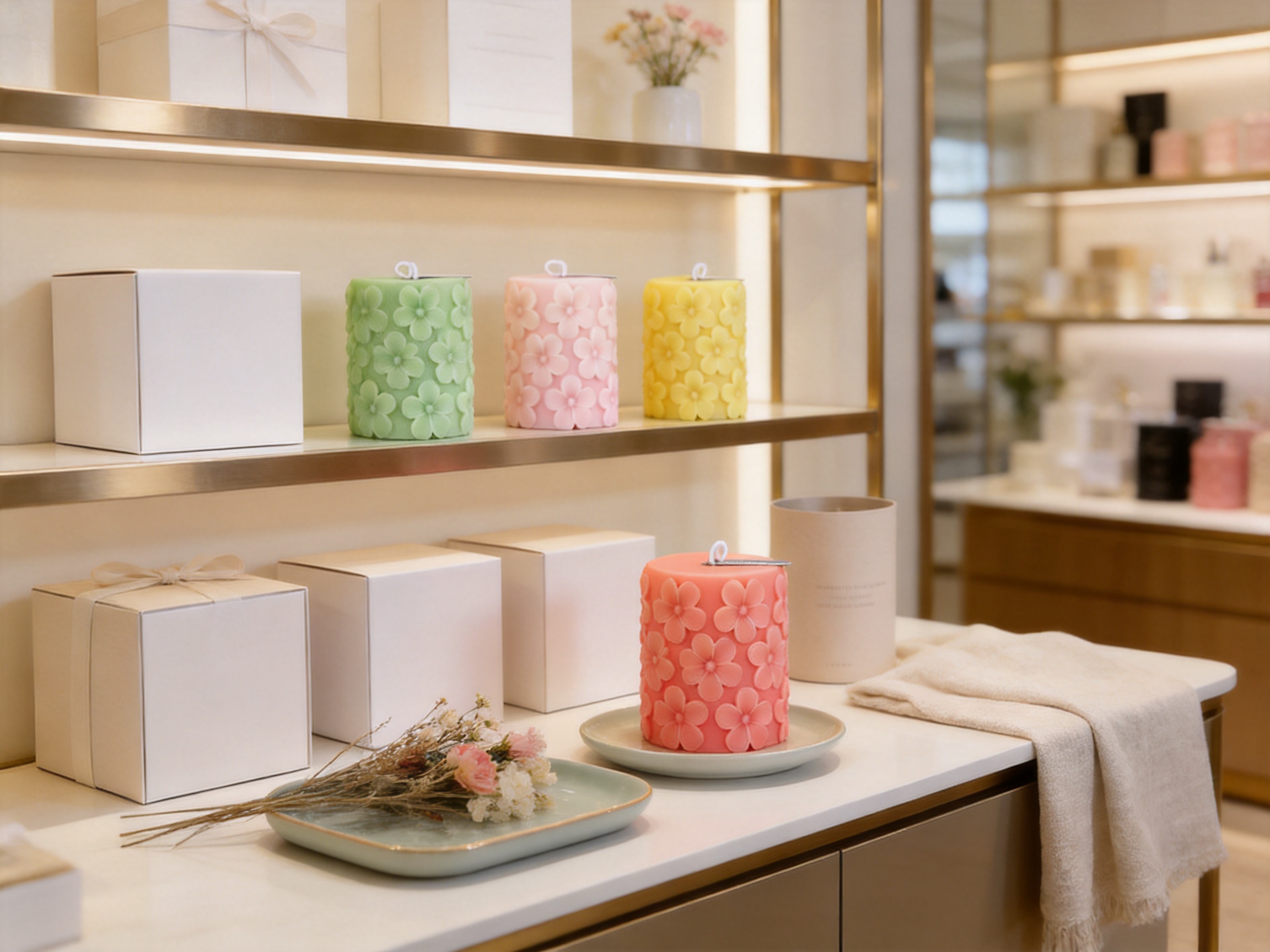

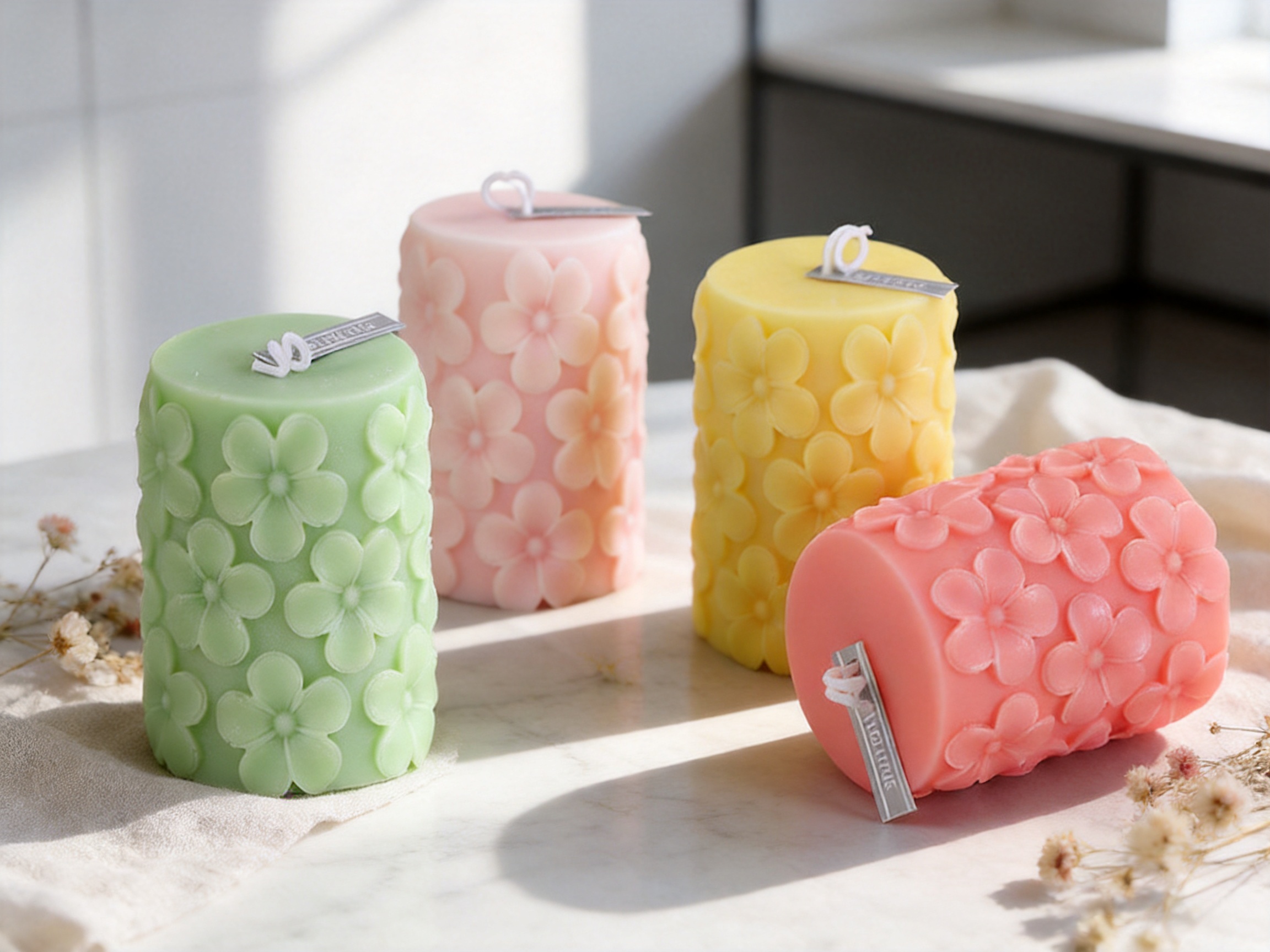

Embossed Five-Petal Cylinder Flower Series Handmade Candle
In the contemporary home-fragrance market, candles compete on more than scent alone. Buyers increasingly evaluate the complete product experience: the visual character of the vessel or wax form, the quality of the surface finish, the consistency of the fragrance, the reliability of the burn, the flexibility of color and packaging, and the supplier’s ability to deliver at the right scale. A candle must function as a fragrance product, a decorative object, a seasonal accessory, and, for many retailers, a dependable component of a broader product collection.
The Embossed Five-Petal Cylinder Flower Series Handmade Candle responds to these expectations through a balanced combination of decorative relief, soft color, practical pillar construction, and OEM/ODM flexibility. Its cylindrical profile is covered by a regular pattern of raised five-petal flowers. Rather than depending on one oversized ornament or a complicated sculptural silhouette, the candle creates interest through an all-over texture that remains visible from every viewing angle.
This approach gives the product a particularly versatile position within the scented-candle category. It can be displayed as a small decorative accent, grouped into a coordinated color collection, included in a seasonal assortment, or developed as a customized private-label item for retailers and distributors. The design is expressive enough to stand out on a shelf while remaining restrained enough to suit modern interiors, botanical themes, gift collections, and everyday home-fragrance displays.
Behind the product is a supply and quality structure designed for international buyers. Hangzhou Leo Home Trading Co., Ltd. works with candle factories, jar-customization partners, and color-box factories, supported by product-development, sourcing, quality-control, and cross-border marketing capabilities. This network enables the company to support product customization while maintaining the operational advantages required for repeat orders, collection development, and international delivery.
The Embossed Five-Petal Cylinder Flower Series Handmade Candle is a cylindrical pillar candle with an embossed floral surface. The central design element is the five-petal flower, repeated across the exterior in a regular pattern. Each flower is integrated into the candle’s surface rather than applied as a separate decoration, creating a unified appearance and a tactile finish.
The available color direction includes soft pastel green, pink, yellow, and coral. These colors provide a fresh, approachable palette that can support several merchandising themes. Pastel green can reinforce botanical, wellness, and spring collections. Pink can suit romantic, feminine, and gifting-focused assortments. Yellow can bring warmth and optimism to seasonal displays, while coral can add a more energetic accent without becoming visually aggressive.
The candle’s cylindrical form is important to its performance as both a decorative and functional product. Unlike a flat decorative tablet or a highly irregular sculpted candle, a cylinder can be displayed upright with a stable visual presence. Its vertical format also allows the embossed floral pattern to wrap continuously around the body, making the candle attractive from multiple angles rather than only from the front.
The design is intentionally consistent. The flowers are distributed in an organized pattern, which gives the surface a sense of order and helps the candle look polished when displayed individually or in groups. Regular repetition also supports collection merchandising. When several colorways are placed together, the common relief pattern visually connects the products while allowing each color to contribute a separate mood.
The handmade character is expressed through the decorative process and the attention given to the surface design. At the same time, the product is suitable for a structured commercial supply program. This combination is valuable for buyers who want an artisanal visual impression without giving up the consistency expected in wholesale purchasing.
Many candles rely on one of three common forms of differentiation: fragrance strength, container graphics, or an unusual silhouette. The five-petal embossed cylinder takes a different route by making the wax surface itself the primary visual feature. The relief adds depth, shadow, and touch without requiring a separate container or a complicated accessory.
The raised flowers catch ambient light along their edges. When the candle is placed near a window, under retail lighting, or beside other home accessories, the relief creates small changes in brightness across the surface. These variations help the product appear more dimensional than a plain-colored pillar candle, even when the base color is soft and understated.
The pattern also creates a tactile benefit. A smooth pillar candle can look attractive, but an embossed surface invites closer inspection. Shoppers can see the detail and understand that the product offers more than a standard molded cylinder. For gift buyers, this additional texture can improve the perceived value of the candle without requiring an excessive or overly ornate design.
Compared with a single large flower motif, an all-over pattern offers a more balanced visual experience. A single motif may appear directional, meaning the candle has a clear front and back. The repeated floral arrangement allows the product to work in open shelving, tabletop displays, gift boxes, and group presentations where customers may view it from different sides.
Compared with highly intricate sculpted candles, the cylinder offers a more practical balance between decoration and everyday usability. An extremely complex shape may be more vulnerable to handling damage, may be difficult to pack efficiently, and may be harder to coordinate with other products. The embossed cylinder retains decorative appeal while maintaining a straightforward overall geometry.
The flower scale is calibrated to the cylinder diameter. This proportion is commercially important. If the flowers were too small, the surface would appear visually noisy and the relief might not read clearly at normal viewing distance. If they were too large, the design could become crowded or dominate the candle excessively. A controlled scale gives the product a recognizable identity while preserving the calm quality associated with modern home décor.
Color is a major factor in candle purchasing. A fragrance may attract attention, but color often determines whether the product fits a room, a gift theme, or a retailer’s seasonal plan. The pastel green, pink, yellow, and coral options provide a flexible foundation for building a coordinated product line.
Soft pastel green supports natural and botanical positioning. It can be placed with dried flowers, ceramic planters, linen textiles, wellness products, or other nature-inspired home accessories. The floral embossing reinforces this association without making the product appear overly literal or themed.
Pink offers broad appeal in gifting and lifestyle retail. It can be used for spring collections, celebratory displays, romantic gift assortments, or product lines aimed at customers who prefer gentle and warm tones. In combination with the five-petal pattern, pink gives the candle a delicate decorative character.
Yellow adds lightness and energy. It can be used in spring and summer displays, cheerful gift selections, kitchen or dining-room collections, and color-blocked merchandising arrangements. Because the design remains structured, the yellow color can appear lively without making the product feel visually disorganized.
Coral provides a stronger accent for buyers who want a warmer and more noticeable tone. It can be combined with pink and yellow for a sunset-inspired collection or paired with pastel green for a balanced botanical palette. Coral may also help retailers create a focal point within a broader display of softer colors.
The four colorways can be sold individually or as a coordinated set. A retailer may choose one color for a focused private-label collection, or combine several shades to create a multi-item display. This flexibility is especially useful for stores that organize products by season, room palette, event, or customer preference.
| Colorway | Primary Visual Character | Potential Merchandising Direction | Collection Pairing Ideas |
|---|---|---|---|
| Pastel green | Fresh, botanical, calm | Wellness, spring, natural living | Coral, cream, wood tones |
| Pink | Soft, gentle, giftable | Romantic gifting, feminine lifestyle, spring | Yellow, white, light green |
| Yellow | Bright, optimistic, warm | Summer, cheerful gifting, seasonal décor | Pink, coral, natural fibers |
| Coral | Warm, expressive, energetic | Accent displays, summer, contemporary décor | Pastel green, yellow, neutral shades |
For OEM orders, the color direction can be developed further according to target-market requirements. Buyers may request a specific palette, coordinated packaging colors, or a collection that matches an existing brand identity. The product’s repeated floral pattern provides a stable design foundation while allowing color to carry the seasonal or commercial message.
The product uses a single centered wick positioned through the cylindrical wax body. A centered wick is an important part of a stable pillar-candle design because it supports a more even path through the wax when the candle is burned under suitable conditions. The column form also provides a relatively extended burn time proportionate to its size, making the candle suitable for both decorative placement and repeated use.
As the candle burns, the embossed surface remains visually identifiable through the early and middle stages of use. This gradual transition is a meaningful product advantage. The relief does not disappear immediately when the flame is lit, so the candle can continue to function as a decorative object while it is being enjoyed as a fragrance product.
The relationship between the external pattern and the internal burn is carefully considered. A decorative candle should not be designed only for an unopened display state. Its visual identity should continue to support the user experience after purchase. The flower pattern changes gradually as wax is consumed, creating a natural progression from a full decorative column to a softer, partially used form.
As with all candles, safe and appropriate use depends on following the relevant care instructions. The candle should be placed on a stable, heat-resistant surface, kept away from flammable materials, and burned under supervision. The wick should be maintained according to the recommended care guidance, and the product should not be left unattended or used near children or pets.
The product is intended to combine decorative value and practical home fragrance. It can be displayed on a dining table, bedroom console, shelf, entryway table, bathroom counter, or gift presentation area. Its cylindrical format is easy to integrate into different spaces, while the floral relief gives it more visual personality than a plain pillar candle.
The candle market includes a wide range of products, from simple unscented pillars to heavily decorated jars and complex sculptural forms. The Embossed Five-Petal Cylinder Flower Series Handmade Candle occupies a middle position that can be commercially advantageous: it offers a clear decorative signature while retaining the straightforward usability of a pillar candle.
A plain pillar candle may be cost-effective and easy to produce, but it often relies heavily on packaging or color to attract attention. The embossed floral surface gives this product an immediate point of differentiation. Shoppers can recognize the design even before reading the label, and retailers can present it without relying entirely on printed graphics.
Novelty candles shaped like animals, foods, or highly specific objects can perform well in selected markets, but their appeal may be limited to a particular theme. The five-petal flower is broadly understandable and adaptable. It can support botanical, romantic, seasonal, elegant, or everyday home-fragrance positioning depending on the color, scent, and packaging.
The repeated relief creates a clear shelf identity, but the overall cylindrical structure keeps the product visually organized. This balance may be preferable to designs with too many protrusions, delicate parts, or irregular edges. The candle can be displayed in groups and packed as part of a coordinated assortment without losing its individual character.
Some decorative candles are most effective as single statement pieces, while others are designed primarily for multipacks. This flower cylinder can operate in both formats. A single candle can serve as a small home accent or gift item, while several colorways can form a cohesive set for seasonal and lifestyle retail.
The raised flower pattern adds a physical dimension that a printed design cannot reproduce. Customers can see and feel the workmanship. For buyers seeking a handmade or craft-inspired appearance, this tactile quality can strengthen the product story and support a higher perceived value.
The cylinder and repeated surface pattern create a dependable base for OEM development. Fragrance, color, labeling, packaging, and collection presentation can be adapted for different markets. Instead of developing an entirely new form for each project, buyers can use the established design as a platform and focus customization resources on the details most important to their customers.
The product is appropriate for a range of channels because it combines decorative appeal with a recognizable home-fragrance function. In independent lifestyle stores, the candle can be displayed alongside ceramics, textiles, dried flowers, and small home accessories. The embossed flowers make it visually relevant even when it is not lit.
In gift shops, the candle can be positioned as an accessible decorative gift. Its color variety allows the buyer to choose a shade that reflects the recipient’s taste or the occasion. A coordinated box, sleeve, or paper insert can further explain the floral design and care instructions.
For online retail, the embossed relief can be emphasized through close-up product photography and multiple-angle images. Since the pattern wraps around the cylinder, image sets can show the product from the front, side, and back. Color comparisons and group photographs can help shoppers understand the available assortment.
Home décor retailers may use the candle as a small styling object. The vertical form can add height to a tabletop arrangement, while the pastel color palette can complement neutral interiors. The product can also be grouped with trays, vases, books, and seasonal accessories to create a complete visual story.
Florists and botanical gift businesses may find the design especially relevant because of its floral surface. The candle can be included in gift baskets, spring arrangements, self-care collections, or plant-themed assortments. The floral relief provides a connection to the botanical theme without requiring real flowers or a short product lifespan.
Hospitality and event businesses may also consider the candle for room styling, guest gifts, seasonal displays, or event favor collections, subject to appropriate safety, fragrance, packaging, and regulatory requirements. Custom color and packaging options can help match a particular event identity or hospitality concept.
A decorative candle is only commercially successful when the design can be translated into a consistent product. The supplier’s manufacturing and sourcing structure is therefore as important as the appearance of the candle. Hangzhou Leo Home Trading Co., Ltd. supports product development through a network that includes 10 candle factories, 8 jar-customization partners, and 8 color-box factories.
This partner structure provides access to specialized capabilities across the broader home-fragrance category. For the embossed cylinder, it supports the coordination of wax-product development, surface design, color control, packaging, and export preparation. For buyers developing a larger product line, the same network can support related jar candles, shaped candles, LED candles, jelly candles, gift sets, and associated packaging formats.
The company’s role as an international trading and supply-chain partner is significant for overseas clients. Rather than limiting the relationship to a single product transaction, the company can coordinate sourcing, customization, inspection, packaging, and delivery support. This integrated approach can reduce the number of separate suppliers a buyer must manage.
OEM and ODM projects may begin with a product concept, a reference sample, a drawing, a target color, a fragrance direction, or a packaging idea. The company provides professional R&D support for refining specifications and translating a concept into a manufacturable product. This is especially useful when a buyer wants to adjust the flower scale, color palette, fragrance profile, label treatment, or packaging structure.
Working from a reference or drawing also helps establish a shared understanding before production. Details can be discussed and confirmed in advance, reducing ambiguity between the buyer, product-development team, and manufacturing partners.
Different parts of a candle project may require different specialists. One partner may focus on wax products, another on containers, and another on color-box production. A coordinated supply-chain system makes it possible to align these components around a single product program.
For the flower series, this can be valuable when a buyer wants both pillar candles and complementary container candles in the same collection. Shared color references, packaging graphics, and fragrance positioning can be managed across related products, helping the final assortment appear intentional rather than assembled from unrelated sources.
The company states that it operates an in-house laboratory and applies quality control across key stages, from raw materials to finished goods. This structure supports a more systematic approach to product consistency. Quality control is particularly important for handmade and decorative candles because buyers must evaluate not only appearance but also surface definition, color uniformity, wick placement, fragrance performance, packaging condition, and finished-product presentation.
Raw-material checks help establish a reliable foundation for production. In-process inspection can identify issues before large quantities are completed. Finished-goods inspection provides a final opportunity to confirm that products meet agreed specifications before packing and shipment.
The company reports daily capacity of up to 50,000 units for stable bulk delivery and replenishment, while also supporting smaller volumes and trial runs. This range is useful for different stages of a buyer’s product plan. A new retailer may begin with a smaller test order to evaluate customer response, while an established distributor may require larger repeat shipments.
Capacity alone does not guarantee a successful program, but it provides a foundation for scaling when supported by quality control, production planning, and coordinated logistics. For seasonal collections, the ability to move from sampling to a larger order can help buyers respond to market demand without changing the overall product concept.
Quality assessment for an embossed candle should include both visual and functional criteria. The floral pattern should be sufficiently clear and consistent across the candle surface. Buyers may review the regularity of the flowers, the smoothness of transitions, the definition of raised edges, and the absence of obvious surface defects.
Color consistency is another important point. When several candles are sold as a set, the shades should support a coordinated appearance. A buyer may establish an approved color reference for pastel green, pink, yellow, or coral and use that reference during sampling and production review.
Wick positioning should be checked because the centered wick supports the intended burning behavior of the cylinder. The product should also be evaluated for overall stability, clean presentation, and packaging protection. Any custom fragrance should be reviewed for the intended scent character, strength, and compatibility with the product concept.
Packaging quality matters because the raised floral surface may require suitable protection during transport. The package should protect the candle from abrasion, impact, dust, and excessive movement while also presenting the design clearly to the final customer. Color boxes, sleeves, inserts, or protective components can be developed according to the buyer’s positioning and shipping requirements.
Inspection standards should be agreed before mass production. A professional purchase program may include approved samples, color references, packaging artwork, labeling requirements, carton specifications, and acceptance criteria. Clear documentation helps align the trading company, manufacturing partners, and buyer.
The candle is designed as a flexible platform for private-label and custom development. Fragrance is one of the most important customization areas. A buyer may select a soft floral scent to reinforce the flower pattern, a green or herbal direction to complement pastel green, a fruit-inspired scent for yellow or coral, or a more neutral fragrance for broad everyday appeal.
Color customization can be used to follow a brand palette, match a seasonal trend, or create an exclusive collection. The existing pastel colors provide a starting point, while custom shades may be explored for specific markets or campaigns. It is advisable to evaluate color under consistent lighting and against the intended packaging materials.
Packaging customization can substantially change the market position of the same candle. A simple paper sleeve may support an accessible everyday product. A printed color box can create a more complete gift presentation. A premium rigid box, coordinated insert, or multi-candle set can support a higher-end assortment, subject to the buyer’s budget and target price.
Labels and product information can also be adapted. Buyers may require brand marks, fragrance names, collection names, care instructions, warning information, barcode placement, country-of-origin details, or market-specific compliance text. These details should be confirmed early because they affect artwork approval, printing, packing, and import preparation.
Size and assortment planning can be discussed for OEM orders. The cylindrical form may be developed as an individual item or included in a series with multiple sizes, complementary colors, or related shapes. Any changes to dimensions, wax formulation, wick selection, fragrance load, or packaging should be evaluated through sampling and testing before mass production.
Hangzhou Leo Home Trading Co., Ltd. is based in Hangzhou, China, and focuses on international trading and supply-chain solutions for household and daily necessities. Founded in January 2025, the company combines digital tools, product sourcing, customization, and cross-border marketing support for overseas clients.
The company reports experience delivering products to more than ten countries and regions across North America, Europe, and the Middle East. This international exposure can help inform communication about documentation, packaging expectations, product specifications, and shipping coordination. Buyers should still confirm all destination-market requirements for candles, fragrance products, labels, packaging, and safety information before ordering.
Its location within Zhejiang Province provides access to manufacturing and logistics resources. The company also identifies convenient logistics near Ningbo Port as an advantage for international shipment planning. Efficient port access can be important when handling seasonal inventory, replenishment orders, or coordinated product collections.
The company’s stated strengths include customization, supply-chain integration, quality assurance, diverse product styles, flexible delivery, and market experience. These strengths are relevant to the embossed candle because the product can be sold as a standalone item but can also become part of a wider home-fragrance program.
For buyers, the value of a trading partner lies in coordination. A supplier that can help connect product development, production, packaging, inspection, and delivery may reduce the administrative burden of managing multiple vendors. This can be especially useful for small and medium-sized brands that want custom products but do not have a large internal sourcing department.
The modern candle market is crowded, so a successful product needs a clear reason to be chosen. The embossed five-petal cylinder offers several connected reasons. It has a recognizable design, a flexible color system, a practical pillar format, and the potential for custom fragrance and packaging.
Its competitive advantage does not depend on one exaggerated feature. Instead, it comes from the interaction of multiple moderate strengths. The floral relief creates differentiation. The cylinder supports usability and display stability. The pastel colors broaden styling options. The centered wick supports the intended burn structure. The customization program makes the product adaptable to different retail concepts.
This balanced design may also support longer commercial relevance. Highly trend-driven products can attract immediate attention but may become difficult to sell once the trend fades. A flower pattern is familiar and approachable, while the regular geometric arrangement keeps the appearance contemporary. This allows the product to work in seasonal collections without being limited to a single season.
The candle also benefits from being visually legible in both physical and digital retail. In a store, the raised flowers provide texture and shadow. Online, close-up photography can communicate the surface detail. In a catalog, the available colors can be shown as a unified series. For social media, grouped arrangements can create attractive lifestyle imagery without requiring a complex set design.
For wholesalers and importers, the product’s assortment potential is another advantage. A single product concept can generate multiple stock-keeping units through color, fragrance, size, packaging, and set configuration. This allows a buyer to build variety while preserving a coherent visual identity.
One effective merchandising approach is to group the four colorways together. The coordinated arrangement immediately communicates that the candles belong to a series. The display can use a gradient from pastel green through yellow and coral to pink, or it can create a contrast between cool and warm tones.
A second approach is to merchandise the candle with natural materials. Wood trays, linen, dried flowers, ceramic vessels, and neutral backgrounds can reinforce the handcrafted and botanical qualities of the embossed surface. This presentation is suitable for lifestyle stores and online photography.
A third approach is to create fragrance-led groups. If different colorways are assigned different scents, the retailer can present the collection as a sensory journey. Product names, scent notes, and color associations can help shoppers choose according to mood or room.
A fourth approach is gift-set development. Two or more colors can be packed together, with matching or complementary fragrance profiles. A small card can explain the floral relief, handmade character, and safe-use instructions. This format may be particularly effective during spring, holidays, housewarming seasons, and other gifting periods.
A fifth approach is to pair the candle with related home-fragrance products. Jar candles, reed diffusers, room accessories, or LED candles can be developed within a consistent color and packaging system. This creates opportunities for cross-selling and helps retailers build a more complete category presentation.
Buyers should begin by identifying the intended market position. The same embossed candle can be presented as an accessible decorative accent, a premium handmade gift, a seasonal home accessory, or a private-label fragrance product. The desired position will influence fragrance selection, packaging, color development, quantity, and inspection standards.
The target customer should also be considered. Some customers prioritize decorative appearance, while others focus on fragrance, sustainability, giftability, or price. A clear understanding of the customer helps determine whether the product should emphasize the embossed design, the scent story, the color collection, or the packaging experience.
Buyers should request and approve samples before mass production. A sample review can cover the flower pattern, surface finish, candle color, wick position, fragrance impression, package structure, label information, and overall presentation. For custom projects, sample approval should be documented so that production can be compared against the approved reference.
Order quantities and delivery timing should be discussed early, especially for seasonal collections. The company supports both smaller trial runs and larger orders, but actual schedules depend on specifications, production planning, packaging requirements, testing, and shipping arrangements.
Importers should confirm destination-market requirements for candle labeling, fragrance ingredients, warning statements, packaging materials, and product documentation. Requirements can differ by country and sales channel. A professional supplier can assist with coordination, but the buyer remains responsible for confirming the rules applicable to its market and business model.
Home-fragrance buyers are increasingly attentive to packaging efficiency, material choices, product longevity, and responsible sourcing. While specific sustainability claims should be verified for each project, the candle’s durable decorative format can support a more considered product story than a disposable novelty item.
Packaging development should balance protection and material use. The embossed surface needs appropriate protection during transport, but excessive packaging may increase cost and waste. Buyers can work with the supplier to evaluate sleeves, inserts, recycled-content options, compact cartons, or other formats where suitable and compliant with the target market.
Product longevity also matters. A candle that works as décor before and during use may provide a more complete value proposition to the customer. The user can enjoy the color and floral texture as part of the interior arrangement, then light the candle for fragrance and atmosphere. This dual role can improve perceived usefulness.
Responsible communication is essential. Buyers should avoid making environmental, handmade, non-toxic, or natural claims unless those claims are supported by appropriate documentation. Clear and accurate product information protects the brand and helps customers make informed decisions.
The main feature is the all-over embossed pattern of repeated five-petal flowers wrapped around a cylindrical pillar candle. The relief creates texture, light variation, and a recognizable decorative identity from multiple viewing angles.
The current color direction includes pastel green, pink, yellow, and coral. These colors can be merchandised individually or grouped into a coordinated flower series. Custom color development may also be discussed for OEM orders.
Yes. The product is designed for everyday home fragrance as well as decorative display. It has a single centered wick and a pillar format intended to provide a relatively extended burn time proportionate to its size. Users should always follow the supplied candle-care and safety instructions.
The embossed surface is designed to remain legible through the early and middle stages of burning. As wax is consumed, the relief naturally changes and gradually becomes less prominent.
A plain pillar candle has a smooth exterior and often depends on color or packaging for differentiation. This product uses an integrated floral relief to provide additional depth, tactile interest, and shelf presence while retaining the practical cylindrical form.
The embossed cylinder offers decorative detail without relying on a highly irregular shape. Its regular profile can be easier to display, coordinate, and pack, while the floral surface still provides a distinctive handmade and decorative appearance.
Yes. Fragrance is identified as a customizable element for OEM orders. Buyers can discuss scent direction, fragrance selection, and the relationship between fragrance, color, packaging, and target market.
Custom color development can be discussed. Buyers should provide a target color reference or palette and approve samples before production so that the final color direction is clearly defined.
Yes. OEM and ODM support includes packaging development, labels, and color boxes. The appropriate packaging format depends on the desired retail position, shipping requirements, quantity, and target-market information.
Yes. The candle can be sold as an individual product, a multi-color set, or part of a broader home-fragrance assortment. Related styles may include jar, shaped, jelly, and LED candles, depending on the buyer’s collection plan.
The company reports support for smaller volumes and trial runs as well as larger bulk orders. Exact minimum quantities and production conditions should be confirmed for each customized project.
The company states that it uses an in-house laboratory and applies quality control from raw-material selection through finished-goods inspection. Buyers should agree on project-specific inspection criteria and approve samples before mass production.
Yes. The floral relief and pastel palette are suitable for spring, summer, botanical, romantic, and gifting collections. Custom fragrance and packaging can further adapt the product to a specific season or campaign.
A buyer should ideally provide the target market, expected quantity, preferred colors, fragrance direction, packaging concept, labeling requirements, desired delivery schedule, and any reference drawings or samples. The more clearly these details are established, the easier it is to prepare an accurate development plan.
The candle should be placed on a stable, heat-resistant surface and kept away from flammable objects, children, and pets. It should be burned under supervision and cared for according to the instructions supplied with the final product.
The Embossed Five-Petal Cylinder Flower Series Handmade Candle brings together several qualities that matter in the modern home-fragrance market: a distinctive decorative surface, a practical pillar format, a soft and flexible color palette, collection potential, and OEM/ODM adaptability. Its repeated floral relief gives the product an identity that is visible, tactile, and suitable for display from every angle.
Compared with a plain pillar candle, it offers stronger visual differentiation. Compared with a highly complex sculptural candle, it provides a more organized and versatile format. Compared with a single-color novelty product, it can support a broader collection strategy through multiple colors, fragrances, sizes, and packaging directions.
The supplier’s manufacturing and sourcing strengths support the product’s commercial potential. A network of candle factories, jar-customization partners, and color-box factories provides access to coordinated product development. In-house laboratory support, quality-control procedures, customization capabilities, flexible delivery, and international logistics experience create a foundation for both trial programs and larger supply arrangements.
For retailers, importers, distributors, and private-label brands, the candle can serve as more than an individual SKU. It can become the visual starting point for a complete botanical or lifestyle collection. With carefully selected fragrance, packaging, color, and merchandising, the product can occupy a clear position in everyday home décor, seasonal gifting, modern home fragrance, and international lifestyle retail.
The strongest opportunity lies in its balance. The design is decorative but not excessive, handcrafted in appearance but suitable for structured production, colorful but easy to coordinate, and distinctive while remaining broadly approachable. This balance gives the Embossed Five-Petal Cylinder Flower Series Handmade Candle a practical foundation for brands seeking a refined, customizable, and commercially adaptable addition to their home-fragrance portfolio.
1. Product specification and descriptive materials for the Embossed Five-Petal Cylinder Flower Series Handmade Candle, supplied for this article.
2. Company profile and supply-chain information for Hangzhou Leo Home Trading Co., Ltd., supplied for this article.
3. General principles of candle design, wick placement, burn behavior, and consumer candle safety.
4. General practices in private-label home-fragrance product development, packaging coordination, quality inspection, and international sourcing.
5. General retail merchandising principles for decorative candles, seasonal home accessories, gift products, and coordinated color collections.

Room 1701, Building C1, Wangjing, Xiaoshan District, Hangzhou City, Zhejiang Province, China.

+86-15937257616

Copyright© 2026 Hangzhou Leo Home Trading Co., Ltd. All Rights Reserved.

Luxury Candles Home Fragrance Manufacturers Modern Candles Factory