 English
 Français
News
Home / Author / Catherine Wu — Key Account After-Sales Specialist / Amber Ribbed Glass Dual-Use Taper and Tealight Candle Holder: A Versatile Accessory for Modern Home Fragrance Collections
Content

The candle accessory market continues to develop as consumers look for products that combine decorative appeal, practical function, and compatibility with different interior styles. Candle holders are no longer viewed merely as protective supports for a flame. They are increasingly used as tabletop accents, seasonal styling pieces, gift-set components, and coordinated accessories for broader home fragrance collections. For retailers, distributors, hospitality buyers, and private-label brands, this creates an opportunity to offer products that deliver more than one use while maintaining a distinctive visual identity.
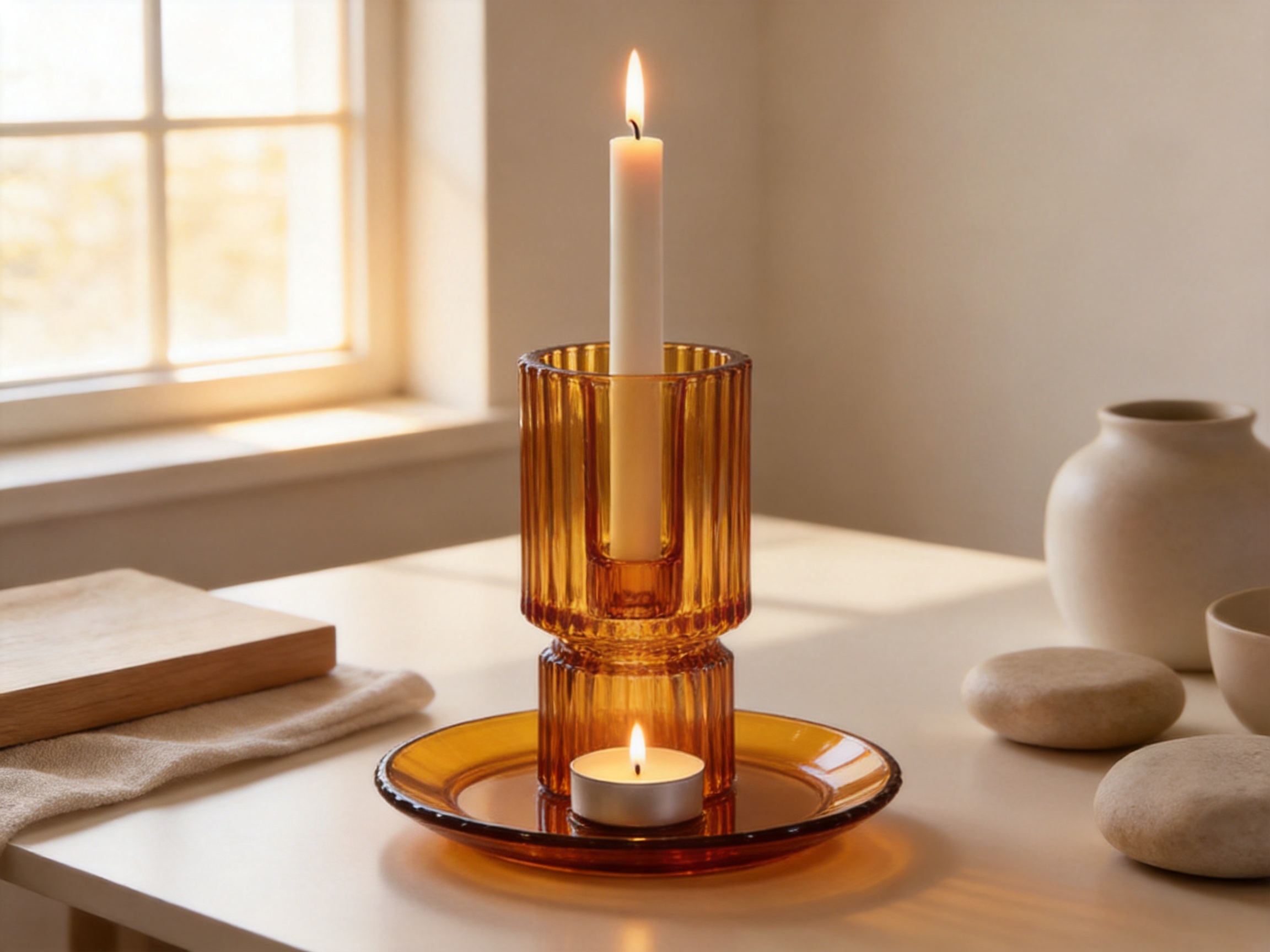
The Amber Ribbed Glass Dual-Use Taper and Tealight Candle Holder is designed for this evolving market. Its two-tier cylindrical structure creates two separate candle-use zones within one compact glass accessory. The narrow upper channel accepts a taper candle, while the wider lower disc accommodates a tealight. This dual-use construction gives the holder a practical advantage over single-purpose taper holders and tealight cups, allowing one product to support different candle formats and different merchandising concepts.
Its amber-toned glass, ribbed surface, and balanced proportions further strengthen its market appeal. The warm transparent color provides more visual character than plain clear glass while retaining a degree of light transmission. The ribbed texture produces subtle refraction as light moves through the body, adding depth to the candle display without making the item appear overly ornate. The result is an accessory that can suit Scandinavian interiors, warm-neutral rooms, contemporary dining tables, relaxed hospitality settings, and seasonal home fragrance displays.
For international buyers, the product also benefits from a flexible development approach. It can be offered in different heights, coordinated as a set, or adapted through color and configuration development for OEM programs. These possibilities allow customers to build a broader assortment rather than relying on a single fixed stock-keeping unit. Through structured sourcing, supplier coordination, product development, quality control, packaging support, and export management, Hangzhou Leo Home Trading Co., Ltd. can help overseas buyers introduce this type of accessory efficiently and consistently.
The core concept behind this candle holder is functional versatility. A conventional taper holder is shaped around one candle type. A conventional tealight cup is also designed for a single format. The dual-use holder combines both functions in a tiered form, creating a more adaptable product for consumers and a more commercially useful item for retailers.
The upper section is formed as a narrower channel intended to stabilize a taper candle. The lower section expands into a wider disc-like area that can hold a tealight. These zones remain visually connected through the cylindrical glass body, so the product reads as one coordinated object rather than two unrelated components. This allows users to select the candle format that best suits the occasion, the room, or the available inventory.
For an individual consumer, this means the holder can support different styling ideas throughout the year. A taper may create a more formal appearance for a dining table, celebration, or evening gathering. A tealight may provide a smaller, softer glow for a bedside surface, shelf, bathroom counter, or relaxed everyday setting. The same accessory can therefore adapt to changing preferences without requiring the purchase of two separate holder styles.
For retailers, the dual-use design can support multiple merchandising stories. It can be placed beside taper candles as a tabletop accessory, grouped with tealights as a compact ambient-lighting product, or included in a gift assortment with scented candles and other home fragrance items. This cross-category compatibility increases the number of ways the holder can be presented in a store, catalog, online shop, or seasonal display.
The product also occupies an attractive middle position between purely decorative glassware and highly utilitarian candle hardware. It provides a practical function, but its amber color and ribbed texture give it enough decorative value to be purchased as part of a home styling concept. This balance is particularly important in the current home fragrance market, where consumers often expect accessories to complement the appearance of their rooms even when they are not in use.
The most important competitive feature is the two-tier construction. The narrow upper channel and wider lower disc are designed around different candle formats, creating a product with broader use potential than a single-purpose holder. This design is especially valuable for buyers who want to reduce assortment complexity while still giving consumers meaningful choice.
A retailer can stock one coordinated accessory and merchandise it with more than one candle family. A taper-focused display can emphasize height, dining, and occasion styling. A tealight-focused display can emphasize compact ambient lighting, relaxation, and everyday use. The holder remains relevant in both contexts, which can help reduce the risk associated with products that depend on only one seasonal or decorative trend.
The dual-use function can also support bundle development. A package may contain the holder with tapers, tealights, or a combination of both. A retailer could offer separate candle refills while the holder remains in the consumer’s home. This creates opportunities for repeat sales and helps the accessory function as part of a broader product ecosystem rather than as an isolated purchase.
The holder is compact enough to arrange in groups of three or four, yet substantial enough to maintain visual presence when used alone. This balance is important for both home users and professional merchandisers. Small accessories that disappear in a display may not generate sufficient perceived value, while oversized accessories may be difficult to ship, store, or combine with other products.
Grouped arrangements can create visual rhythm through different heights, candle colors, or flame levels. A collection of holders may be placed along a dining table, on a mantel, within a retail window, or around a decorative tray. When used individually, the holder can serve as a small accent on a side table, console, shelf, or bathroom surface.
Different height options expand the styling potential further. A collection can use a low, medium, and taller configuration to create variation without losing overall coordination. Height differentiation also makes it possible for buyers to develop tiered retail sets, mixed-size gift boxes, or collections intended for different room types.
The glass body is described as thick enough to feel substantial without appearing visually heavy. This characteristic supports the product’s positioning as a quality accessory. Consumers often assess glass products through both appearance and tactile response. An item that looks too thin may seem fragile or inexpensive, while excessively heavy glass can appear cumbersome and may increase shipping and handling costs.
A balanced glass structure can help create a more reassuring user experience. The holder should feel stable on a flat surface, provide enough material presence to complement a candle, and retain a clean silhouette that works with modern interiors. This combination is particularly appropriate for buyers seeking a premium-looking accessory without the visual bulk associated with some ceramic or metal alternatives.
For international supply, structural balance is also relevant to packaging development. Product protection must account for the glass material, the tiered form, and the possibility of multiple units being packed together. A coordinated sourcing and packaging process can help buyers evaluate the relationship between product dimensions, protective materials, carton efficiency, and shipping requirements before mass production.
Clear glass is widely used in candle accessories because it is neutral, transparent, and easy to coordinate. However, its widespread use can also make it difficult for a new product to stand out. The amber tone of this holder gives it a warmer and more distinctive appearance while preserving some of the visual lightness associated with glass.
Amber glass can bridge the space between completely transparent glass and fully opaque materials. It offers color without creating the dense visual block associated with solid ceramic, painted metal, or dark stone. When a candle is placed inside or near the holder, the warm tone can contribute to a softer and more inviting atmosphere.
This makes the product suitable for interiors that use beige, cream, taupe, sand, warm gray, wood, natural fiber, and muted terracotta colors. It can also provide contrast in rooms dominated by white, black, or cool neutral tones. Because the color is recognizable but not excessively bright, it has potential for use in everyday collections as well as autumn and winter seasonal assortments.
The ribbed texture adds a second layer of visual interest. Instead of presenting a completely smooth surface, the vertical or structured ribbing creates repeated lines across the glass body. These lines interact with surrounding light, producing subtle optical refraction and giving the amber tone more depth.
When a candle is lit nearby, the surface can help break up and redirect highlights. The effect is decorative but restrained. It does not depend on complex ornamentation, printed graphics, or elaborate sculptural forms. This supports a contemporary product language in which texture, material, and proportion provide the main visual character.
Ribbing can also make the holder more identifiable in product photography. Smooth amber glass may blend into a large category of similar accessories, while a textured body creates a clearer silhouette and stronger surface detail. This can be useful for online retail listings, catalog pages, trade-show displays, and social-media merchandising, where a product must communicate its character quickly.
The holder’s design avoids dependence on a single decorative theme. Its amber color can support warm, rustic, vintage-inspired, or autumnal environments, while the cylindrical form and restrained ribbing can fit modern and Scandinavian interiors. This broad compatibility improves its suitability for international markets with different aesthetic preferences.
In a Scandinavian-inspired room, the holder can be paired with pale wood, linen, simple ceramics, and neutral textiles. In a contemporary setting, it can be combined with black metal, smoked glass, stone surfaces, or geometric accessories. In a warm-neutral interior, its amber color can reinforce an atmosphere of comfort and relaxation. In hospitality settings, it can add a small accent to guest rooms, dining tables, lounges, and reception areas.
This design flexibility also helps private-label customers create a collection around the product. Matching colors, candle fragrances, packaging materials, and supplementary accessories can be selected to emphasize minimalism, natural living, festive warmth, or modern luxury without changing the basic structure of the holder.

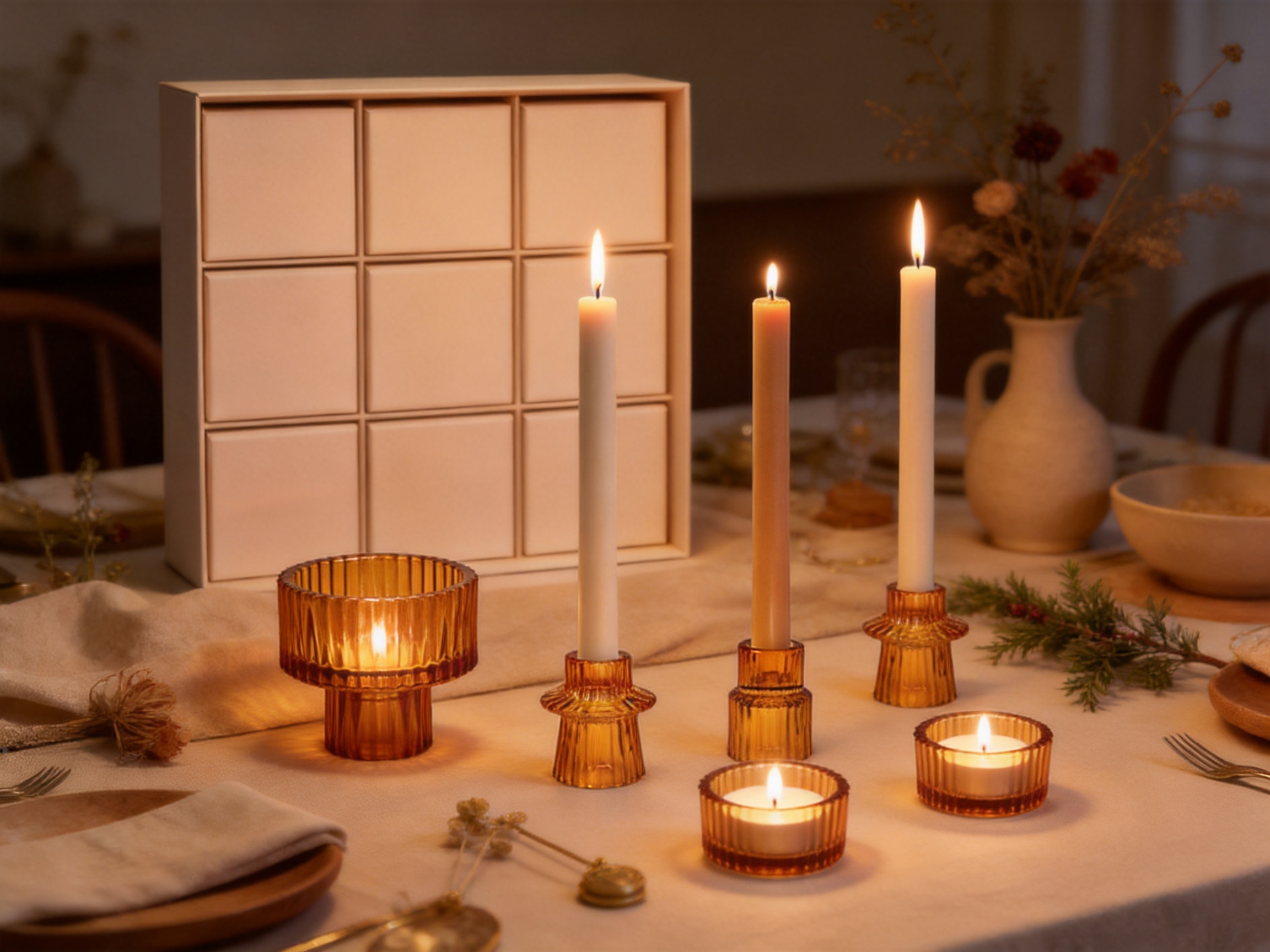
Amber Ribbed Glass Dual-Use Taper & Tealight Candle Holder
Single-purpose candle holders remain useful, but they can limit both consumer application and retail positioning. A taper holder may be unsuitable for tealights, while a tealight cup may not provide enough support or visual height for a taper. Buyers must often stock multiple accessory types to cover different candle formats.
The dual-use holder addresses this limitation through one coordinated design. Its two functional areas enable consumers to alternate between candle formats, and retailers can present the same item across multiple product categories. This does not eliminate the value of specialized holders, but it gives buyers an additional option for collections that prioritize adaptability and efficient assortment planning.
| Feature | Dual-Use Amber Ribbed Glass Holder | Single-Purpose Taper Holder | Single-Purpose Tealight Holder |
| Candle compatibility | Supports a taper or a tealight in designated areas | Designed primarily for tapers | Designed primarily for tealights |
| Merchandising flexibility | Can be displayed with two candle formats | Usually connected to one candle category | Usually connected to one candle category |
| Visual character | Amber tone, ribbed texture, tiered cylindrical form | Varies by material and shape | Often compact and low-profile |
| Display options | Works singly or in mixed-height clusters | Often arranged in linear or grouped settings | Often used in repeated groups |
| Collection potential | Suitable for coordinated colors, heights, and gift sets | Typically focused on taper accessories | Typically focused on tealight accessories |
| Retail value proposition | One accessory serving multiple use occasions | Clear but narrower application | Clear but narrower application |
The comparison demonstrates why the product can be commercially attractive. Its advantage is not simply that it performs two functions; it is that the two functions are integrated into an aesthetically coherent object. Consumers do not need to choose between visual appeal and usefulness, while retailers do not need to treat the item as a basic utilitarian component.
The holder can also help solve display challenges. A product that works with multiple candle formats can remain relevant when one category experiences a seasonal slowdown. Tapers may be emphasized during formal entertaining periods, while tealights may receive greater attention in relaxation or gift-focused campaigns. The holder can move between these narratives without changing its fundamental identity.
In everyday homes, the holder can be used to create a small, controlled point of light. Its compact dimensions make it suitable for sideboards, bookshelves, bedside tables, coffee tables, dining surfaces, and entryway consoles. Users can choose a taper for a taller visual accent or a tealight for a lower, more discreet glow.
Its compatibility with home fragrance products can also support layered sensory experiences. A scented candle may provide fragrance, while the holder contributes color, texture, and reflective warmth. If the user changes fragrances by season, the amber holder can continue to coordinate with the collection instead of appearing tied to one specific scent.
Because the holder is not dependent on printed branding or a highly specialized motif, it can remain in the home after a particular campaign ends. This increases its potential as a durable accessory rather than a short-term novelty item.
The two-tier form makes the holder suitable for table styling. Several units can be placed along a dining table, on a serving console, or around a centerpiece. Different heights can help create a layered arrangement, while the amber color can add warmth to neutral table linens and natural materials.
For formal settings, tapers can create a more traditional candlelit atmosphere. For casual meals or smaller tables, tealights may provide sufficient illumination without occupying too much vertical space. The ability to change candle formats enables the same accessory to serve both occasions.
Event planners, restaurants, boutique hotels, and catering businesses may also value the product because a coordinated collection can be reused across different table concepts. It can work with seasonal flowers, greenery, stoneware, wood, metal cutlery, and textile-based table settings.
The holder is suitable for inclusion in scented candle gift sets, home fragrance boxes, housewarming collections, and seasonal décor programs. Its amber color naturally supports autumn and winter presentations, but the simple form allows it to remain relevant during other periods as well.
A gift set may combine the holder with a scented tealight assortment, a taper pair, or candles in fragrances such as wood, amber, vanilla, spice, or botanical blends. Packaging can present the item as a reusable accessory rather than a disposable container. This can strengthen the perceived value of the set and encourage repeat purchase of compatible candle refills.
For private-label customers, the product can become an anchor item within a broader collection. Coordinated jars, scented candles, reed diffusers, gift boxes, labels, and accessories can share the same amber color story or ribbed texture. This creates a more complete shelf presentation and can help a brand communicate consistency across multiple home fragrance categories.
Hospitality buyers often require decorative products that are attractive, repeatable, and easy to integrate into different spaces. The holder may be used in boutique hotel rooms, restaurant tables, lounge areas, spa reception spaces, and event venues. Its compact form supports storage and arrangement, while the dual-use structure allows staff to adapt the display to different occasions.
In commercial applications, product consistency is especially important. Buyers may need multiple units with matching color, dimensions, and surface finish. A structured quality-control process can help reduce variation and ensure that replenishment orders remain aligned with approved samples.
The holder is well suited to OEM and ODM development because its basic design offers several areas for controlled variation. Buyers may request different heights, color tones, packaging formats, assortment combinations, or related accessory designs. These adaptations can be developed according to market positioning, sales channel, price point, and seasonal requirements.
Different heights can create a coordinated family of products. A shorter version may be positioned as a compact tealight accessory, while a taller version may emphasize taper use and tabletop presence. A mixed-height set can be marketed for group display, while a single-height unit may be appropriate for simpler packaging and lower entry pricing.
Configuration development may also include sets of two, three, or four pieces. A set can contain identical holders for a uniform appearance or mixed heights for a more dynamic arrangement. Buyers can select the configuration that best suits their sales channel, from individual online listings to boxed gift assortments.
Amber is the defining color direction for this version, but the design may support related color development for OEM programs. Buyers could explore lighter honey tones, deeper smoked amber, neutral brown, muted green, or other carefully selected glass colors, subject to technical feasibility and target-market requirements.
Surface development may also be considered. The ribbed texture is a strong identity feature, but related patterns or degrees of transparency could support different collections. The goal should be to preserve the product’s functional clarity and recognizable form while giving each customer a meaningful level of differentiation.
Packaging is an important part of the commercial offer, particularly for glass products. A suitable package must protect the holder during transport while presenting its color, texture, and dual-use function clearly to the buyer. Packaging development can include protective inserts, individual boxes, multi-piece cartons, printed sleeves, gift packaging, and private-label artwork.
Retail communication should explain the two candle-use zones in concise language. Product photography can show the holder with a taper, with a tealight, and in a grouped arrangement. A clear insert or package panel can explain intended use, care recommendations, and compatibility with appropriate candle sizes.
For online sales, high-quality images and accurate dimensions are especially important. Since the product’s value depends on both its visual details and its functional structure, buyers should be able to see the ribbed surface, amber transparency, upper channel, lower disc, and overall scale.
Although Hangzhou Leo Home Trading Co., Ltd. operates as an international trading and supply chain company, its strength lies in coordinating specialized production resources and quality processes for overseas buyers. This structure is valuable for customers who want access to product development and manufacturing support without managing multiple independent suppliers themselves.
The company’s product network includes ten candle factories, eight jar customization partners, and eight color box factories. This integrated partner structure can support the development of coordinated home fragrance collections and accessories. For a buyer, the benefit is the ability to discuss product specifications, candle compatibility, packaging requirements, and private-label presentation through one organized supply-chain partner.
For a glass candle holder, advanced manufacturing support begins with clear product specifications. These may include glass color, ribbed texture, dimensions, upper channel size, lower disc size, thickness, weight, surface finish, acceptable tolerance, packaging method, and inspection standard. Establishing these details before production helps reduce ambiguity between product development, factory execution, and final inspection.
Sample development allows buyers to evaluate the holder before committing to mass production. A sample can be reviewed for color, texture, proportions, stability, candle fit, visual balance, and packaging compatibility. It also gives the buyer an opportunity to compare the holder with existing taper and tealight products in the intended collection.
When changes are required, the development process can focus on specific areas rather than restarting the entire project. For example, a buyer may request a warmer amber tone, a slightly different height, a revised channel dimension, or an alternative box configuration. Recording these changes in an approved sample or specification sheet helps create a reliable production reference.
Supplier integration is particularly useful when the holder is sold with candles or other home fragrance products. Different factories may be responsible for glass accessories, candle filling, labels, cartons, and gift-set assembly. Without effective coordination, differences in timing, color, packaging dimensions, or product specifications can create delays.
A centralized trading and supply-chain partner can coordinate communication among these production resources. This can help align the holder with candle dimensions, confirm packaging space, manage component quantities, and organize shipment readiness. It also gives the buyer a single point of contact for progress updates and commercial documentation.
Glass products require careful inspection because appearance and structure are both important. Relevant inspection points may include cracks, chips, sharp edges, uneven surfaces, color consistency, ribbing clarity, dimensional accuracy, base stability, and packaging protection. The upper channel and lower disc should be checked to confirm that they correspond to the approved design.
Hangzhou Leo Home reports a quality system supported by an in-house laboratory and strict control across key stages, from material selection to finished-goods inspection. For this product category, quality assurance should be connected to both the glass accessory and any accompanying candles or packaging components.
Inspection standards can be established according to the buyer’s market and sales channel. A premium retail program may require more stringent visual consistency, while a promotional assortment may emphasize cost efficiency within agreed quality limits. In either case, clear acceptance criteria make production outcomes easier to evaluate.
The company reports daily capacity of up to 50,000 units across its supply network, while also supporting smaller volumes and trial runs. This combination can be useful for customers at different stages of development. A new buyer may begin with a test order to evaluate consumer response, while an established retailer may require larger replenishment quantities during seasonal peaks.
Capacity is not only a question of maximum output. Consistent scheduling, raw-material preparation, packaging coordination, inspection timing, and export readiness are equally important. A structured supply chain can help align these stages so that large orders are delivered more predictably and smaller trial runs remain commercially accessible.
As with all candle accessories, the holder should be used on a stable, heat-resistant surface and kept away from flammable materials. Candles should be placed securely in the intended area, and users should follow standard candle-safety practices. Retail packaging should communicate appropriate use and care information in language suitable for the target market.
The holder’s dual-use function does not mean that every candle size is suitable for every area. Tapers should fit securely within the upper channel, while tealights should sit evenly in the lower disc. Exact candle compatibility should be confirmed during product development and sample approval. This is one reason why dimensional specifications and practical testing are important before mass production.
Visual inspection should confirm that the glass body is free from unacceptable cracks, chips, sharp edges, or structural defects. The base should rest evenly on a flat surface. The ribbed surface should remain sufficiently clear and consistent to meet the product’s intended appearance. For amber glass, color variation should also be assessed against the approved sample.
Packaging must protect the holder from impact and abrasion during domestic handling, export transportation, warehouse storage, and retail distribution. Individual separation, suitable cushioning, and appropriate carton strength can reduce the likelihood of damage. Buyers should consider whether the item will be sold individually, in a set, or as part of a larger gift box because each format may require a different protection strategy.
The holder allows buyers to expand a home fragrance assortment beyond candles themselves. It can be offered as a complementary accessory, a gift-set component, or a standalone décor item. Because it supports both tapers and tealights, it can connect several product categories through one design language.
This is useful for distributors and retailers that want to build complete collections. A coordinated line may include scented jar candles, taper candles, tealights, reed diffusers, candle accessories, gift packaging, and seasonal décor. The amber ribbed holder can provide a visual bridge among these products.
Cross-selling is easier when an accessory has clear compatibility with products already offered by the buyer. The holder can be sold beside tapers, tealights, candle gift sets, dining accessories, and home décor products. It can also be recommended as an add-on during online checkout or included in themed promotional campaigns.
Its reusable nature strengthens this opportunity. Once a customer owns the holder, future purchases may focus on compatible taper or tealight refills. This creates a longer customer relationship than a single-use decorative product would typically provide.
Because the holder can be developed in different heights and potentially coordinated colors, buyers can build a collection with limited structural complexity. A single basic form may generate several stock-keeping units through controlled variations. This can make it easier to maintain collection consistency while offering consumers visible choice.
A collection approach also supports tiered pricing. A single holder may function as an accessible entry product, while a mixed-height gift set or customized package may occupy a higher price position. The same design foundation can therefore serve multiple commercial levels.
Private-label customers can use packaging, color selection, candle pairing, and product photography to make the holder part of their own brand presentation. A private label does not need to rely only on a logo. Consistent material choices, warm color palettes, coordinated fragrances, and repeated ribbed textures can all contribute to brand recognition.
The supplier’s support across product development, packaging, sourcing, and export documentation can simplify the process for buyers that do not maintain their own manufacturing departments. This is particularly relevant for small and medium-sized brands seeking to introduce distinctive products without building a large in-house procurement team.
Product design is only one part of a successful home fragrance program. The final commercial result also depends on sourcing accuracy, communication, quality consistency, packaging execution, logistics, and after-sales support. An experienced supply chain partner can help connect these activities into one development and delivery process.
Hangzhou Leo Home Trading Co., Ltd. is based in Hangzhou, China, and focuses on international trading and supply chain solutions for household and daily-use products. Founded in January 2025, the company combines product development, international sourcing, and cross-border marketing capabilities. Its home fragrance scope includes scented candles, LED candles, related gift sets, and associated accessories.
The company reports experience serving more than ten countries and regions across North America, Europe, and the Middle East. This international orientation can help buyers address market-specific requirements relating to packaging, labeling, product presentation, documentation, and delivery planning.
Its stated customization capability includes development based on drawings or samples, as well as support for specifications, scents, labels, and packaging. For the amber ribbed candle holder, this can translate into a structured process covering initial concept review, sample refinement, accessory coordination, packaging design, quality inspection, and shipment organization.
The company also emphasizes execution, warmth, and refinement as core values. Execution relates to treating instructions and delivery commitments seriously. Warmth reflects a collaborative approach to customer and team relationships. Refinement emphasizes attention to details across formulation, craftsmanship, product presentation, and export documentation. These values are relevant to a product in which small differences in glass color, ribbing, proportions, and packaging can influence the buyer’s perception of quality.
A simple merchandising strategy is to present the holder with both supported candle formats. One display can show a taper in the upper channel, while another shows a tealight in the lower disc. A small information panel can explain that the accessory is designed for both uses, helping consumers understand its advantage immediately.
The amber color works well in a collection built around cream, beige, sand, natural wood, soft brown, and warm gray. The display can include textured textiles, ceramic vessels, dried botanicals, and home fragrance products in complementary tones. This approach emphasizes the holder’s ability to create a calm, layered interior atmosphere.
For autumn, winter, and festive periods, the holder can be paired with taper candles in warm white, rust, deep red, or muted green. Tealights can be offered as a lower-profile option for smaller gatherings or decorative trays. The amber glass can reinforce seasonal warmth without requiring a highly themed shape that becomes difficult to sell after the holiday period.
A group of three or four holders in different heights can create a minimalist focal point. The arrangement can remain visually simple if the surrounding products use a restrained palette and clean forms. This strategy highlights the ribbed texture and cylindrical silhouette while demonstrating the product’s ability to maintain individual presence in a cluster.
For gift sales, the holder can be combined with a small assortment of tealights, a taper pair, or a scented candle. The package should explain that the accessory can be reused with different candles, which increases perceived value. A well-designed box, protective insert, and concise care instructions can make the product suitable for housewarming, birthday, holiday, and seasonal gifting.
Buyers considering this product should begin by identifying the intended sales channel and target consumer. A premium home décor retailer may prioritize glass clarity, color consistency, gift packaging, and mixed-height sets. A mass-market distributor may prioritize cost efficiency, compact packaging, and simplified assortment. A hospitality buyer may focus on repeatability, stability, replenishment, and consistent appearance across large quantities.
The next step is to confirm the approved product dimensions and candle compatibility. The buyer should review the upper channel, lower disc, overall height, base diameter, glass thickness, and weight. Practical tests should be conducted with the intended taper and tealight formats to confirm fit and visual balance.
Color approval should be based on a physical sample or an agreed reference rather than screen images alone. Amber glass can appear different under daylight, warm indoor lighting, and photography conditions. An approved sample provides a more reliable production standard.
Packaging requirements should be discussed early. Buyers should determine whether the product will be packed individually, in pairs, in mixed-height sets, or inside a larger gift box. This decision affects carton dimensions, protective inserts, labeling, shipping efficiency, and final retail presentation.
For OEM programs, buyers should prepare a clear specification sheet covering color, texture, dimensions, tolerance, quantity, packaging artwork, inspection requirements, and delivery schedule. The supplier can then coordinate relevant production partners and use the approved sample as the reference for mass production.
Trial orders can be useful for evaluating customer response before a larger launch. A trial may test online conversion, retail display performance, packaging durability, product returns, and consumer understanding of the dual-use function. Feedback from the trial can guide later decisions about height, color, set configuration, and promotional messaging.
The holder combines two candle-use areas in one design. The narrow upper channel is intended for a taper, while the wider lower disc accommodates a tealight. This gives it broader practical and merchandising potential than a holder designed for only one candle format.
The product is designed to support both formats, but the intended use should follow the approved product instructions and safety guidance. Buyers should confirm whether simultaneous use is appropriate for the specific configuration and should always maintain safe clearance from flammable materials.
Amber glass provides a warm alternative to clear glass while remaining visually lighter than opaque ceramic or metal. It complements warm-neutral interiors, adds color to a display, and can create attractive light interaction when paired with a candle flame.
The ribbed texture creates surface detail and subtle optical refraction. It gives the glass greater visual depth, improves product recognition in displays and photography, and supports contemporary decorative styling without requiring elaborate ornamentation.
Yes. Its compact form allows several units to be grouped together, and different heights can be combined to create a layered arrangement. It can also be used individually on a shelf, table, console, or other stable surface.
Different height options are available for development, subject to project requirements and production feasibility. Height variation can support mixed-size collections, different candle uses, and different retail price points.
Color variations and height configurations can be developed for OEM programs. The final color range should be confirmed through physical sampling, technical review, and an approved production reference.
Yes. It can be combined with tapers, tealights, scented candles, or other home fragrance products. Gift-set packaging can be customized to communicate the dual-use function and protect the glass during transport.
Important checks include glass color, ribbed texture, surface condition, dimensional accuracy, channel fit, base stability, edge condition, structural integrity, packaging protection, and consistency against the approved sample.
The company supports smaller volumes and trial runs in addition to larger bulk deliveries. Specific minimum order quantities, development charges, lead times, and packaging requirements should be confirmed for each project.
Potential buyers include candle retailers, home décor distributors, gift companies, hospitality businesses, private-label brands, event suppliers, and home fragrance importers. The product’s compatibility with both tapers and tealights gives it relevance across several sales channels.
It can be positioned as a versatile candle accessory, a tabletop styling item, a gift-set component, or a reusable home fragrance companion. Its strongest message is the combination of warm amber ribbed glass and two-format candle compatibility.
The Amber Ribbed Glass Dual-Use Taper and Tealight Candle Holder brings together functional flexibility, warm material character, and broad merchandising potential. Its narrow upper channel and wider lower disc allow it to serve both taper and tealight applications, giving consumers more choice and retailers more ways to present the product.
The amber-toned ribbed glass differentiates it from plain clear holders while avoiding the heaviness of fully opaque materials. Its texture creates subtle refraction, its cylindrical form supports modern styling, and its compact proportions allow use in both individual and grouped arrangements. Different heights and potential color configurations further increase its suitability for coordinated collections and OEM programs.
Its commercial value is strengthened by the supply-chain capabilities of Hangzhou Leo Home Trading Co., Ltd. The company provides access to product development, international sourcing, supplier coordination, packaging support, quality control, and export services. With a network that includes candle factories, jar customization partners, and color box factories, it can help buyers develop not only the holder itself but also compatible home fragrance collections and gift presentations.
For brands and distributors seeking a candle accessory that combines decorative appeal with practical adaptability, this product offers a strong foundation. It can support everyday home fragrance, dining displays, seasonal merchandising, hospitality use, gift programs, and private-label collections. By combining a distinctive amber ribbed finish with a dual-use structure and coordinated supply-chain support, it provides a commercially flexible solution for the modern candle and home fragrance market.
1. Internal product specification and product description for the Amber Ribbed Glass Dual-Use Taper and Tealight Candle Holder.
2. Hangzhou Leo Home Trading Co., Ltd. company profile and stated supply-chain capabilities.
3. General principles of candle accessory product development, packaging protection, and quality inspection.
4. General home fragrance merchandising practices for candles, candle holders, gift sets, and tabletop accessories.
5. General interior styling principles concerning glass, ribbed textures, warm-neutral palettes, and grouped decorative displays.

Room 1701, Building C1, Wangjing, Xiaoshan District, Hangzhou City, Zhejiang Province, China.

+86-15937257616

Copyright© 2026 Hangzhou Leo Home Trading Co., Ltd. All Rights Reserved.

Luxury Candles Home Fragrance Manufacturers Modern Candles Factory