
 English
 Français
News
Home / Author / Sophia Lin — Product Sales Executive / Why Character Tealight Sets Are Transforming Seasonal Candle Gifting
Content
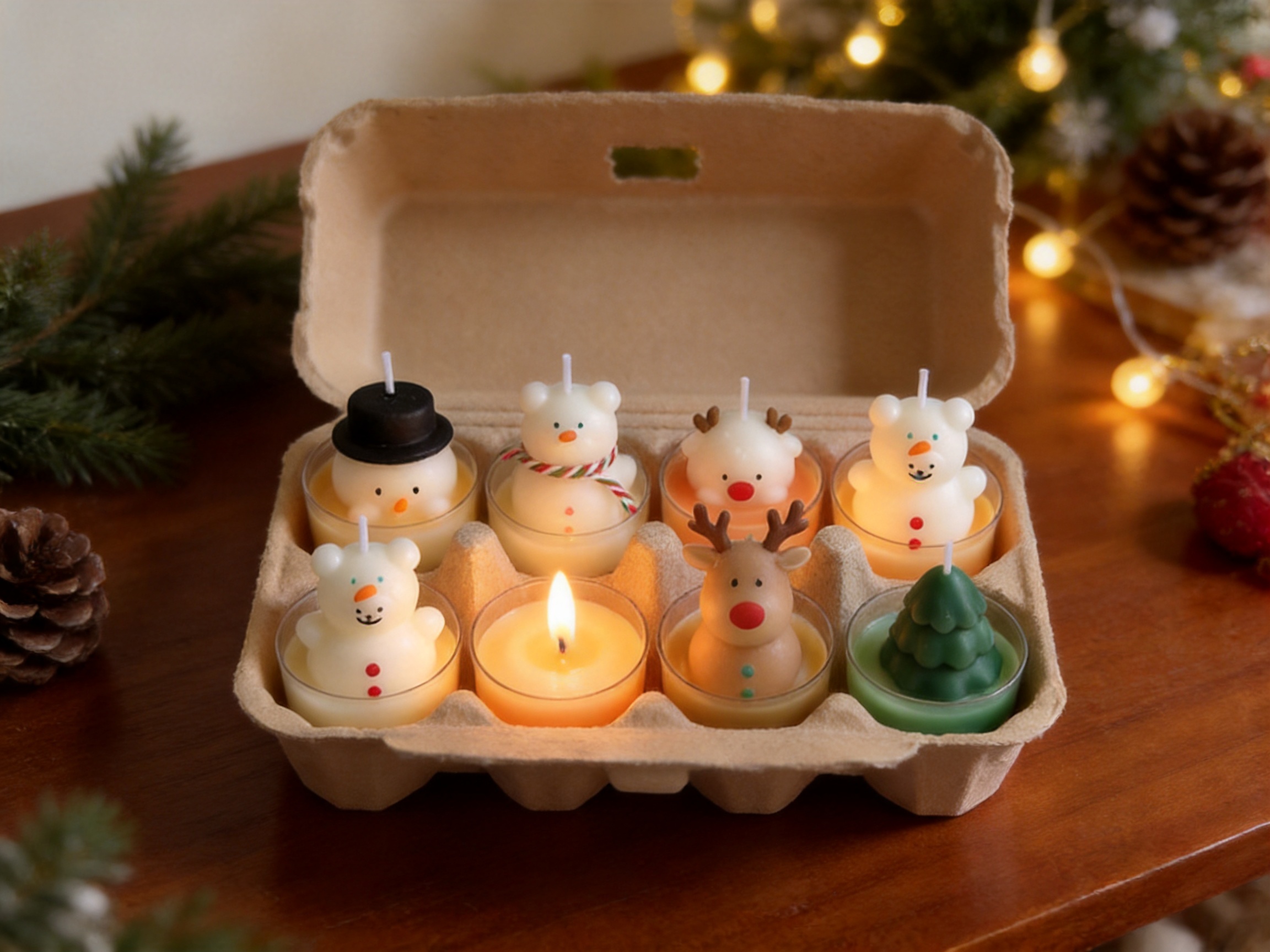
Seasonal candles have evolved from simple lighting products into decorative, emotional, and highly giftable lifestyle items. Consumers increasingly look for products that combine atmosphere, visual appeal, convenience, and a memorable story. The Christmas Character Tealight Festival Series Handmade Candle responds to these expectations with a compact nine-piece collection featuring snowmen, a reindeer, and a Christmas tree. Each figure is presented in a transparent tealight cup containing colored wax, creating a product that functions as both a festive display and a practical candle assortment.
Unlike a conventional pack of identical tealights, this collection uses variety as its central design feature. The characters are individually shaped and hand-finished, allowing the set to communicate the warmth and playfulness of the Christmas season before a flame is even lit. When illuminated, the transparent cups reveal a warm glow through the colored wax and help the figures become small decorative focal points on dining tables, mantelpieces, shelves, gift trays, reception desks, and retail displays.
The product is developed by Hangzhou Leo Home Trading Co., Ltd., a Hangzhou-based international trading and supply chain company focused on household products, home fragrance, daily necessities, and customized lifestyle goods. Through its network of candle factories, jar customization partners, color box factories, product development resources, and quality-control systems, the company supports buyers seeking seasonal products that are attractive, adaptable, and suitable for international distribution.
The Christmas Character Tealight Festival Series Handmade Candle is a nine-piece Christmas tealight set. Its assortment includes snowmen in different poses, a cheerful reindeer, and a Christmas tree. Every character is placed inside a transparent tealight cup filled with colored wax. The compact format makes the set easy to display, package, transport, and retail.
The character assortment is an important part of the product’s commercial appeal. A collection with multiple designs encourages customers to examine the entire box rather than viewing the product as a basic commodity. The snowmen create a sense of winter charm, the reindeer introduces a recognizable Christmas animal motif, and the tree provides a central seasonal symbol. Together, they form a balanced visual story.
Each figure is hand-finished with painted facial features and accessory details. Depending on the character, these details may include hats, carrot noses, antlers, ribbons, and other festive elements. These small features give the figures expressive personalities and make the product feel more like a miniature holiday scene than a standard candle pack.
The wax palette includes cream, orange, and green. These colors support the identity of the figures while adding visual contrast inside the transparent cups. Cream contributes a soft snow-like appearance, orange supports details such as carrot noses and warm seasonal accents, and green naturally complements the Christmas tree. The color coordination creates a unified assortment while preserving individuality among the pieces.
The set is presented in an egg-carton style kraft box. This packaging format is practical and visually appropriate for a collection of small character candles. It helps keep the pieces organized, gives the product a gift-ready presentation, and reduces the need for additional wrapping. The kraft appearance also supports a natural, handmade, and craft-oriented positioning.
Logo, character selection, and wax color can be customized. This flexibility allows importers, retailers, distributors, hospitality businesses, and corporate gift buyers to adapt the product to their own seasonal programs. Buyers may develop a private-label version, adjust the character mix, select colors that correspond to a retail theme, or coordinate the packaging with an existing brand identity.

Christmas Character Tealight Festival Series Handmade Candle
The candle market contains many basic tealights, jar candles, pillar candles, and decorative wax products. While these formats remain popular, they often compete primarily on fragrance, burn performance, size, packaging, or price. Character tealights add another important dimension: immediate visual recognition.
A conventional tealight may be used to create a warm glow, but its appearance is usually secondary to its function. A character tealight is designed to be noticed before use. Its sculpted shape, facial expression, seasonal accessories, and colored wax make it relevant as a decorative object even when unlit. This dual purpose improves its suitability for gift sets, seasonal displays, event styling, and impulse purchases.
The nine-piece variety also helps the set overcome the uniformity that can make standard candle packs feel ordinary. Customers can enjoy different characters in one purchase, while retailers can present the product as a complete Christmas scene. Variety may also increase perceived value because the customer receives a curated collection rather than a repetitive group of identical units.
Another advantage is compactness. Large decorative candles can require substantial shelf space, protective packaging, and higher shipping costs. This set maintains a small overall footprint while delivering multiple decorative elements. Retailers can place it on seasonal shelves, gift tables, checkout displays, Christmas market stalls, or online product pages without needing extensive display infrastructure.
The transparent tealight cup further differentiates the product. Instead of completely concealing the wax, the cup allows the color and flame to remain visible. When lit, the container helps create an illuminated effect around each character. This gives the product an additional layer of visual interest that is not available from opaque packaging or fully enclosed decorative forms.
The product is also suitable for several purchasing occasions. It can be sold as a family holiday decoration, a small hostess gift, a corporate seasonal gift, a Christmas market item, a stocking filler, or part of a larger home-fragrance assortment. Its broad usage potential reduces dependence on a single sales channel.
Hand-finished details are central to the personality of the collection. Small painted features can change the appearance of a figure significantly. A snowman’s face, a reindeer’s antlers, or a tree’s ribbon can transform a simple wax shape into a recognizable seasonal character. These details create emotional appeal and encourage customers to inspect the product closely.
Hand finishing also supports the perception of craftsmanship. In a market where many products are highly standardized, visible manual work can communicate care, individuality, and attention to detail. This is especially valuable for Christmas products because holiday shopping is strongly connected with emotion, tradition, generosity, and personal expression.
The handmade appearance does not mean that production must be inconsistent. With suitable molds, work instructions, color controls, inspection procedures, and skilled finishing teams, a supplier can combine the visual warmth of handcraft with the repeatability required for commercial orders. The objective is to preserve character while maintaining dependable quality across each batch.
For buyers, the painted features provide opportunities for customization. Facial expressions, accessory colors, ribbon shades, and small decorative elements may be adjusted for a particular market or campaign. A retailer seeking a traditional Christmas look may select classic red, green, and cream accents. A modern lifestyle brand may prefer neutral tones, muted colors, or a more minimalist character style.
The tactile and visual qualities of the finished characters also improve merchandising. Retail staff can arrange the pieces in a tray, a seasonal basket, or a tabletop scene. Online sellers can show the full assortment in a single image while also using close-up images to highlight the painted details. These presentation options help communicate value more effectively than a product photograph of identical plain tealights.
Color is one of the fastest ways for a customer to recognize a seasonal product. The cream, orange, and green wax palette used in this set creates an immediate connection with winter characters and traditional Christmas imagery. The colors are not merely decorative; they help organize the visual language of the assortment.
Cream wax can suggest snow, warmth, and softness. It works naturally with snowmen and provides a light base for painted facial features. Orange creates a lively accent and is particularly suitable for carrot-inspired details or warm festive elements. Green connects with evergreen branches and Christmas trees, reinforcing the outdoor and traditional aspects of the holiday season.
Because the wax is visible through the transparent cups, the colors remain part of the display even when the candles are not burning. This makes the set useful for daytime decoration, retail presentation, and gift styling. Once lit, the flame adds warmth to the colors and creates a changing appearance as the surrounding light becomes more subdued.
Color customization expands the product’s usefulness beyond a single standard assortment. Buyers can request colors matched to a retail campaign, a corporate identity, a regional preference, or a specific packaging concept. Seasonal color programs might include icy blue and white for a winter theme, red and gold for a traditional holiday collection, or pastel colors for a contemporary gift range.
Color consistency is particularly important for wholesale buyers. When multiple units are displayed together, uneven shades can reduce the professional appearance of the collection. A controlled process for pigment selection, wax preparation, batch comparison, and finished-product inspection helps maintain a stable visual standard. This is one area where a supplier’s technical organization directly influences the commercial result.
The quality of a character tealight begins before wax is poured. It starts with product planning, character development, mold preparation, material selection, color confirmation, and packaging design. Hangzhou Leo Home Trading Co., Ltd. supports this process through product development resources and an integrated supply chain that connects candle production with packaging and customization partners.
The first stage is to define the product concept. For a Christmas character collection, the design team considers the number of pieces, character balance, seasonal recognition, size, stability, decoration requirements, packaging arrangement, and target price. The nine-piece format provides enough variety to create a complete assortment while remaining compact and easy to manage.
Character selection should create contrast without making the set appear disconnected. Snowmen may vary in pose or accessory details, while a reindeer and Christmas tree add different silhouettes. The collection must be visually diverse enough to be interesting but cohesive enough to look like one product line.
At this stage, the company can also work with buyers using drawings, reference samples, or design instructions. The customization process may include changes to character proportions, facial expressions, accessory colors, logo application, box layout, or the selection of characters included in the final assortment.
Character candles require molds that can reproduce small facial features, accessories, contours, and stable bases. Mold design must consider how easily the wax can be released, how consistently the details will appear, and whether the finished figure can be safely placed in the transparent tealight cup.
Accurate molds help reduce variation between pieces. They also make it possible to maintain the same character identity over repeat orders. A well-prepared mold preserves the intended silhouette and supports efficient production while leaving room for hand finishing after demolding.
For seasonal collections, mold planning is particularly valuable because the product may need to be produced in large quantities within a limited selling period. A stable mold system enables repeatable output and helps suppliers respond to replenishment requests during the Christmas selling season.
Wax preparation involves selecting suitable raw materials, measuring components, managing temperature, and preparing the requested colors. The exact formula may be adjusted according to the desired appearance, handling properties, container format, and target market requirements.
Color management requires more than selecting a pigment from a chart. The appearance of the final wax can be influenced by the base material, pigment concentration, temperature, cooling conditions, surface finish, and the transparency of the cup. A controlled sample approval process helps buyers confirm the visual result before bulk production begins.
Batch controls are important for maintaining consistency across a large order. Production teams can compare samples against approved references and inspect the cream, orange, and green shades for unwanted variation. This supports a uniform retail display and reduces the risk of mixed visual quality between cartons.
Once the wax is prepared, it is poured into the character molds or the intended tealight format under controlled conditions. Pouring needs to be managed carefully to reduce surface defects, air pockets, incomplete details, and uneven filling. Cooling conditions also affect the final appearance and stability of the pieces.
After cooling, the candles are removed from the molds. Each piece is checked for shape integrity, surface condition, base stability, and visible defects. Any pieces that do not meet the approved standard can be separated before proceeding to hand finishing.
The transparent cup format requires careful alignment and handling. The character, wax, and cup should form a stable visual unit. Correct placement helps prevent the piece from appearing tilted or poorly centered in the packaging, especially when the set is viewed through the open egg-carton style box.
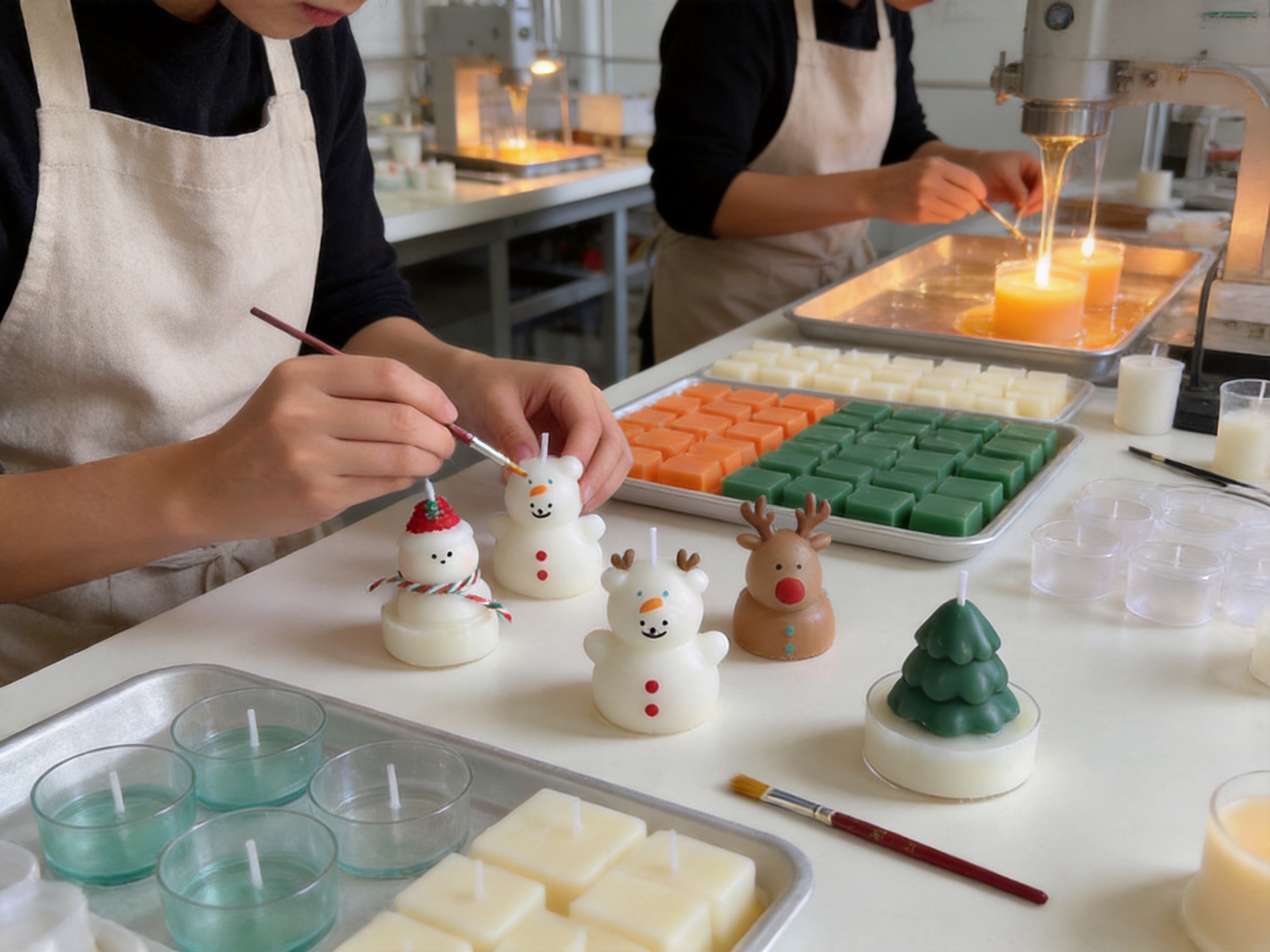
Hand painting gives the characters their final personality. Workers apply facial features, accessory colors, ribbons, antlers, carrot noses, hats, and other details according to approved samples or work instructions. This stage combines manual skill with quality control.
Consistent brushwork is important because small details are highly visible on a character product. Lines should be clean, color placement should match the design, and decorative elements should remain proportional to the figure. A controlled finishing procedure helps retain the handmade appearance without allowing avoidable inconsistencies.
Finishing inspection may include checking for smudges, incomplete paint coverage, misplaced features, irregular accessories, surface damage, and color transfer. The purpose is not to remove every minor sign of handcraft, but to ensure that each piece meets the intended commercial standard.
After finishing, the candles are arranged in the egg-carton style kraft box. The packaging must protect the small figures, maintain the intended assortment, and present the product clearly. Each compartment should hold the appropriate character securely while allowing the buyer to understand the variety of the collection.
The kraft box supports an efficient gift-ready format. It reduces the need for separate wrapping and can be adapted with labels, printed sleeves, stickers, inserts, or private-label branding. Packaging customization allows the same basic candle concept to serve different retail identities and price positions.
Before shipment, the finished sets can be reviewed for quantity, character selection, paint quality, packaging condition, labeling, carton arrangement, and order compliance. Export preparation also requires attention to documentation, shipping marks, carton dimensions, and handling requirements.
Hangzhou Leo Home coordinates supply chain resources and international order support so that buyers can manage product development and delivery through one commercial partner. This is particularly useful for customers purchasing multiple home and lifestyle products who want a consolidated sourcing process.
A seasonal product must arrive in the market on time and in consistent condition. Christmas products have a defined sales window, so delays, quality disputes, or packaging issues can have a greater impact than they would for an evergreen product. A reliable supplier therefore needs to combine product quality with production planning and logistics coordination.
Hangzhou Leo Home reports an integrated network including 10 candle factories, 8 jar customization partners, and 8 color box factories. This structure gives the company access to multiple production resources and supports flexibility across product categories. It also helps the company coordinate candles, containers, and packaging instead of treating each component as an unrelated purchase.
The company’s quality-control approach includes oversight from raw material selection through finished-goods inspection. An in-house laboratory and inspection procedures support the review of materials, color, appearance, packaging, and product consistency. For buyers, this reduces the need to coordinate quality checks with several independent suppliers.
Manufacturing capacity is another commercial advantage. The company reports daily capacity of up to 50,000 units, while also supporting smaller trial runs and flexible order requirements. This combination is useful for different customer types: a large retailer may require substantial seasonal volume, while a developing brand may begin with a market test before committing to a larger order.
Supply chain strength also contributes to pricing competitiveness. A coordinated supplier network can help manage component sourcing, production schedules, packaging arrangements, and shipping preparation. Efficient coordination does not replace quality; rather, it allows quality standards and cost control to be considered together.
| Product and Supply Advantage | Commercial Benefit | Relevance to Buyers |
|---|---|---|
| Nine-piece character assortment | Higher visual variety and stronger gift appeal | Suitable for seasonal retail, gifting, and decorative displays |
| Hand-finished painted details | More expressive and distinctive appearance | Supports craft-oriented and premium seasonal positioning |
| Transparent tealight cups | Visible wax color and warm illuminated effect | Improves display impact before and during use |
| Custom character selection | Better alignment with local market and campaign needs | Useful for private-label and themed collections |
| Custom wax colors | Greater design flexibility | Allows coordination with packaging or brand identity |
| Egg-carton style kraft packaging | Gift-ready presentation and organized storage | Reduces additional packaging requirements |
| Integrated candle and packaging network | More efficient project coordination | Helps simplify sourcing and production management |
| Flexible volume support | Suitable for testing, seasonal replenishment, and bulk programs | Supports both emerging brands and established buyers |
The first advantage is product storytelling. Standard candles often communicate their value through fragrance, vessel design, or decorative color. This character set communicates through a visual holiday narrative. Snowmen, a reindeer, and a Christmas tree can be understood immediately by shoppers across different language markets.
The second advantage is assortment depth. Nine different pieces offer a stronger unboxing and display experience than a uniform pack. The customer can distribute the candles throughout a home, use them in different rooms, or arrange them together as a complete scene. This gives the product more practical and decorative possibilities.
The third advantage is shelf visibility. Character forms and colored wax are easier to recognize from a distance than plain white or metallic tealight cups. On a busy seasonal display, visual distinction can help attract attention and encourage customers to pick up the box.
The fourth advantage is gift readiness. The kraft box provides a natural presentation that does not require a separate decorative container. This can reduce the time and cost associated with gift preparation while also presenting the assortment as a considered collection.
The fifth advantage is private-label flexibility. Because logo, character selection, and wax color are customizable, buyers do not have to sell the product as a fixed, generic item. They can position it under a house brand, a seasonal collection, a promotional theme, or a corporate gifting program.
The sixth advantage is suitability for multiple channels. The product can appear in physical stores, online marketplaces, Christmas fairs, hotel gift shops, garden centers, museum shops, corporate gift catalogs, and home-decoration boutiques. Its compact size and clear visual theme support both in-person and online merchandising.
The seventh advantage is emotional accessibility. Christmas character products can appeal to families, children under appropriate adult supervision, collectors of seasonal decorations, and adults seeking nostalgic holiday styling. This broad emotional range can support a wider customer base than a highly specialized decorative candle.
Retailers can use the set as a compact seasonal feature. It may be displayed on a shelf alongside Christmas ornaments, gift wrap, home fragrance, or table decorations. The box can remain closed for organized presentation or be supported by a sample display that shows the character details.
Because the characters are colorful and recognizable, the product can work well in impulse-oriented areas. Seasonal endcaps, checkout zones, gift tables, and small decorative baskets are all potential locations. Its compact dimensions make it easier to combine with other products without overwhelming the display.
The handmade visual style is suitable for Christmas markets and craft fairs, where shoppers often value products with a personal and festive appearance. The set can be presented as a complete gift, a table decoration, or a small collection of holiday candles.
The transparent cups and painted features also provide an easy conversation point for sellers. Staff can explain that the set contains multiple character designs, that the figures are hand-finished, and that the box is ready for gifting. These details can help transform a small candle set into a more engaging purchase experience.
Businesses often seek gifts that are useful, attractive, and easy to distribute. The nine-piece format is suitable for employee gifts, customer appreciation programs, event giveaways, and seasonal hospitality packages. Logo customization can support corporate identity, while custom wax colors can be coordinated with company campaigns.
Corporate buyers may also request customized packaging, message cards, or selected character combinations. A supplier with product development and packaging coordination capabilities can help manage these requirements as one project rather than requiring the buyer to work with separate candle and printing vendors.
Hotels, restaurants, event venues, and catering companies can use character tealights for seasonal table settings and reception areas. The figures can add warmth to Christmas dinners, private parties, winter promotions, and holiday-themed retail environments.
The compact size allows event planners to place individual pieces at different tables or combine several units into a central display. The variety of characters can create a less repetitive visual arrangement than identical tealights.
Online sellers can communicate the product’s value through a series of images: a full-set image, a close-up of painted details, a packaging image, and a lit-use image. The product’s strong visual identity is suitable for social-media promotion, seasonal email campaigns, online gift guides, and marketplace listings.
For online merchandising, it is important to state clearly that the set contains nine pieces, identify the character types, explain the transparent cup format, and show the kraft box. Clear communication reduces uncertainty and helps customers understand the difference between a character assortment and a standard tealight pack.
Customization is one of the strongest commercial features of the product. Buyers can begin with the existing nine-piece concept or develop a version that better suits a specific market. The most direct options include logo placement, character selection, and wax color.
A private label can be applied through packaging, stickers, printed sleeves, inserts, or other approved methods. The appropriate option depends on the buyer’s branding requirements, order quantity, packaging structure, and target price.
Branding should remain visually balanced with the Christmas character theme. A simple logo placement on the kraft box may preserve the handmade appearance, while a more detailed printed sleeve can support a premium gift collection. Buyers can also include seasonal messages, care information, product names, or multilingual labeling.
The standard set combines snowmen, a reindeer, and a Christmas tree. Buyers may request a different ratio or a more focused collection. For example, a winter range could emphasize snowmen, while a woodland theme could include more animal characters. A traditional Christmas program may prioritize trees, gift motifs, and classic holiday figures.
Character customization should be evaluated together with mold requirements, production scheduling, packaging layout, and order volume. The supplier’s product development team can help determine which changes are practical and how they may affect the final product.
Color can be adjusted for brand consistency, regional preferences, seasonal trends, or retail positioning. Buyers should approve physical color samples because digital screens may not represent the final wax appearance accurately.
Color changes may also affect the appearance of painted details and packaging. A coordinated approval process helps ensure that wax, character decorations, labels, and the kraft box create a unified presentation.
The egg-carton style kraft box can serve as a starting point for additional packaging development. Buyers may explore printed panels, custom labels, internal inserts, barcode placement, seasonal messages, or protective shipping cartons. Packaging decisions should reflect the sales channel and the required level of gift presentation.
Although the product is decorative and gift-oriented, it remains a candle and should be marketed with clear usage information. Buyers should provide appropriate safety guidance, including the need to keep burning candles away from flammable materials, children, and pets, and to avoid leaving a lit candle unattended.
Instructions should also explain how to position the tealight on a stable, heat-resistant surface and how to extinguish it safely. If the product is sold in different markets, buyers should review local labeling and safety requirements before finalizing packaging.
Clear communication supports customer trust. Product descriptions should distinguish between decorative appearance and candle function, explain the number of pieces, identify customization options, and avoid unverified claims about burn time, fragrance, or performance. Specific technical details should be confirmed during the product development and approval process.
For international buyers, documentation and labeling should be reviewed early. This may include carton marks, product names, country-of-origin information, material statements, safety warnings, and any market-specific requirements. Early review helps prevent last-minute changes that could delay shipment.
Many buyers do not need only a candle factory. They need a partner that can connect product development, manufacturing, packaging, inspection, and export coordination. This is especially true for seasonal products, where several components must be completed within a narrow timetable.
Hangzhou Leo Home Trading Co., Ltd. was founded in January 2025 and operates from Hangzhou, China. The company focuses on international trading and supply chain solutions for household and daily-use products. Its product scope includes personal care, home and garden products, daily tools, home fragrance, LED candles, scented candles, shaped candles, and gift sets.
The company’s stated strengths include customization, supply chain integration, quality assurance, product diversity, flexible delivery, and international market support. It reports experience serving more than 10 countries and regions across North America, Europe, and the Middle East, with logistics access connected to Ningbo Port.
For a seasonal candle project, this structure can reduce the number of separate communication channels. A buyer may discuss product specifications, character development, color, packaging, inspection, and shipment planning with one coordinated partner. This can make the project easier to manage, particularly for overseas customers working across time zones.
The company’s emphasis on execution, warmth, and refinement also aligns with the nature of home-fragrance products. Execution supports dependable delivery of instructions and deadlines. Warmth reflects the emotional role of candles in the home. Refinement supports attention to details such as color, painting, packaging, and export documentation.
Before placing a bulk order, buyers should define the intended sales channel, target market, estimated volume, desired character mix, wax colors, logo requirements, packaging format, delivery schedule, and inspection expectations.
A sample approval should confirm the visual appearance of each character, the consistency of the wax colors, the placement of painted details, the fit within the transparent cup, the arrangement in the kraft box, and the overall presentation of the set.
Buyers should also ask for confirmation of production capacity, lead time, packaging specifications, carton information, labeling requirements, and the process for handling quality issues. These discussions help align expectations before production begins.
| Evaluation Area | Questions to Confirm |
|---|---|
| Product assortment | Does the set contain the approved nine pieces and character combination? |
| Visual finish | Are facial features, hats, antlers, ribbons, and other details applied consistently? |
| Wax colors | Do the cream, orange, and green shades match the approved samples? |
| Container presentation | Are the candles centered and stable in the transparent tealight cups? |
| Packaging | Does the kraft box protect the pieces and provide the required gift presentation? |
| Customization | Are the logo, character selection, color, and label requirements documented? |
| Quality control | What inspections are completed before shipment and how are results recorded? |
| Delivery planning | Can the supplier meet the required seasonal timeline and replenishment schedule? |
| Market compliance | Are safety information, labeling, and export documents suitable for the target market? |
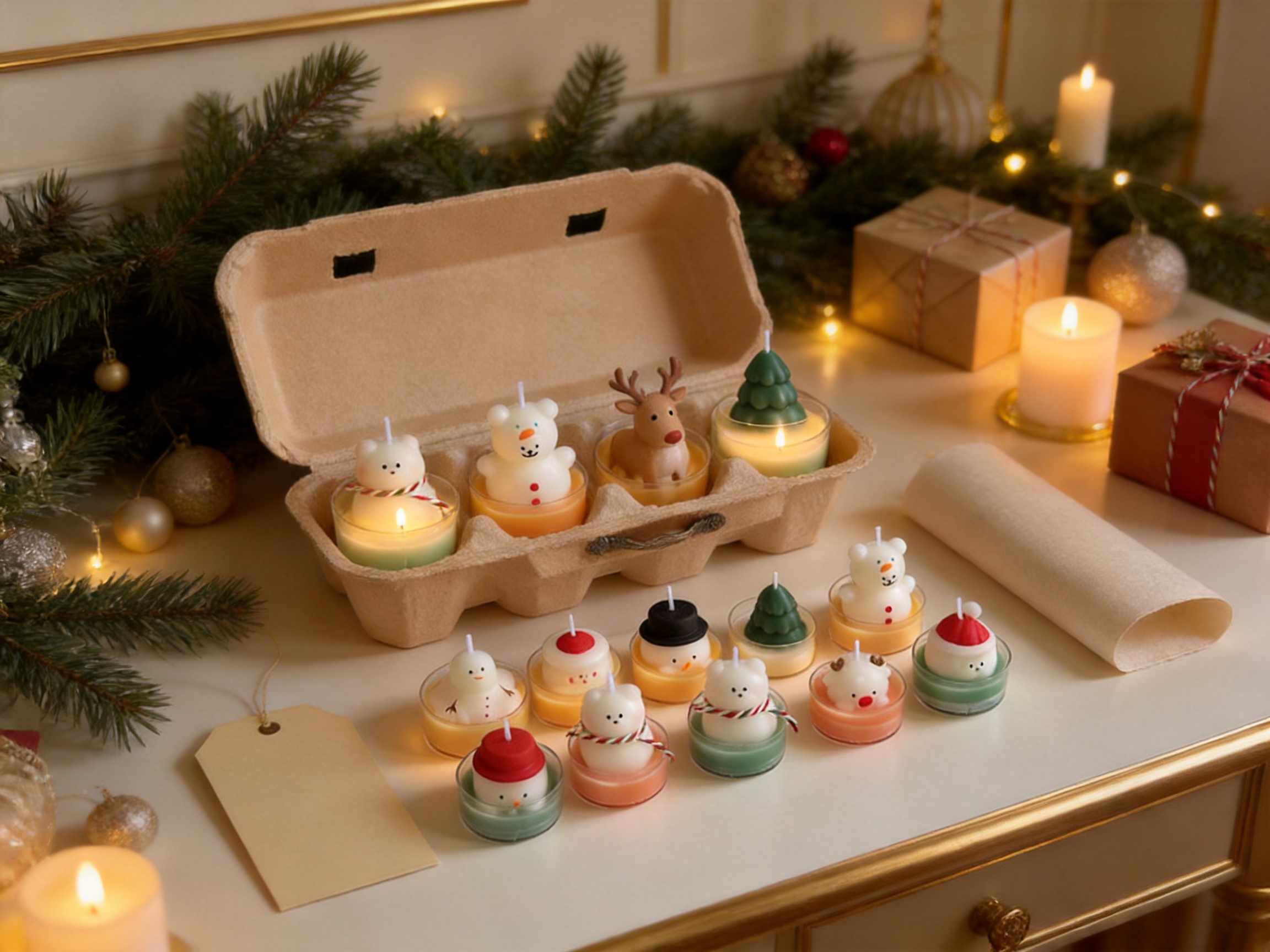
The set can be merchandised as a complete miniature Christmas scene. Retailers may place it beside pine branches, ornaments, gift wrap, ceramic decorations, or other home-fragrance products. A small riser can improve visibility and make the kraft box easier to see from the front of a display.
For online stores, the first image should show the complete assortment clearly. Additional images can focus on the hand-painted details, the transparent cups, the kraft packaging, and the warm appearance when lit. Product copy should use direct language and explain the practical and decorative benefits.
Cross-selling can expand the average order value. The set may be paired with scented candles, reed diffusers, candle accessories, Christmas tableware, gift bags, or seasonal home decorations. Because it belongs to the broader home-fragrance and gift category, it can be integrated into existing holiday collections.
Retailers can also create tiered seasonal offerings. The character tealight set may serve as an accessible entry-level gift, while larger jar candles, premium candle sets, or customized corporate packages provide higher-priced options. This allows one seasonal theme to serve multiple budgets.
The set includes nine character tealights. The assortment features snowmen in different poses, a reindeer, and a Christmas tree.
No. The collection is designed as a varied assortment rather than a pack of identical candles. The different characters and poses create a more decorative and giftable presentation.
The described assortment uses cream, orange, and green wax. These colors coordinate with the seasonal character designs and are visible through the transparent tealight cups.
Yes. Wax color is customizable, subject to product development, sample approval, and order requirements. Buyers should confirm the desired colors with the supplier before production.
Yes. Character selection is listed as a customization option. Buyers can discuss alternative combinations, proportions, and seasonal themes with the product development team.
Yes. Logo and packaging customization are available for suitable projects. The final branding method may depend on packaging design, order quantity, and market requirements.
The standard product is presented in an egg-carton style kraft box. This format organizes the nine pieces and provides a gift-ready appearance without requiring additional packaging.
Plain tealights are generally uniform and primarily functional. This set combines tealight functionality with sculpted characters, hand-painted details, coordinated wax colors, transparent cups, and a gift-oriented assortment.
Potential channels include holiday retail stores, Christmas markets, online shops, corporate gift programs, hotel gift shops, home-decoration boutiques, event suppliers, and seasonal promotional campaigns.
Yes. The ability to customize logos, character selection, wax color, and packaging makes the product suitable for private-label and branded seasonal collections.
The company reports support for smaller volumes and trial runs as well as larger production programs. The exact minimum order quantity should be confirmed for the selected customization plan.
The company reports daily capacity of up to 50,000 units through its production network. Actual capacity and lead time depend on the product specification, customization, packaging, and order schedule.
Buyers should review physical samples covering character shape, painted details, wax color, cup placement, packaging arrangement, labels, and overall presentation. Written approval helps establish a clear production reference.
The supplied product description identifies the item as a Christmas character tealight set but does not specify a fragrance. Buyers seeking scented or unscented production should confirm the formulation during product development.
Appropriate candle-safety information should be provided for the target market. General guidance includes using the candles on a stable heat-resistant surface, keeping them away from flammable items, and never leaving a burning candle unattended.
The transparent cup allows the colored wax and flame to remain visible. This strengthens the decorative effect and helps the characters create a warm glow when illuminated.
Yes. The compact gift-ready box, seasonal theme, logo customization, and assortment format make it suitable for employee gifts, customer appreciation, promotional programs, and holiday events.
Hangzhou Leo Home supports a broader range of home fragrance, personal care, home and garden, daily-use, candle, and gift products. Its supply chain resources include candle factories, jar customization partners, and color box factories.
The Christmas Character Tealight Festival Series Handmade Candle offers a strong combination of seasonal storytelling, compact functionality, handmade visual appeal, and customization potential. Its nine-piece format gives buyers more than a standard pack of tealights: it provides a small collection of snowmen, a reindeer, and a Christmas tree that can decorate a space, create a warm glow, and serve as a ready-to-give holiday present.
The product’s main competitive advantages include character variety, hand-painted details, coordinated cream, orange, and green wax, transparent tealight cups, and egg-carton style kraft packaging. These features improve shelf visibility, gift appeal, display flexibility, and suitability for different sales channels.
Behind the product, Hangzhou Leo Home Trading Co., Ltd. provides an integrated approach to product development, manufacturing coordination, packaging customization, quality assurance, and international delivery support. Its network of production and packaging partners, reported laboratory and inspection capabilities, flexible order support, and experience in overseas markets give buyers a structured way to develop seasonal candle programs.
For retailers and importers seeking a Christmas product with strong visual identity and broad gifting potential, this character tealight collection provides a practical starting point. Through customized colors, character combinations, logos, and packaging, it can be adapted from a standard festive assortment into a distinctive private-label product line.
1. Product specification and description for the Christmas Character Tealight Festival Series Handmade Candle, supplied by Hangzhou Leo Home Trading Co., Ltd.
2. Company profile and supply chain information for Hangzhou Leo Home Trading Co., Ltd., including customization, quality assurance, production capacity, and international market support.
3. General principles of candle product development, wax color management, mold preparation, hand finishing, packaging coordination, and finished-goods inspection.
4. General retail merchandising practices for seasonal home fragrance, decorative candles, gift sets, and holiday product assortments.
5. General candle-use and fire-safety guidance for household decorative candle products.

Room 1701, Building C1, Wangjing, Xiaoshan District, Hangzhou City, Zhejiang Province, China.

+86-15937257616

Copyright© 2026 Hangzhou Leo Home Trading Co., Ltd. All Rights Reserved.

Luxury Candles Home Fragrance Manufacturers Modern Candles Factory