 English
 Français
News
Home / Author / Marina Zhao — Senior Product Sales Manager / Golden Wax 464 Soy Candle Wax: A Professional Foundation for High-Performance Container Candles
Content

In the modern home-fragrance market, candle quality begins long before the wick is trimmed or the first flame is lit. The wax determines how a candle looks, how easily it accepts fragrance, how firmly it adheres to the vessel, how evenly it burns, and how consistently it performs from one production batch to the next. For candle manufacturers, private-label brands, craft makers, and distributors, choosing the right wax is therefore a strategic decision rather than a simple purchasing choice.
Golden Wax 464 Imported Soybean Candle Wax is a flake-form soy wax developed primarily for container candles. Its melting point of approximately 49–51.5°C and recommended pouring temperature of about 57°C make it suitable for a broad range of jar candle production processes. The wax can accept fragrance oil at up to 12% of total weight, giving makers flexibility when developing products with noticeable cold and hot scent throw.
What distinguishes this wax from many basic soy waxes is its additive-enhanced formula. The soybean-based additives are intended to reduce surface frosting, improve adhesion to glass vessels, and support stronger fragrance performance during burning. These characteristics address several of the most common difficulties in soy candle production, including uneven surfaces, visible pull-away, weak scent release, and inconsistent appearance after cooling.
At the same time, no wax can eliminate every production variable. Ambient temperature, vessel design, fragrance composition, cooling speed, wick selection, and pouring technique all influence final results. Golden Wax 464 should therefore be understood as a capable and forgiving production material that performs best when supported by disciplined testing and controlled manufacturing procedures.
Soy wax is produced from soybean oil that has been processed and hydrogenated into a solid material. Compared with traditional paraffin wax, soy wax is widely selected by brands that want to offer plant-based or vegetable-derived candle products. Its smooth burning profile, soft appearance, and compatibility with a wide range of fragrances have made it a popular material for container candles.
However, soy wax also presents technical challenges. Pure or minimally modified soy wax may develop frosting, a white crystalline appearance that can become visible on the surface or sides of a candle. It may also contract during cooling, leaving a gap between the wax and the glass wall. In addition, soy wax often requires careful wick testing because its comparatively soft structure and lower melting range influence the way a candle forms a melt pool.
A professional soy wax formula must balance several properties at the same time. It should melt efficiently, blend with fragrance oil, remain stable during pouring, cool with an attractive finish, adhere reasonably well to the vessel, and burn predictably. If one property is improved at the expense of another, the candle may look appealing but perform poorly, or burn well while appearing inconsistent.
Golden Wax 464 is designed to address these requirements in a practical container-candle format. Its flake form supports convenient weighing and handling, while its melting range allows the material to be processed using standard candle-making equipment. The formula is particularly relevant for jar candles, tins, tumblers, gift candles, seasonal collections, and other products in which the wax remains inside a vessel during use.
The wax is supplied in flake form rather than as a large solid block. This format provides several manufacturing advantages. Flakes can be weighed accurately, transferred into melting vessels with less manual effort, and divided into different batch sizes for sampling or mass production. They also tend to expose more surface area to heat than large blocks, which can support more efficient melting when the material is loaded properly.
For small workshops, flake wax reduces the need for heavy cutting or breaking equipment. For larger production lines, it can simplify raw-material feeding and improve operator efficiency. Accurate weighing is especially important when a formulation includes fragrance oil, dye, additives, or other components calculated as a percentage of total batch weight.
Flake handling also supports staged production. A manufacturer can prepare a small test batch for fragrance evaluation, a medium batch for vessel and wick trials, and a larger batch for commercial production without needing to modify the basic weighing process. This flexibility is useful for OEM and ODM projects, where different clients may require different fragrances, colors, jar sizes, or fill weights.
The stated melting point of 49–51.5°C places the wax within a practical range for container candle manufacturing. It can be melted using standard wax melters, heated pouring tanks, stainless-steel pitchers, or laboratory-scale vessels equipped with temperature control. The relatively moderate melting range can help manufacturers manage energy consumption and processing time compared with materials that require substantially higher temperatures.
Melting point is not the same as recommended processing temperature. A wax may become liquid at its melting point but still require additional heat to ensure that all flakes have fully melted and that the batch is uniform. Operators should avoid relying only on visual appearance. A clear liquid surface does not always confirm that the entire batch has reached a consistent temperature or that fragrance and color will disperse evenly.
For reliable production, the wax should be heated gradually and monitored using a calibrated thermometer or automated temperature sensor. Excessive heating should be avoided because unnecessarily high temperatures may darken certain fragrances, increase evaporation of volatile components, or create unnecessary thermal stress for the wax.
A recommended pouring temperature of approximately 57°C provides a useful starting point for container candle development. Pouring at a controlled temperature can influence the candle’s surface, adhesion, crystallization pattern, and overall appearance. A temperature that is too high may increase cooling time or contribute to fragrance loss, while a temperature that is too low may cause premature thickening, uneven surfaces, or poor bonding with the vessel wall.
The recommended temperature should not be treated as an inflexible rule. Different glass types, vessel sizes, fragrance oils, dyes, room temperatures, and cooling conditions can require adjustments. A narrow, tall jar may cool differently from a wide tumbler. A heavily fragranced formulation may behave differently from an unscented test batch. A colored candle may also show surface effects that are not visible in a white or natural wax formulation.
For this reason, professional candle development should include a temperature trial. A maker may test pours at slightly different temperatures around the recommended point, then compare the final results after complete cooling and curing. The best temperature is the one that delivers the desired appearance and adhesion under the actual production conditions.
Golden Wax 464 can accept fragrance oil at up to 12% of total weight, subject to the compatibility of the selected fragrance and the requirements of the finished product. This relatively high fragrance capacity gives product developers room to create candles with more pronounced scent profiles. It can be particularly valuable for floral, woody, gourmand, seasonal, and luxury home-fragrance collections where scent intensity is an important selling point.
Fragrance loading should always be calculated accurately. If the total batch weight is used as the basis, the fragrance percentage must be applied consistently across every production run. Some manufacturers calculate fragrance as a percentage of wax weight, while others calculate it as a percentage of the final combined batch. These methods are not identical, so the chosen method should be documented and used consistently.
More fragrance does not automatically mean better performance. Excessive loading can affect adhesion, surface quality, cure time, wick behavior, and burn stability. A fragrance that performs well at 8% may become oily or unstable at 12%. The correct level depends on the fragrance’s chemical composition, the vessel, the wick, the desired scent strength, and the applicable safety requirements.
The practical advantage of a wax with a higher stated fragrance capacity is flexibility. Manufacturers can test several fragrance levels and select the lowest loading that provides the desired scent performance. This may support cost control while still producing a satisfying customer experience.
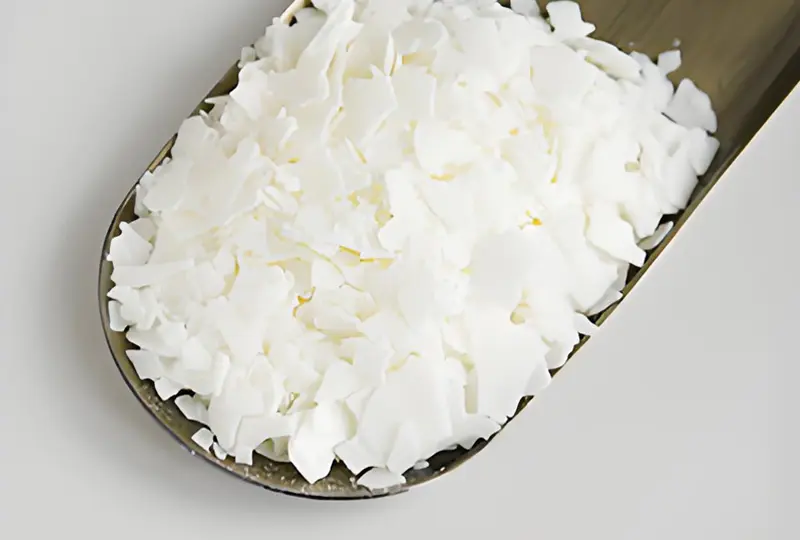
Golden Wax 464 Imported Soybean Candle Wax
Frosting is one of the most recognizable visual challenges associated with soy wax. It appears as a pale or crystalline layer on the surface or sides of the candle. Frosting does not necessarily mean the candle is unsafe or unusable, but it can reduce the perceived quality of a finished product, particularly when the candle is intended for premium retail presentation.
The soybean-based additives in Golden Wax 464 are designed to reduce the likelihood and visibility of frosting. This gives manufacturers a useful advantage over basic soy waxes that may show stronger crystallization under the same conditions. A smoother appearance can improve shelf presentation, photography, gift packaging, and customer perception.
It is important to recognize that reduced frosting is not the same as guaranteed frosting-free performance. Cooling rate, temperature fluctuations, vessel material, fragrance chemistry, colorants, and storage conditions can all influence crystal formation. Even an additive-enhanced wax may display some frosting if the production environment changes significantly.
The most reliable approach is to combine the wax’s built-in performance characteristics with controlled cooling. Avoiding sudden temperature changes, minimizing drafts, and allowing candles to cool at a stable room temperature can help maintain a more consistent appearance.
Pull-away occurs when the wax contracts during cooling and separates partially from the vessel wall. Wet spots may also appear when areas between the wax and glass reflect light differently. These effects are especially visible in clear containers and can make a candle appear inconsistent even when its burn performance is acceptable.
Golden Wax 464 includes additives intended to improve adhesion between the wax and glass. Better adhesion can support a cleaner visual relationship between the candle fill and the vessel, especially when the jar is viewed from multiple angles. This is valuable for transparent packaging, premium candle collections, retail displays, and products sold through online photography.
Vessel preparation remains important. Glass should be clean, dry, and free from dust, oil, or manufacturing residue. The temperature difference between the wax and the vessel should also be considered. A very cold container can cause the wax to cool too quickly at the wall, while excessive vessel heating may extend cooling time or alter the final texture.
Even with an adhesion-enhancing formula, some wet spots or pull-away may occur. The product material reduces risk but does not remove the need for process control. Manufacturers should evaluate adhesion after the candle has fully cooled and again after curing, transportation simulation, and exposure to normal storage conditions.
Scent throw is generally discussed in two forms: cold throw, which is the fragrance perceived when the candle is unlit, and hot throw, which is the fragrance released while the candle burns. Both are important, but hot throw is often the decisive factor in the consumer experience.
The additive-enhanced structure of Golden Wax 464 is intended to support fragrance release during burning. When the wax melts around the wick, fragrance components are carried into the liquid melt pool and released into the surrounding air. A suitable wax can help create a balanced relationship between fragrance retention during storage and fragrance release during use.
However, fragrance performance is never determined by wax alone. Wick diameter, wick material, vessel width, fragrance concentration, cure time, room size, airflow, and burning duration all have an effect. A candle that appears weak after a short test may perform better after a full cure period. Similarly, an oversized wick may create excessive heat and release fragrance rapidly but produce an unstable or unsafe flame.
Golden Wax 464 gives manufacturers a strong starting point for scent development, but finished candle testing remains essential. The goal is not merely a high fragrance level. The goal is a balanced candle that provides pleasant scent distribution without smoking, overheating, excessive mushrooming, or an unstable flame.
Before production begins, the wax should be inspected for packaging integrity, contamination, unusual odor, discoloration, and signs of moisture exposure. The batch number, incoming quantity, and storage date should be recorded. Fragrance oils and other materials should be checked in the same way.
A professional quality system treats raw material inspection as the first manufacturing checkpoint. Even a well-formulated wax can be affected by poor storage or improper handling. Materials should be kept in a clean, dry area away from direct sunlight, extreme temperature changes, and strong external odors.
Wax and fragrance should be weighed using calibrated equipment. For commercial work, a written batch sheet should identify the wax quantity, fragrance name, fragrance percentage, target batch weight, colorant amount if applicable, processing temperatures, operator, and production date.
Formula control is particularly important for OEM and ODM production. A client may approve a specific scent strength, appearance, and fill weight. If the production team changes the fragrance percentage or pouring temperature without recording the adjustment, the final product may not match the approved sample.
The flakes should be melted gradually in a clean vessel with suitable temperature control. The wax should be stirred gently when necessary to promote even melting, but excessive agitation should be avoided because it may introduce air bubbles or cause splashing.
Manufacturers should confirm that the batch is fully liquid and uniform before adding fragrance. Heating should be sufficient for complete melting but should not continue at unnecessarily high temperatures. A controlled thermal process protects the visual quality of the wax and helps preserve the character of fragrance oils.
Fragrance oil should be added according to the approved formula and mixed thoroughly. The mixing method should be consistent from batch to batch. Insufficient mixing can create fragrance concentration differences within the same production lot, while overly vigorous mixing can introduce bubbles.
The fragrance should be compatible with soy wax and suitable for candle use. Each fragrance should be evaluated independently because oils differ in viscosity, volatility, color, and interaction with the wax. A fragrance supplier’s technical documentation should be reviewed before commercial formulation.
Glass jars or other containers should be inspected for cracks, chips, sharp edges, contamination, and dimensional differences. The wick should be centered and securely fixed before pouring. For high-volume production, jigs or centering tools can improve repeatability.
Container cleanliness is essential to adhesion and appearance. A small amount of dust, oil, or residue may create visible defects or interfere with the bond between the wax and the vessel. Containers should be handled carefully after cleaning so that fingerprints and airborne particles do not become a recurring problem.
Pouring should begin near the recommended temperature of 57°C, followed by controlled trials when the vessel, fragrance, or production environment changes. The operator should maintain a steady flow and avoid unnecessary movement of the container immediately after filling.
Inconsistent pouring can result in different surface textures or fill levels. Commercial operations should use standardized procedures for pitcher speed, fill height, and batch temperature. When producing multiple colors or fragrances, the same process should be documented for each variation.
Freshly poured candles should cool in a stable environment away from drafts, direct sunlight, air-conditioning outlets, and sudden temperature changes. Rapid cooling may increase the chance of frosting, cracking, uneven surfaces, and pull-away.
After cooling, the candles should be allowed to cure before final burn testing. Cure time allows the wax and fragrance system to stabilize. The ideal period may vary according to fragrance composition, candle size, and product requirements. A consistent curing schedule improves the comparability of test results.
After curing, the wick should be trimmed to the specified length. The candle should be inspected for surface smoothness, frosting, wet spots, pull-away, contamination, wick position, fill height, label alignment, and packaging condition.
Visual inspection should be combined with performance testing. A candle may look excellent but burn poorly, or it may show a minor cosmetic variation while delivering excellent performance. The acceptable standard should be defined before production rather than decided inconsistently by individual operators.

A reliable candle supplier must control more than the raw material itself. The finished product depends on the relationship between wax, fragrance, wick, vessel, color, packaging, and production environment. A structured quality-control system helps identify problems early and prevents inconsistent goods from reaching customers.
Appearance testing should evaluate the top surface, sidewall adhesion, color consistency, frosting, cracks, sinkholes, air bubbles, and foreign particles. Clear glass makes sidewall conditions easy to observe, while opaque vessels may require additional checks during production.
Samples should be examined under consistent lighting. A surface that appears acceptable under warm factory lighting may show defects under retail or daylight conditions. For export products, approved reference samples can help maintain consistent standards across different production batches.
Each candle should meet the specified net weight and fill level. Significant variation may affect customer expectations, burning duration, shipping cost, and compliance with product labeling requirements. Measuring the finished candle rather than relying only on the amount poured can reveal losses caused by equipment or handling.
Container dimensions should also be recorded. Small differences in diameter can change the appropriate wick size and affect melt-pool development. A change in vessel supplier or mold should therefore trigger a new round of testing.
Burn testing evaluates ignition, flame stability, melt-pool development, total burn behavior, soot, smoking, mushrooming, heat around the vessel, and scent release. Testing should include the first burn and subsequent burns under controlled conditions.
The first burn is especially important because the candle should generally be allowed enough time to develop a suitable melt pool without overheating the vessel. Subsequent tests reveal whether the wick remains stable as the candle becomes shorter. Burn records should include start time, end time, flame observations, melt-pool diameter, and any visible residue.
Cold throw can be assessed after curing by evaluating the candle at a standardized distance and under consistent room conditions. Hot throw should be evaluated during a controlled burn, taking into account room size, ventilation, and test duration.
Professional evaluations should distinguish between fragrance intensity and fragrance quality. A very strong scent may not be desirable if it becomes harsh, smoky, or unbalanced when heated. The preferred result is a clean and recognizable fragrance that performs comfortably in the intended room environment.
Candles may experience vibration, temperature changes, compression, and handling during transportation. Samples should be evaluated after realistic storage or transport simulation to identify changes in adhesion, surface condition, fragrance leakage, packaging damage, or wick movement.
This stage is particularly useful for export orders. A candle that performs well immediately after production may develop visible wet spots or pull-away after exposure to temperature variation. Understanding these risks allows the supplier to improve packaging, palletization, storage instructions, and production conditions.
Golden Wax 464 is well suited to standard jar candles for home fragrance brands, lifestyle retailers, gift shops, and online stores. The wax’s intended container-candle performance supports product designs that emphasize attractive surface quality, glass adhesion, and fragrance release.
Jar candles can be developed in many formats, including clear tumblers, amber jars, ceramic vessels, frosted glass, colored glass, and decorative containers. Each format should be tested individually because vessel shape and material influence heat distribution and visual appearance.
Private-label clients often require a consistent base material across a collection of fragrances. A dependable soy wax can simplify product development by allowing multiple scents to be tested within a familiar processing system. The client can then vary fragrance, color, vessel, label, and packaging while maintaining a coherent production foundation.
The ability to support different fragrance loadings also gives brands flexibility in creating standard, premium, and seasonal product tiers. The final formulas should remain within the validated performance range and should be supported by individual burn testing.
Scented candles are frequently sold as part of holiday collections, housewarming gifts, wellness sets, and promotional packages. Golden Wax 464 can support these projects when the manufacturer needs a visually attractive wax with fragrance flexibility and dependable container performance.
Seasonal products often involve shorter development timelines. A structured sourcing and testing system can help brands move efficiently from fragrance selection to sample approval and mass production. Even under time pressure, however, burn testing and packaging inspection should not be skipped.
The flake format and accessible processing temperature make the wax practical for smaller makers as well as larger manufacturing operations. Artisan producers can work with manageable batch sizes while testing new fragrance combinations, vessel designs, and market concepts.
Small-batch makers should document every formula and process adjustment. Reproducibility becomes more important as demand grows. A candle that is made successfully once may not perform the same way if the room temperature, fragrance level, or pour temperature changes.
Golden Wax 464 is primarily designed for container candles. It may also be blended with beeswax to produce pillar or molded candles with greater structure. Beeswax can contribute firmness and rigidity, helping a soy-based blend better retain its shape after removal from a mold.
Blending should be treated as a separate formulation project. The ratio of soy wax to beeswax will influence melting behavior, hardness, fragrance capacity, surface appearance, release from the mold, and wick requirements. A blend that performs well in a jar should not automatically be transferred to a pillar mold without new testing.
| Property | Production Relevance | Practical Consideration |
|---|---|---|
| Physical form | Easy weighing and handling | Useful for small batches and scaled production |
| Melting point | Supports standard wax-melting equipment | Monitor temperature rather than relying on appearance alone |
| Recommended pour temperature | Provides a starting point for surface and adhesion control | Adjust through vessel and environmental testing |
| Fragrance capacity | Allows development of noticeable scent profiles | Validate every fragrance and loading level individually |
| Surface performance | Additives help reduce frosting | Stable cooling conditions remain important |
| Glass adhesion | Helps improve the visual connection between wax and vessel | Clean, properly prepared containers are essential |
| Primary application | Container candles | Jar, tumbler, tin, and decorative vessel products |
| Secondary application | Possible beeswax blends for molded candles | Requires separate formula and burn validation |
The performance of candle wax is only one part of a successful commercial program. Brands also need dependable sourcing, product development support, quality control, packaging coordination, and export execution. Hangzhou Leo Home Trading Co., Ltd. supports these requirements through an integrated supply-chain model focused on home fragrance and related household products.
The company operates from Hangzhou, China, and works with manufacturing and customization partners across the candle supply chain. Its stated network includes ten candle factories, eight jar customization partners, and eight color-box factories. This structure allows projects to be coordinated across wax products, finished candles, vessels, labels, and packaging rather than being handled as isolated purchasing tasks.
For customers developing a new candle line, this integrated approach can reduce communication gaps. Fragrance selection, vessel dimensions, wick testing, filling requirements, labeling, and carton specifications can be considered together. Coordinating these factors early helps reduce the risk of a finished candle that looks attractive but does not fit its packaging or perform correctly in its chosen container.
OEM and ODM customers may require modifications based on drawings, samples, target markets, or retail positioning. Customization can involve candle dimensions, fragrance selection, colors, jar styles, labels, box structures, gift-set combinations, and shipping cartons.
The company’s product-development support is intended to help clients move from a concept to a manufacturable product. A strong development process should include sample review, formula documentation, performance testing, approval records, and production follow-up. This is especially important when a client wants to build a family of products with consistent visual and fragrance identity.
The company describes an in-house laboratory and quality-control procedures covering key stages from material selection through finished-goods inspection. For candle products, laboratory and technical checks can support evaluation of wax condition, fragrance compatibility, burn behavior, surface quality, vessel fit, and batch consistency.
An in-house quality function can also make communication faster. When a sample shows frosting, poor adhesion, weak scent throw, or an unstable flame, technical personnel can help determine whether the cause is related to wax, fragrance, wick, container, temperature, or cooling. This problem-solving process is more valuable than simply replacing a batch without identifying the underlying cause.
The company reports daily capacity of up to 50,000 units while also supporting smaller quantities and trial runs. This combination is useful for brands at different stages of development. A new customer may begin with samples or a limited market test before moving to a larger recurring order.
Flexible capacity can also support seasonal replenishment. Holiday candle demand may rise quickly, while promotional collections may require short production windows. A supplier with access to multiple manufacturing resources can help distribute production and manage changing order requirements more effectively.
International candle shipments require careful coordination of product specifications, packaging, cartons, documentation, and delivery schedules. The company’s location in Zhejiang Province and access to logistics resources near Ningbo Port support export operations for overseas customers.
For candle products, logistics planning should consider glass breakage, temperature exposure, carton strength, pallet stability, and container loading. Proper packaging protects the finished candle and reduces the possibility that a high-quality product will arrive with chipped vessels, damaged labels, or shifted inserts.
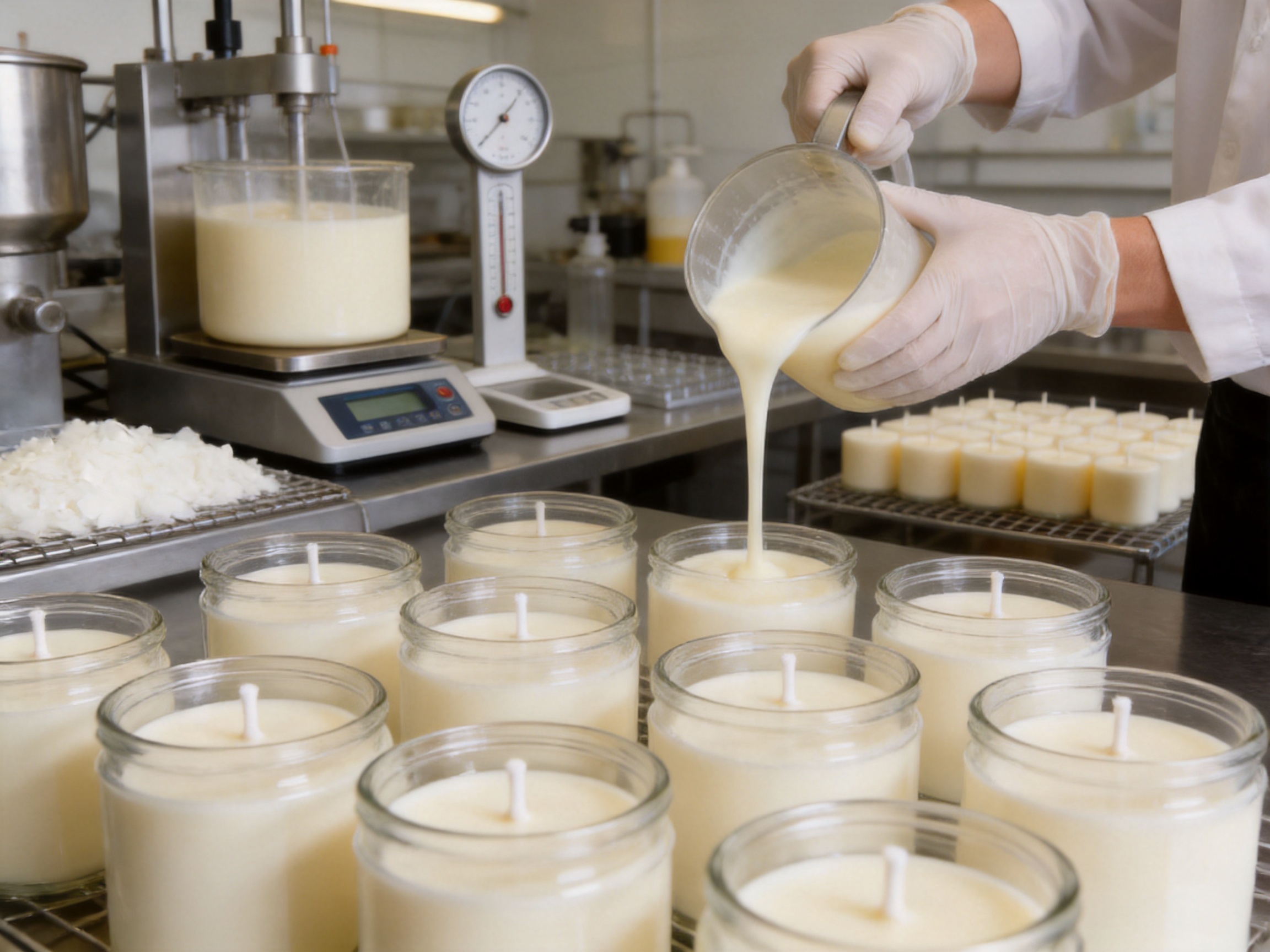
Competition in the candle market is not based solely on price. Consumers compare appearance, fragrance strength, burn time, packaging, ingredients, vessel design, and overall brand experience. A wax that supports multiple points of product quality can help manufacturers build a more competitive offering.
Golden Wax 464 provides several practical advantages. Its soy-based composition meets demand for vegetable-derived candle materials. Its additive-enhanced formula addresses common soy-wax appearance issues. Its fragrance capacity allows the development of noticeable scent profiles. Its flake format supports efficient handling. Its container-candle focus aligns with one of the largest and most versatile segments of the home-fragrance market.
Compared with a basic wax that requires extensive correction, a more specialized formula may reduce development time and lower the risk of rejected samples. A smoother process can also support more consistent output across different fragrances and vessel styles. These benefits may contribute to better production efficiency, more attractive retail presentation, and stronger customer satisfaction.
The competitive advantage becomes greater when the material is paired with a supplier that can coordinate finished candles, jars, packaging, customization, testing, and export logistics. A wax supplier that only provides raw material may not be able to help solve vessel or packaging problems. An integrated trading and sourcing partner can offer broader support throughout the product life cycle.
Soy wax should be stored in a cool, dry, clean area away from direct sunlight and strong odors. The packaging should remain closed until the material is needed. Exposure to moisture, dust, heat, or contamination can affect handling and may introduce quality risks during production.
Inventory should be managed using a clear rotation system. Older approved stock should generally be used before newer stock when storage conditions have been maintained properly. Batch records should be retained so that finished products can be traced back to the material used.
During handling, operators should use clean tools and avoid placing flakes on unprotected surfaces. If a bag is opened and not fully consumed, it should be resealed securely. Any material that shows unusual odor, color, texture, or contamination should be isolated for evaluation rather than mixed into normal production.
If frosting appears, review the cooling environment, pouring temperature, fragrance formula, vessel temperature, and storage conditions. Reducing temperature fluctuations and avoiding rapid cooling may improve the result. The additive-enhanced formula helps reduce frosting risk, but process control remains necessary.
Check vessel cleanliness, glass temperature, pouring temperature, cooling speed, and the shape of the container. Tall or unusually shaped vessels may cool unevenly. Minor wet spots can be difficult to eliminate completely, so product standards should distinguish between acceptable visual variation and serious adhesion failure.
Evaluate fragrance loading, fragrance compatibility, cure time, wick size, melt-pool development, and room conditions. A wick that is too small may not create a sufficient melt pool, limiting fragrance release. A fragrance that has not cured adequately may also appear weaker than expected.
Smoking may be associated with an oversized wick, an untrimmed wick, fragrance imbalance, contamination, drafts, or poor wick positioning. The wick should be trimmed according to the approved specification before testing. If smoking continues, the wick and formula should be reassessed.
Review pouring temperature, cooling rate, batch mixing, fragrance incorporation, and movement of the vessel after pouring. Uneven surfaces may also appear when the wax begins to thicken during a long filling process. Production teams should keep batch temperature and pouring speed as consistent as possible.
It is primarily designed for container candles, including jar candles, glass tumblers, tins, and other vessels in which the wax remains inside the container during use.
The stated melting point is approximately 49–51.5°C. Manufacturers should still melt the wax under controlled conditions and verify that the entire batch is fully liquid and uniform before fragrance is added.
The recommended starting point is approximately 57°C. The exact temperature may need adjustment based on vessel type, fragrance, batch size, room temperature, cooling speed, and desired surface appearance.
The wax can accept fragrance oil at up to 12% of total weight, subject to fragrance compatibility and product testing. The best loading level should be determined through scent, appearance, adhesion, and burn evaluations.
No. Its soybean-based additives are intended to reduce frosting, but frosting can still occur because of cooling conditions, temperature changes, fragrance chemistry, dyes, vessel characteristics, and storage conditions.
No wax can guarantee that these effects will never occur. The formula is designed to improve glass adhesion, but clean vessels, proper temperature control, stable cooling, and appropriate testing are still required.
It is mainly intended for container candles. It may be blended with beeswax to create a firmer material for molded or pillar candles, but the blend must be developed and tested separately.
The calculation method should be defined in the production formula. Some manufacturers calculate fragrance as a percentage of wax weight, while others use total finished batch weight. The selected method must be applied consistently and documented clearly.
Cure time depends on candle size, fragrance composition, wax behavior, and product requirements. Manufacturers should establish a standard cure period through comparative testing and use the same period for approval samples and production batches.
There is no universal wick size for every candle. Wick selection depends on vessel diameter, wax depth, fragrance, color, burn-time requirements, and the desired melt pool. Each vessel and formula combination requires burn testing.
Yes, it can be evaluated for colored candle production. However, colorants may affect appearance, fragrance perception, burning behavior, and surface texture, so each color system should be tested before mass production.
Support may include product development, fragrance selection, vessel customization, label and packaging coordination, sample preparation, quality inspection, production organization, and export delivery assistance. The exact scope should be confirmed for each project.
A finished candle depends on multiple connected components, including wax, fragrance, wick, vessel, label, box, and shipping carton. Coordinating these elements through an integrated supply chain can reduce communication gaps and improve consistency from sample approval to mass delivery.
Golden Wax 464 Imported Soybean Candle Wax offers a practical and versatile foundation for professional container candle production. Its flake form supports efficient handling, its 49–51.5°C melting point fits standard processing methods, and its recommended pouring temperature of approximately 57°C provides a useful starting point for controlled manufacturing. With fragrance loading of up to 12% of total weight, it also gives product developers room to create expressive and commercially attractive scent profiles.
The wax’s additive-enhanced formulation provides meaningful advantages over basic soy waxes by helping reduce frosting, improve adhesion to glass, and support scent throw during burning. These advantages can contribute to better visual quality, stronger product presentation, and a more satisfying consumer experience.
Its performance is strongest when combined with disciplined production practices. Accurate weighing, controlled melting, compatible fragrance selection, clean vessels, stable cooling, careful curing, wick testing, and finished-product inspection are all essential. Occasional wet spots or pull-away may still occur, but the risk can be managed through process development and environmental control.
Beyond the material itself, the strength of a commercial candle program depends on the supplier’s ability to coordinate product development, manufacturing resources, quality control, customization, packaging, and export logistics. Hangzhou Leo Home Trading Co., Ltd. brings together candle factories, jar partners, packaging resources, laboratory support, and international supply-chain experience to help customers develop and deliver home-fragrance products.
For brands seeking a soy-based wax for jar candles, private-label collections, seasonal gift sets, or customized home-fragrance lines, Golden Wax 464 represents a strong starting point. When supported by careful testing and an organized manufacturing partner, it can help transform a raw material into a consistent, attractive, and competitive finished candle range.
1. Soybean Wax Processing Principles for Container Candle Manufacturing.
2. Candle Formulation and Fragrance Compatibility: Technical Guidance for Professional Makers.
3. Best Practices for Wax Melting, Pouring, Cooling, and Curing.
4. Container Candle Wick Selection and Controlled Burn Testing Procedures.
5. Quality Management Methods for Home-Fragrance Product Manufacturing.
6. International Packaging and Logistics Considerations for Glass Candle Products.
7. Supplier-provided technical information for Golden Wax 464 Imported Soybean Candle Wax.
8. Company-provided information regarding product development, quality assurance, customization, manufacturing coordination, and international supply-chain services.

Room 1701, Building C1, Wangjing, Xiaoshan District, Hangzhou City, Zhejiang Province, China.

+86-15937257616

Copyright© 2026 Hangzhou Leo Home Trading Co., Ltd. All Rights Reserved.

Luxury Candles Home Fragrance Manufacturers Modern Candles Factory