 English
 Français
News
Home / Author / Marina Zhao — Senior Product Sales Manager / Colored Scented Votive Glass Jar Candle: A Refined Solution for Modern Home Fragrance Collections
Content
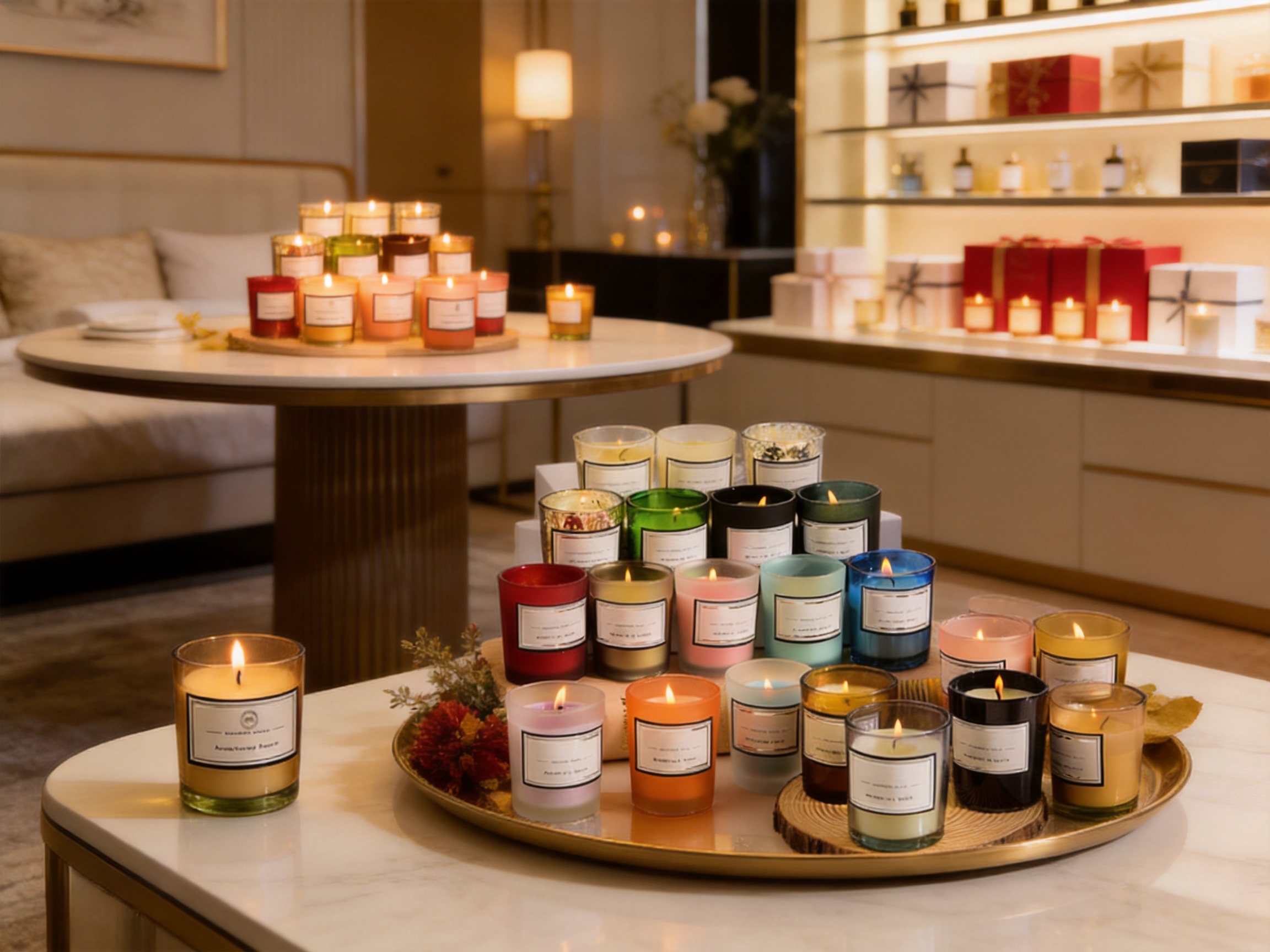
Home fragrance has developed from a simple household accessory into an important part of interior styling, personal wellness, gifting, and retail presentation. Consumers increasingly look for products that combine atmosphere, appearance, convenience, and dependable performance. A candle must therefore do more than produce a pleasant scent. It should contribute to the visual character of a room, burn consistently, fit naturally into different spaces, and provide a satisfying experience from the first use to the last.
The Colored Scented Votive Glass Jar Candle is designed around these expectations. Its compact glass container, rich color, scented wax, and gift-ready appearance create a balanced product for everyday use, decorative collections, hospitality environments, seasonal merchandising, and private-label programs. The colored glass introduces visual depth before the candle is even lit. Once illuminated, it filters the flame into a soft, warm glow that gives the product a distinctive atmospheric quality.
This combination of decorative value and practical performance gives the candle an important advantage in a crowded home fragrance market. Many basic votive candles offer only a flame and fragrance. Many decorative candles provide an attractive exterior but lack flexible placement or consistent fragrance performance. This product is positioned between these two extremes, offering a compact format with an elevated presentation and the functional benefits expected from a scented jar candle.
Behind the finished product is a supply chain and development system designed to support quality, customization, and dependable delivery. Product development, fragrance selection, glass sourcing, color coordination, packaging, inspection, and export preparation can be managed through an integrated network of specialized partners. This structure allows buyers to develop collections more efficiently while maintaining control over specifications and target-market requirements.
The Colored Scented Votive Glass Jar Candle belongs to the glass jar candle category and is suitable for a wide range of home fragrance programs. Its compact votive format makes it especially useful for buyers who need a product that can be sold individually, grouped into sets, included in gift boxes, or displayed as part of a coordinated room fragrance collection.
The product is made with scented wax and a glass jar selected for its decorative appearance and functional role. The colored exterior produces a richer visual effect than clear glass, helping the candle stand out on retail shelves, dining tables, bedside cabinets, bathroom counters, and display trays. The color also enhances the candle’s identity when it is unlit, which is important because many consumers first evaluate a candle as a decorative object before considering its fragrance.
When lit, the jar creates a warm and softened glow. Rather than presenting the flame as an isolated point of light, the colored glass helps distribute the illumination across the container. This makes the candle suitable for quiet evenings, dinner settings, relaxation routines, seasonal displays, and hospitality use. The compact size also enables users to arrange several candles together, creating layered light without requiring a large amount of table space.
The product can serve several market segments. In the everyday home fragrance segment, it provides an accessible way to add scent and warmth to a room. In the gifting segment, its refined appearance supports use as a small yet presentable atmospheric gift. In the retail and private-label segment, the jar can be developed with different fragrance profiles, labels, color schemes, and packaging formats to suit a brand’s identity.
Its broad application is one of its strongest commercial characteristics. A single product structure can be adapted for spring collections, holiday assortments, wedding favors, hotel amenities, wellness programs, boutique displays, and promotional gift sets. This flexibility helps buyers reduce the need to develop completely different candle formats for every sales channel.

Colored Scented Votive Glass Jar Candle
Glass is one of the most established materials in the candle industry because it offers a useful combination of visibility, stability, cleanliness, and decorative potential. The colored glass used for this votive candle adds another level of product differentiation. It creates a sense of depth and richness that is difficult to achieve with plain transparent containers or ordinary opaque packaging.
Color affects how consumers interpret a fragrance product. Soft neutral colors may communicate calmness and minimalism, while deeper tones can suggest warmth, luxury, seasonal character, or sophistication. When the color of the jar is coordinated with the fragrance and packaging, the result is a more complete product story. For example, a warm-toned glass can support comforting gourmand scents, while cool shades may complement fresh, herbal, or aquatic fragrance concepts.
The visual advantage continues after the candle is lit. The glass becomes part of the lighting experience, allowing the flame to create a gentle halo. This is especially valuable in hospitality and decorative settings where the candle is expected to contribute to the ambiance of a complete environment. A plain candle may provide light, but a carefully colored container helps shape the mood of the surrounding space.
Colored glass can also improve shelf presence. In a retail display containing many similar candles, a distinctive container helps attract attention from a distance. Consumers often scan shelves quickly, and products with recognizable silhouettes or coordinated color families are easier to notice. A collection of colored votive candles can be displayed by fragrance, season, room, or tonal palette, giving retailers additional merchandising possibilities.
Compared with heavily decorated containers, colored glass offers a more restrained and versatile appearance. Printed patterns, metallic finishes, or complex external decorations may be appropriate for certain collections, but they can restrict the product to a narrow style. Colored glass provides visual interest while preserving a clean base that can be adapted to minimalist, modern, rustic, festive, or premium packaging concepts.
The material also works well for reusable decorative applications after the candle has been consumed. Depending on the final design and consumer instructions, an empty jar may be used for small accessories, decorative objects, or storage. This potential reinforces the perception of value and supports consumer interest in products that have a longer visual life beyond their primary function.
A candle’s appearance may create the first impression, but its actual performance determines whether the consumer feels satisfied. The Colored Scented Votive Glass Jar Candle is designed to use scented wax that burns evenly and releases a delicate, long-lasting fragrance. This balance between visual design and functional behavior is essential for a product intended for both personal use and gifting.
Even burning is influenced by several factors, including wax formulation, wick selection, fragrance loading, container dimensions, pouring temperature, cooling conditions, and curing time. A dependable candle development process must consider these elements together rather than treating them as separate decisions. A fragrance that performs well in one container may behave differently in another, and a wick that works in one wax system may not provide the same result in a different formulation.
Product development therefore begins with the relationship between the jar, wax, fragrance, and wick. The container’s diameter and height help determine the appropriate wick structure. The wax must be compatible with the selected fragrance and capable of forming a stable surface. The fragrance must be evaluated for scent strength, cold throw, hot throw, color impact, and burning behavior. These details are important for maintaining consistency across production batches.
A well-balanced candle should create a stable flame without excessive smoking, tunneling, or rapid wax consumption when used according to proper instructions. The objective is not simply to make the candle burn, but to make the experience predictable and attractive. An even melt pool supports more consistent fragrance release and helps the candle use its wax efficiently throughout its service life.
The fragrance experience is also designed to be versatile. A delicate, long-lasting scent can be suitable for bedrooms, living rooms, dining areas, reading corners, reception spaces, and gift occasions. It is less demanding than an overly intense fragrance and can be incorporated into a broader home fragrance program. Buyers can also use fragrance customization to create collections based on relaxation, freshness, warmth, seasonal celebration, or everyday comfort.
For private-label customers, scent development can be coordinated with target-market preferences. Some markets may favor clean and airy fragrances, while others may respond more strongly to woody, floral, fruity, spicy, or gourmand profiles. The supply system supports fragrance selection and adjustment so buyers can create a product line that reflects local purchasing habits and brand positioning.
The compact votive format is one of the product’s most practical advantages. Large candles can create a strong visual statement, but they require more space and may not be suitable for every room. A small glass jar can be placed almost anywhere a consumer wants to introduce fragrance or gentle light.
On a bedside table, the candle can support a quiet evening routine without overwhelming the surrounding décor. On a dining table, several units can be arranged in a line or cluster to create a warm centerpiece. In a living room, the candle can be placed on a tray, shelf, mantel, or side table. In a bathroom, it can complement a relaxation or self-care setting. Its manageable scale also makes it practical for apartment living, office environments, and hospitality rooms.
The compact size encourages grouping. Consumers can purchase multiple fragrances or colors and combine them according to mood or occasion. Retailers can sell the product as a single unit for trial purchases or as a coordinated set for gifting. This provides flexibility in both product presentation and pricing strategy.
Votive candles are also useful for event styling. Weddings, dinners, celebrations, restaurants, hotels, and seasonal displays often require multiple small light sources rather than one large centerpiece. The glass jar format helps create a consistent visual language across many units, while the color selection can be matched with event themes or interior palettes.
From a logistics perspective, a compact format can support efficient packing and assortment planning. Multiple units may be combined into gift boxes or shipping cartons with a range of fragrance variations. Packaging can be developed to protect the glass while presenting the product attractively. For buyers testing a new scent collection, smaller candle formats may also reduce the risk associated with launching a large, expensive product before demand has been established.
The home fragrance market includes many candle formats, including tin candles, clear glass jar candles, pillar candles, ceramic candles, molded candles, and miniature tealights. Each has particular strengths, but the Colored Scented Votive Glass Jar Candle offers a useful balance of presentation, flexibility, and everyday usability.
Tin candles are lightweight and often economical, but they may not provide the same decorative transparency or warm visual depth as colored glass. Their appearance can be more utilitarian, which may limit their use in premium displays or formal gifting. The glass jar creates a more refined impression and can remain visually appealing even when placed in a visible living area.
Clear glass candles offer visibility of the wax and flame, but they may appear less distinctive when displayed among similar products. Colored glass introduces a stronger identity and can support coordinated collections. It also softens the light, creating a more atmospheric result in low-light settings.
Pillar candles can offer impressive height and sculptural impact, yet they generally require a tray or holder to manage melted wax. A jar candle contains the wax within its vessel, making it easier to position on ordinary household surfaces when used correctly. This built-in containment improves convenience and helps support a cleaner decorative presentation.
Large candles may provide longer burning times, but they are less flexible for small spaces and can be more difficult to transport or gift. The votive size makes the product approachable, easy to combine, and suitable for buyers who want to purchase several scents without committing to a large format.
Very small tealights may be inexpensive and convenient, but they often have limited branding space and a less substantial gift appearance. The colored glass jar provides more room for a label, sleeve, box, or decorative presentation. It therefore occupies a valuable position between the low-cost convenience product and the large premium centerpiece.
| Product Attribute | Colored Scented Votive Glass Jar Candle | Basic Tin Candle | Large Pillar Candle | Miniature Tealight |
|---|---|---|---|---|
| Decorative visual impact | High, supported by colored glass and warm illumination | Moderate, depending on label and finish | High, with a sculptural appearance | Low to moderate |
| Placement flexibility | High for bedrooms, tables, shelves, bathrooms, and displays | High | Moderate, often requiring a tray or holder | High, but usually used in groups |
| Gift suitability | High, especially with coordinated packaging | Moderate to high | High, but less convenient to transport | Moderate, usually as part of a set |
| Collection customization | Strong options for color, fragrance, labels, and packaging | Strong options for labels and finishes | Strong options for shapes and colors | Limited branding area |
| Space efficiency | Excellent for compact displays and grouped arrangements | Excellent | Moderate | Excellent |
| Atmospheric lighting | Soft, warm, and visually diffused through colored glass | Warm, with limited container effect | Strong, depending on size and shape | Small and concentrated |
This comparison shows why the colored votive jar format is commercially attractive. It does not attempt to replace every candle style. Instead, it offers a balanced solution for buyers who need a decorative, customizable, compact, and gift-friendly product with broad application potential.
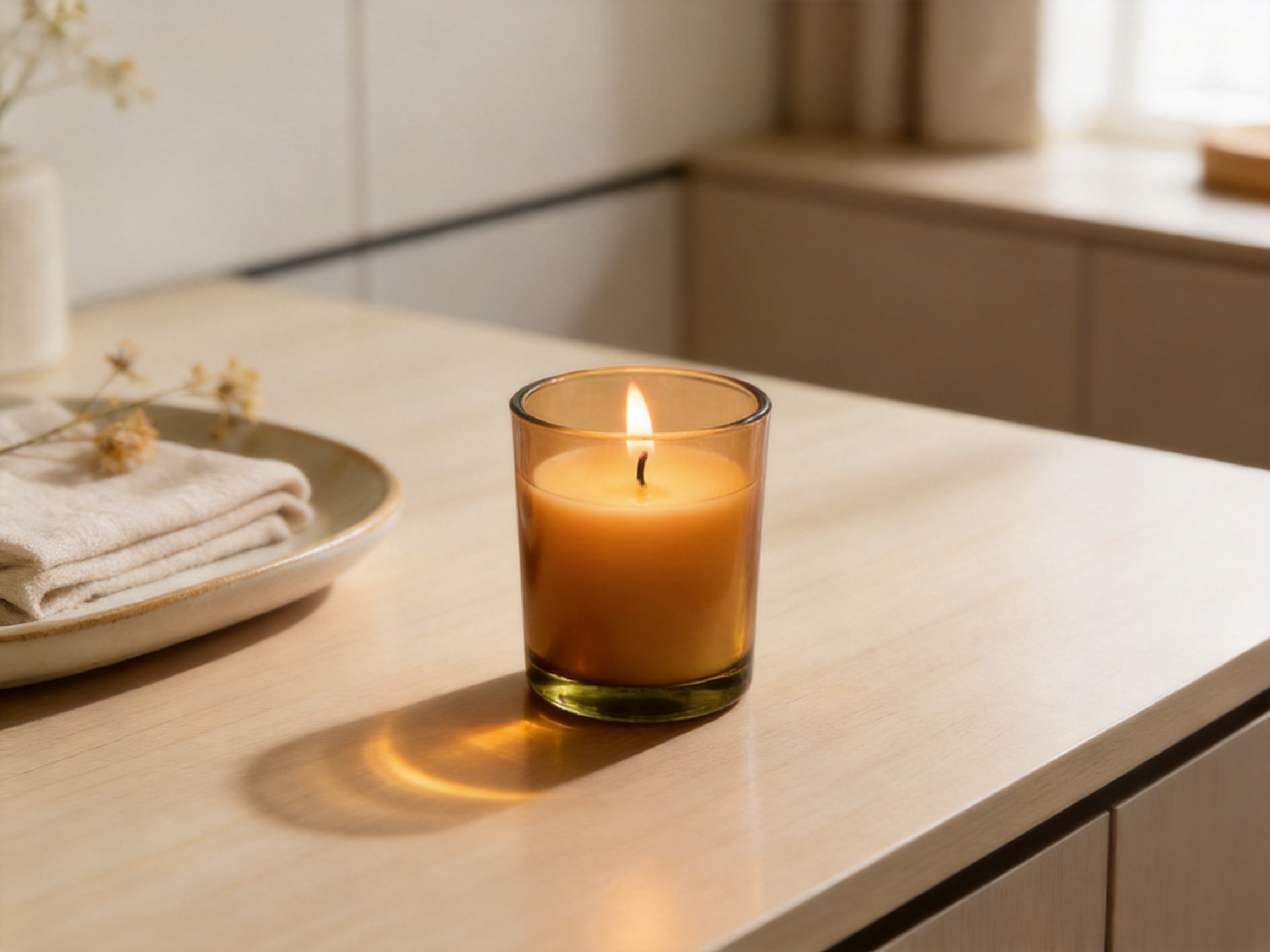
Reliable candle manufacturing requires more than pouring wax into a container. The final product is the result of coordinated decisions involving raw materials, container specifications, fragrance compatibility, wick performance, production control, finishing, packaging, and inspection. A structured process helps reduce variation and supports stable quality for both trial orders and larger production programs.
The process begins with the selection of suitable wax, fragrance materials, wicks, glass jars, labels, and packaging components. Each material must be evaluated according to the product’s intended use and target market. Wax should provide a stable burn and consistent appearance. Fragrance oils should be selected for appropriate scent character and compatibility with the wax system. Wicks should be matched to the jar diameter and formulation.
Glass selection involves more than choosing a color. The jar must have a suitable shape, stable base, consistent wall structure, and appearance compatible with the intended packaging. Color consistency is particularly important when a collection includes multiple units or when repeat orders are expected. Packaging materials must protect the glass during handling and transportation while preserving the product’s visual appeal.
Fragrance and wax blending is controlled to support uniform distribution and consistent scent performance. Temperature management is important because wax must be heated sufficiently for processing without being exposed to unnecessary thermal stress. Fragrance is generally incorporated under controlled conditions to help preserve its intended character and ensure an even blend.
Mixing must be sufficiently thorough to reduce the possibility of fragrance concentration differences between batches. The formulation may also be evaluated for surface appearance, adhesion to the jar, cooling behavior, and compatibility with the selected wick. These considerations are especially important when the candle is intended for a premium or export collection, where consumers expect a polished appearance and dependable use.
Wick alignment is a central part of candle quality. A wick that is off-center can produce an uneven melt pool and affect the way heat is distributed within the jar. Production equipment and positioning tools can be used to improve alignment and maintain repeatability across units.
During pouring, the wax temperature and filling speed are managed to reduce surface imperfections, air pockets, or irregular cooling marks. The filling level must remain consistent so that the product looks uniform when displayed. A clean, level surface contributes to the perception of quality and provides a better starting point for the consumer’s first burn.
Cooling conditions influence the final appearance and performance of the candle. Rapid or uneven cooling may create surface changes, adhesion problems, or structural inconsistencies. Controlled cooling helps the wax settle properly within the glass and supports a smoother finished surface.
Curing gives the wax and fragrance system time to stabilize. The appropriate curing period depends on the formulation and product requirements, but the general purpose is to allow the candle to develop more consistent fragrance behavior and structural stability before final inspection and packing.
After cooling and curing, the product can be finished with trimming, cleaning, labeling, and packaging. Excess wax or residue on the exterior of the jar is removed. The wick is checked and trimmed according to the product specification. Labels are applied in a consistent position, and the packaging is inspected for clarity, alignment, and protection.
Quality control is applied across multiple stages rather than only at the end of production. Incoming materials can be checked for appearance, specifications, and conformity. During production, operators and inspectors can monitor filling, wick alignment, color consistency, and surface quality. Finished products can be reviewed for jar condition, label placement, packaging integrity, and general presentation.
Burn testing and fragrance evaluation are important parts of product verification. Samples may be examined for flame stability, melt-pool development, soot behavior, scent release, and overall performance. While user instructions remain essential for safe candle use, controlled testing helps identify formulation or component issues before products are shipped.
The company’s supply chain structure includes cooperation with candle factories, jar customization partners, and color box factories. This network allows specialized suppliers to contribute their expertise while centralized product coordination helps maintain consistency between components. The use of an in-house laboratory and strict quality control across key stages further supports product reliability.
A major advantage for buyers is the ability to coordinate several parts of the project through one experienced trading and supply chain partner. Developing a candle collection often requires communication with wax manufacturers, fragrance suppliers, glass producers, printing companies, packaging factories, quality inspectors, and logistics providers. Managing every supplier independently can increase lead times, communication errors, and administrative work.
An integrated supply network helps simplify this process. The company works with a group of candle factories, jar customization partners, and color box factories, creating access to different capabilities and production options. This structure can support both standard products and customized programs, depending on order requirements, target price, design complexity, and delivery schedule.
The network also supports cost management. By coordinating materials and production stages, buyers can compare options and select appropriate solutions for different market levels. A premium collection may require more specialized glass and packaging, while a promotional program may prioritize efficient materials and competitive pricing. The ability to adjust the supply chain according to project goals is valuable for importers, wholesalers, retailers, and private-label brands.
Production capacity can reach up to 50,000 units per day for suitable programs, while smaller volumes and trial orders may also be supported. This combination of scale and flexibility is important because buyers often need to test fragrance acceptance or consumer response before committing to a large recurring order. A supplier that can support both initial testing and future expansion offers a more practical long-term partnership.
Logistics are supported by the company’s location in Hangzhou and convenient access to Ningbo Port. Efficient export coordination can help manage documentation, shipment planning, and delivery schedules for international customers. The company has supplied products to markets across North America, Europe, the Middle East, and other regions, giving it experience with cross-border communication and order execution.
Customization is essential for buyers who want to create a distinctive home fragrance line rather than sell a generic product. The Colored Scented Votive Glass Jar Candle provides a flexible base for OEM and ODM development. Buyers can work with the supply team to adjust fragrance selection, jar colors, labels, packaging, set composition, and product specifications.
Fragrance customization can begin with a buyer’s preferred scent direction. The development brief may focus on floral softness, fresh citrus, clean linen, herbal relaxation, warm amber, wood, vanilla, fruit, spice, or a seasonal combination. Fragrance selection should consider not only personal preference but also the intended market, price point, room application, and product collection.
Color customization allows the jar to match a brand’s visual identity. Buyers may request a single signature color, a tonal collection, or multiple shades representing different fragrances. Color development should be evaluated for consistency and suitability with the flame effect. A shade that looks attractive in daylight may produce a different impression under warm illumination, so visual testing is an important part of the process.
Label and packaging development can further strengthen market positioning. A minimalist label may support a modern lifestyle line, while a decorative box may be more appropriate for gifting. Packaging can include fragrance names, usage instructions, warning information, barcode space, origin details, and market-specific compliance content. Sets can combine multiple colors or scents to increase perceived value and encourage trial.
ODM support is especially helpful for customers who have a general concept but need assistance refining the final product. The development team can help convert drawings, samples, mood boards, or written requirements into a manufacturable specification. This may involve recommending jar dimensions, adjusting packaging structures, selecting suitable materials, or balancing appearance with cost and production feasibility.
Quality assurance is a central factor in home fragrance purchasing because candles combine heat, fragrance, glass, and packaging in one product. Buyers need confidence that the finished item is visually consistent, performs as expected, and is accompanied by appropriate usage information.
The company’s quality approach covers raw material selection, production monitoring, finished goods inspection, and export preparation. An in-house laboratory supports product evaluation, while factory-level checks help identify issues at their source. This layered approach is more reliable than depending solely on a final visual inspection after production has been completed.
Glass condition is checked for visible defects, structural concerns, and consistency of appearance. Wax is reviewed for surface quality and color. Wicks are assessed for placement and trimming. Labels and boxes are checked for alignment, printing quality, and correct information. Cartons are inspected to help reduce damage during transportation.
Responsible product development also means providing clear instructions for safe use. Consumers should be informed to place candles on a stable, heat-resistant surface, keep the candle away from flammable objects, avoid leaving a burning candle unattended, and keep it away from children and pets. The wick should be trimmed as recommended, and the candle should not be burned beyond the appropriate time stated on the packaging.
Although packaging and candle design support safe use, consumer behavior remains important. Clear warning labels and practical instructions help reduce misuse and improve the overall experience. For international buyers, usage information can be adapted to the language and regulatory expectations of the target market.
The product is suitable for multiple sales channels because it combines compact dimensions with an elevated appearance. In specialty home stores, it can be displayed alongside diffusers, room sprays, candle accessories, and decorative objects. In supermarkets and general merchandise stores, it can serve as an accessible entry product within a home fragrance range.
Online retailers can present the candle through lifestyle photography, fragrance descriptions, color collections, and gift-set combinations. Its visual character is especially suitable for online merchandising because the colored jar can be shown in both unlit and illuminated settings. Product pages can emphasize scent, size, use occasions, packaging, and customization options.
Gift shops can offer individual candles or coordinated sets. A small scented candle is easy for consumers to purchase as a host gift, birthday gift, holiday present, thank-you gesture, or personal treat. When presented in a well-designed box, the product can appear thoughtful without requiring the cost or size of a large premium candle.
Hotels, restaurants, spas, salons, and wellness centers can use the candle to reinforce an atmosphere of comfort and care. Small units can be placed in guest rooms, reception areas, treatment rooms, dining spaces, or event settings. Buyers in these sectors may prioritize consistent supply, fragrance suitability, private labeling, and packaging efficiency.
Corporate gift programs can also benefit from the product’s customization potential. Company colors, seasonal messages, event themes, or custom sleeves can be incorporated into the presentation. A candle communicates warmth, relaxation, and appreciation, making it suitable for customer gifts, employee programs, conferences, and festive campaigns.
Consumers are increasingly attentive to the materials and lifespan of home fragrance products. While the primary purpose of this candle is to provide fragrance and atmosphere, the glass jar can contribute to a longer product lifecycle through reuse after the wax has been consumed. Clear usage and cleaning guidance can help consumers understand possible secondary uses, subject to safe handling and the condition of the container.
Efficient packaging design can also reduce unnecessary material use while still protecting the glass during transport. Packaging engineers and buyers can consider the balance between protective inserts, carton strength, printing coverage, and overall size. A well-designed package should protect the product without creating excessive empty space.
Product durability is another part of perceived value. A candle that burns evenly, presents well, and leaves a clean, attractive container may be viewed more favorably than a product that is used once and discarded immediately. This does not eliminate the importance of responsible sourcing, but it does show how thoughtful design can support a more durable consumer relationship with the product.
For buyers developing long-term collections, consistent component sourcing can also reduce unnecessary redesign and sampling. Once a reliable jar, wax system, and packaging structure have been established, future fragrance or seasonal variations can be created with fewer changes. This can improve development efficiency and reduce the repetition of exploratory work.
The Colored Scented Votive Glass Jar Candle offers a strong combination of appearance, performance, flexibility, and supply support. It has the visual distinction needed to compete in modern retail while retaining the practical scale required for everyday use. The colored glass enhances the flame, the scented wax supports a pleasant fragrance experience, and the compact format allows placement in many environments.
Its advantages are especially clear for businesses seeking adaptable product lines. A buyer can begin with a standard specification, test a limited fragrance assortment, and later expand into custom colors, labels, packaging, and gift sets. The same basic format can serve different price points and sales channels without losing its core identity.
The product is also supported by manufacturing and supply chain capabilities that extend beyond simple order fulfillment. Product development, factory coordination, customization, inspection, and logistics are managed as connected parts of a broader service. This helps buyers reduce complexity and focus on building a commercially effective collection.
The company’s strengths include access to multiple candle factories, jar customization partners, and color box factories; support from an in-house laboratory; daily capacity for suitable bulk programs; experience in international markets; and a commitment to execution, warmth, and refinement. These capabilities are important for buyers who value both product quality and dependable business communication.
Ultimately, the product succeeds because it addresses several consumer needs at once. It creates a warm atmosphere, adds decorative color, releases fragrance, fits into compact spaces, works as a gift, and can be customized for different brand concepts. This broad usefulness gives it a strong position within the modern home fragrance category.

It is a compact scented candle poured into a colored glass container. The glass adds visual depth and filters the flame into a soft, warm glow, while the scented wax provides a delicate fragrance for home, hospitality, gifting, and decorative use.
Colored glass creates a more distinctive appearance and can support a coordinated product collection. When the candle is lit, the color softens and enriches the light, helping create a stronger atmospheric effect than a basic clear container.
It can be used on bedside tables, dining tables, living room furniture, bathroom counters, shelves, trays, reception desks, hospitality settings, and event displays. Its compact size makes it suitable for both individual placement and grouped arrangements.
Yes. Fragrance selection can be developed according to the buyer’s target market, brand identity, season, room application, or collection concept. Possible directions include floral, fruity, fresh, herbal, woody, spicy, gourmand, and relaxing fragrance profiles.
Color customization can be discussed as part of an OEM or ODM project. Buyers may request a signature color, a tonal series, or several colors linked to different fragrances. Final color selection should be evaluated for consistency and appearance under both daylight and candlelight.
Yes. Custom labels, sleeves, color boxes, gift sets, fragrance names, barcodes, usage instructions, and market-specific packaging content can be developed according to project requirements.
Quality management may include checks of raw materials, glass appearance, wax surface, fragrance consistency, wick alignment, filling level, label placement, packaging integrity, and finished product presentation. Product testing can also evaluate burning behavior and fragrance release.
The supply system supports both smaller trial programs and larger production requirements, depending on the customization level and project specifications. Trial orders can help buyers evaluate fragrance acceptance, packaging response, and market potential before scaling up.
Yes. Its compact format is well suited to multi-fragrance or multi-color gift sets. Sets can be organized by season, mood, room, fragrance family, or special occasion.
The supply network coordinates product development, sourcing, production, quality control, packaging, and export logistics. Experience serving customers across North America, Europe, the Middle East, and other markets supports international order communication and delivery planning.
The product combines decorative colored glass, a warm illuminated effect, scented wax, compact placement, gift suitability, and customization potential. These features provide a more complete value proposition than a basic candle focused only on flame or fragrance.
The candle should be placed on a stable, heat-resistant surface and kept away from flammable materials, children, and pets. It should not be left unattended. Consumers should follow the usage and warning instructions provided on the final packaging.
The Colored Scented Votive Glass Jar Candle is a versatile home fragrance product designed for consumers and businesses that value both atmosphere and presentation. Its colored glass container creates visual depth, its scented wax supports a pleasant fragrance experience, and its compact votive format allows flexible placement in homes, commercial spaces, gift assortments, and event displays.
Compared with basic tins, clear jars, large pillars, and miniature tealights, the product offers a balanced combination of decorative value, usability, and customization. It can stand alone as an attractive candle or become part of a broader collection that includes diffusers, scented sets, accessories, and seasonal home fragrance products.
Its commercial potential is strengthened by an integrated supply chain covering product development, fragrance selection, jar customization, packaging coordination, quality assurance, and international logistics. Access to multiple specialized factories, an in-house laboratory, flexible production capacity, and OEM/ODM support gives buyers the tools needed to create reliable and competitive product lines.
For retailers, importers, hospitality buyers, gift companies, and private-label brands, this candle format provides a practical foundation for building a refined home fragrance assortment. It combines the emotional appeal of warm light and fragrance with the operational advantages of compact packaging, adaptable design, and scalable production support.
1. General principles of candle formulation, wick selection, fragrance compatibility, and controlled burning performance.
2. Standard practices for glass container inspection, candle filling, cooling, curing, labeling, and finished goods quality control.
3. Home fragrance retail trends concerning decorative containers, gifting, seasonal collections, and private-label product development.
4. Packaging development principles for fragile glass products, export cartons, protective inserts, and retail presentation.
5. Product development information and company materials supplied for the Colored Scented Votive Glass Jar Candle.

Room 1701, Building C1, Wangjing, Xiaoshan District, Hangzhou City, Zhejiang Province, China.

+86-15937257616

Copyright© 2026 Hangzhou Leo Home Trading Co., Ltd. All Rights Reserved.

Luxury Candles Home Fragrance Manufacturers Modern Candles Factory