 English
 Français
News
Home / Author / Catherine Wu — Key Account After-Sales Specialist / Coconut Soy Wax Lidded Glass Jar Candle: A Refined Choice for Modern Home Fragrance
Content
Home fragrance has become an important part of contemporary living. A well-designed candle can do more than provide a pleasant scent: it can create a welcoming atmosphere, support relaxation, complement interior decoration, and add emotional value to everyday routines. Among the many candle formats available today, the coconut soy wax lidded glass jar candle offers a balanced combination of clean-burning performance, visual simplicity, practical protection, and customization potential.
This candle is designed around a carefully considered product structure. A coconut and soy wax blend forms the fuel base, a clear glass jar provides a stable and attractive container, a wooden lid protects the wax between uses, and a hand-positioned wick supports a steady flame. Together, these features create a product that is suitable for bedrooms, desks, living areas, relaxation spaces, gift collections, hospitality settings, and retail fragrance lines.
For buyers, importers, retailers, and private-label brands, the value of this product extends beyond its appearance. It also reflects the importance of dependable material selection, controlled production, quality inspection, flexible customization, and coordinated supply chain management. A candle may look simple on the surface, but its performance depends on many connected details, including wax formulation, wick selection, vessel quality, pouring temperature, cooling conditions, labeling, packaging, and final inspection.
This article examines the product’s main advantages, its manufacturing considerations, its suitability for different markets, and the capabilities of the supplier behind it. It also explains why a coconut soy wax lidded glass jar candle can offer a competitive alternative to conventional paraffin candles, basic container candles, and less carefully engineered fragrance products.

Coconut Soy Wax Lidded Glass Jar Candle
The coconut soy wax lidded glass jar candle is a container candle produced with a blended vegetable-based wax formulation. Coconut wax contributes a smooth texture and premium positioning, while soy wax supports a stable and widely accepted candle base. The combination is intended to provide a consistent melt pool, a balanced appearance, and a comfortable burning experience when the candle is properly formulated and used according to safety instructions.
The candle is presented in a clear glass jar. This transparent container allows the user to observe the flame and monitor the remaining wax level. It also gives the candle a clean, modern appearance that can fit into a broad range of interior styles. Unlike heavily decorated containers that are tied to a particular season or design trend, a neutral glass jar can be used across multiple collections, including minimalist, natural, wellness, hospitality, and gift-oriented lines.
A wooden lid is included with the product. The lid serves a practical purpose by helping protect the wax surface from dust, airborne particles, and unwanted odors when the candle is not being used. It can also improve the perceived value of the product. A candle with a coordinated lid often appears more complete and gift-ready than an open container without a cover.
The hand-poured construction supports attention to detail during production. Proper pouring and cooling can help create a smoother wax surface, while precise wick alignment supports an even flame position. These details are particularly important for customers who expect a candle to look refined both before and after its first use.
The product’s minimalist label and neutral aesthetic are suitable for both direct-to-consumer packaging and customized private-label programs. The label can serve as a discreet product identifier rather than overwhelming the container. This makes the candle adaptable to different brand identities, color systems, fragrance collections, and market requirements.
Wax is one of the most important factors affecting candle quality. It influences scent diffusion, surface appearance, burn behavior, container adhesion, cooling characteristics, and overall consumer perception. A coconut and soy wax blend is attractive because it combines the properties of two plant-based waxes into a single formulation rather than relying on only one material.
The blended wax is designed to burn cleaner and more evenly, helping reduce soot and residue under suitable burning conditions. A consistent burn is important because it contributes to a more pleasant user experience and can help maintain the appearance of the glass container. Excessive soot may darken the jar, while uneven burning can leave large amounts of unused wax along the sides.
Although every candle is influenced by wick size, fragrance load, room conditions, and user behavior, wax formulation provides the foundation for dependable performance. A well-developed blend can help the candle form a stable melt pool at a controlled rate. This supports a more predictable experience across different uses.
A melt pool is the layer of liquid wax that forms around the wick as the candle burns. Its development affects fragrance release, burn efficiency, and the amount of wax consumed during each session. If the melt pool is too small, the candle may burn unevenly and leave wax around the container walls. If it becomes excessively deep or hot, the candle may burn too quickly.
The coconut and soy formulation is intended to encourage a steady and balanced melt pool. This can improve the candle’s overall performance and help extend practical burn time when the wick is correctly selected for the jar diameter. A consistent melt pool also supports more even fragrance distribution as the candle continues to burn.
Vegetable waxes can provide a soft, elegant appearance that works well with transparent glass packaging. The wax surface is often an important part of the first impression. A smooth top, clean wick placement, and carefully finished jar communicate attention to quality before the candle is ever lit.
Because the candle is hand-poured, production teams can pay close attention to surface finish and wick alignment. Cooling behavior must still be managed carefully, since natural wax blends may be sensitive to temperature changes and may develop minor visual variations. These characteristics are not necessarily defects; however, controlled production and appropriate packaging help maintain a consistent retail presentation.
Many consumers are interested in home fragrance products that combine attractive design with more plant-oriented material choices. Coconut and soy wax can support this market position, particularly when buyers are seeking alternatives to conventional paraffin-based candles. The wax blend can be presented as part of a broader lifestyle concept focused on comfort, simplicity, and conscious product selection.
For retailers, this creates opportunities to position the candle in several categories. It can be sold as a home fragrance product, a relaxation accessory, a decorative object, a gift item, or part of a wellness-inspired collection. The product’s material story adds substance to marketing communication without requiring an overly complicated design.
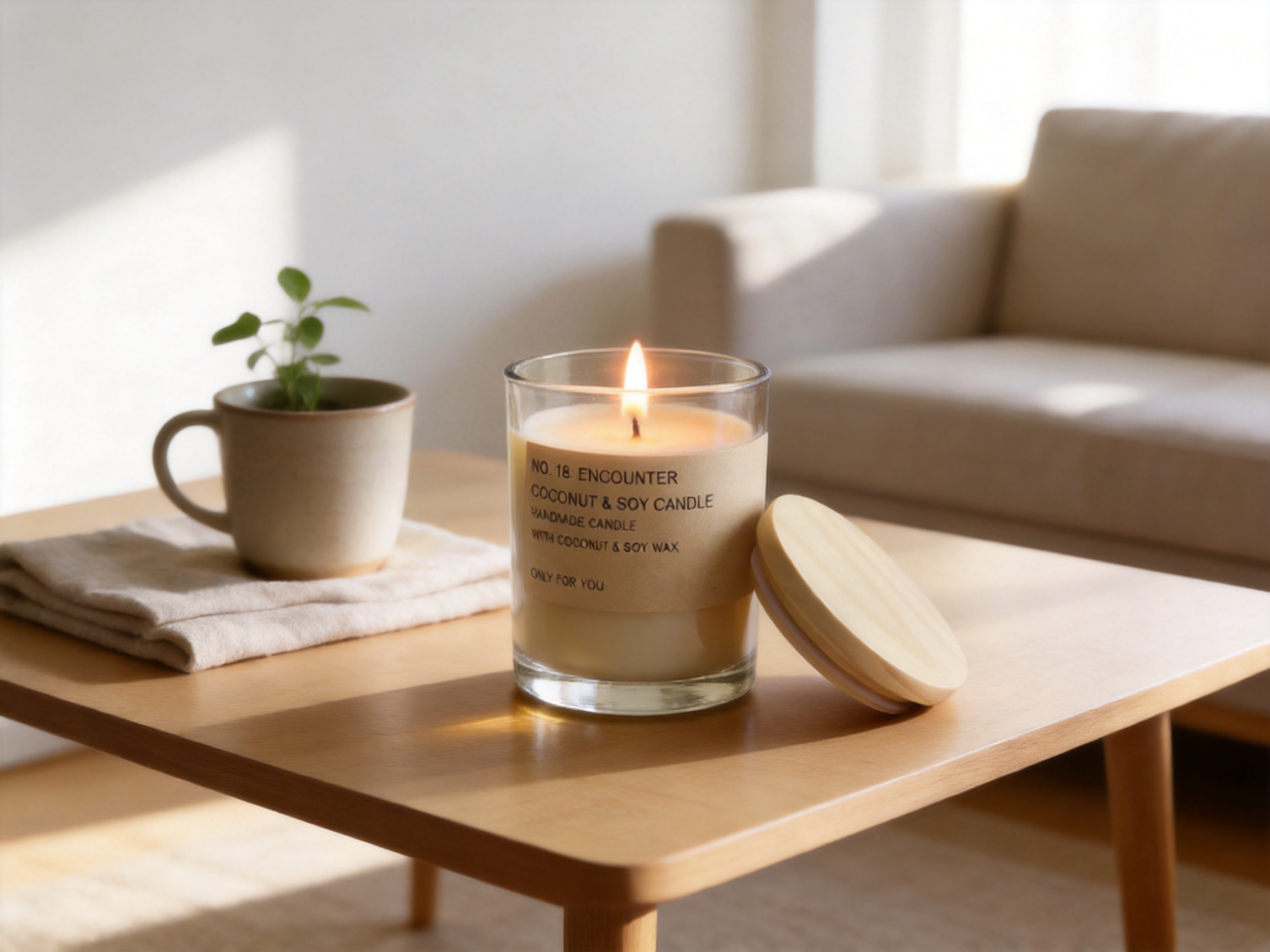
The clear glass jar provides immediate visibility of the candle. Customers can see the wax color, wick position, and approximate fill level without opening the package. This transparency can be useful in retail displays because the product remains visually accessible from different angles.
Glass also has a familiar and premium association in the home fragrance market. It feels more substantial than lightweight plastic packaging and can contribute to a sense of durability. When the candle is placed on a bedside table, shelf, desk, or coffee table, the glass container functions as both packaging and décor.
The thick glass wall is designed to provide improved heat resistance and stability during normal candle use. A robust vessel is important because a candle container must withstand the heat generated by the flame and the surrounding melt pool. Proper container selection and inspection are essential parts of safe candle manufacturing.
The glass must be compatible with the wax formulation, fragrance composition, wick behavior, and intended fill volume. Manufacturing teams evaluate these factors together rather than treating the container as an isolated component. This integrated approach helps reduce the risk of inconsistent performance between different product batches.
The wooden lid adds a useful layer of protection after the candle has been extinguished. It can help keep dust away from the wax and reduce the absorption of surrounding odors. This is especially valuable in bedrooms, kitchens, bathrooms, retail storage areas, and other environments where airborne particles or strong smells may be present.
A lid also helps preserve the product’s visual presentation. When the candle is not in use, the cover gives it a finished appearance and makes storage more convenient. For gift sets and premium collections, a lid can reinforce the perception that the product has been thoughtfully designed from the container to the final accessory.
The glass jar, wooden lid, and minimalist label create a neutral foundation for customization. Different buyers can adapt the product through label design, fragrance selection, box color, typography, and collection naming without changing the fundamental product structure.
This flexibility is valuable for retailers serving different customer groups. A soft botanical label may suit a natural lifestyle collection, while a monochrome design may work for a modern homeware line. A festive label and coordinated carton can reposition the same basic format for seasonal gifting. The container therefore supports multiple commercial directions without requiring a completely new manufacturing concept for every market.
Hand-poured candle production combines manual craftsmanship with process control. The “hand-poured” description should not be understood as an absence of technical standards. On the contrary, consistent results depend on clear production procedures, trained staff, appropriate equipment, controlled materials, and systematic inspection.
Production begins with the selection and preparation of the wax, wick, fragrance materials, glass jars, lids, labels, and packaging components. Each material must be checked for specifications and visible defects before entering the production process. Wax should be stored in suitable conditions, while fragrance materials require careful handling and accurate measuring.
Glass jars are inspected for chips, cracks, uneven walls, contamination, and dimensional inconsistency. Wooden lids are checked for fit, surface condition, odor, and alignment. Wicks are reviewed for length, construction, and compatibility with the intended candle diameter.
Wick alignment is a small detail with a major effect on performance. A wick positioned too close to one side may produce uneven heat distribution and an irregular melt pool. A centered wick supports more balanced burning and improves the visual appearance of the flame.
During production, the wick is secured and aligned before the wax is poured. The process requires attention to spacing, vertical stability, and final height. After cooling, the wick is trimmed to an appropriate length before the candle is packed. These steps help the candle arrive in a condition that is ready for customer use.
Wax temperature and pouring conditions affect the final appearance and structural quality of a container candle. If the wax is poured at an unsuitable temperature, the product may develop an uneven top, poor adhesion to the container, or other surface irregularities. Cooling too quickly or in unstable conditions may also affect the appearance.
A professional production process therefore monitors the wax preparation, fragrance blending, pouring stage, and cooling environment. The goal is to create a smooth surface while maintaining appropriate fragrance distribution and wick stability. Although natural wax blends may show minor variations, controlled procedures help minimize unnecessary inconsistency.
After pouring, the candle requires sufficient time for the wax to cool and stabilize. Depending on the formulation and fragrance, a suitable curing period may support better scent integration and more reliable burn behavior. Once the candle has stabilized, the wick can be trimmed, the jar can be cleaned, and the lid can be fitted.
Final finishing includes checking the label position, removing wax residue from the outside of the vessel, verifying the appearance of the wooden lid, and confirming that the candle is properly packed. These finishing details influence both customer satisfaction and the efficiency of downstream distribution.

Quality assurance is especially important for candles because performance depends on the interaction of multiple components. A high-quality wax alone cannot guarantee a good candle if the wick is unsuitable or the vessel is inconsistent. Similarly, an attractive label cannot compensate for poor surface finish or unstable burning.
The supplier’s quality approach covers key stages from material selection to finished goods inspection. This process is supported by an in-house laboratory and a wider production network that can coordinate different product requirements. Testing and inspection help identify potential issues before products reach export packaging and shipment.
Incoming inspection verifies that materials conform to agreed specifications. For wax, this may include checking material identity, appearance, odor, and batch documentation. Fragrance materials may be reviewed for consistency and packaging integrity. Glass jars are inspected for dimensions and physical condition, while lids, labels, and cartons are checked for fit and print quality.
These controls create a stable starting point for production. If materials vary significantly from one shipment to another, the finished candle may also vary in appearance or performance. Consistent sourcing and inspection are therefore essential for private-label programs that require repeat orders to match earlier batches.
In-process quality checks can include wax temperature monitoring, fragrance measurement, wick centering, fill level verification, cooling observation, and container cleanliness. Production staff can identify deviations while they are still correctable rather than waiting until the final inspection stage.
For a hand-poured product, process discipline is particularly important. Craftsmanship provides flexibility and visual care, but standardized work instructions help ensure that each operator follows the same essential steps. This balance between manual attention and process consistency is one of the strengths of a professional candle supply program.
Representative samples can be evaluated for flame stability, melt pool development, soot behavior, container temperature, scent release, and general appearance. Burn testing helps determine whether the selected wick, wax blend, fragrance load, and jar size work effectively together.
Testing is also useful when customers request a new fragrance, a different fill weight, a new jar size, or a revised label and packaging format. Each change may influence the product in ways that are not visible from a design file alone. A reliable supplier should therefore treat customization as a development process rather than simply an artwork replacement.
Before shipment, finished candles are reviewed for surface quality, wick alignment, label placement, lid fit, packaging condition, and quantity accuracy. Cartons should be checked for correct markings and suitable protection during transportation.
These final checks are especially important for international orders. Products may pass through multiple handling points before reaching a warehouse or store. Secure packaging and accurate documentation help reduce avoidable losses and support smoother delivery.
The supplier behind this product operates as an international trading and supply chain partner focused on household, home fragrance, personal care, home and garden, and daily-use products. Its business model combines sourcing coordination, product development, quality management, customization, and export support.
One important strength is its integrated network of specialized partners. The company works with ten candle factories, eight jar customization partners, and eight color box factories. This structure allows different components to be coordinated according to the needs of a project, rather than forcing every customer to choose from a single fixed factory catalog.
Daily capacity can reach up to 50,000 units, supporting stable bulk delivery and replenishment programs. This level of capacity is valuable for wholesalers, retail chains, seasonal programs, subscription services, and promotional campaigns that require dependable quantities over a defined schedule.
High capacity alone is not enough; it must be supported by planning, material availability, inspection, and logistics coordination. The supplier’s supply chain structure is intended to help connect these functions so that large orders can be managed with greater visibility.
Not every buyer begins with a large purchase. New brands may need to test a fragrance, evaluate customer response, or launch a limited collection before committing to higher volumes. The ability to support smaller volumes and trial runs can reduce the initial risk of market entry.
Trial production is also useful for testing label designs, fragrance combinations, carton structures, and price positioning. Once a product demonstrates market potential, the buyer can move toward larger orders with greater confidence and a clearer understanding of demand.
OEM and ODM services allow buyers to develop products that fit their own market identity. Customization can involve fragrance selection, specifications, jar options, label artwork, packaging, color schemes, and gift-set combinations. Support from product development staff can help convert a general concept into a production-ready specification.
For this candle format, customization possibilities may include different scent families, alternative label materials, modified carton designs, seasonal graphics, barcode integration, multilingual packaging, and coordinated accessories. The core glass jar and wooden lid may remain unchanged while the external presentation is adapted to the target market.
The company has supplied products to more than ten countries and regions across North America, Europe, and the Middle East. International experience can help buyers manage practical requirements such as export documentation, carton planning, shipment coordination, product communication, and delivery scheduling.
Its location near Ningbo Port also supports convenient logistics planning. Port access is an important consideration for international buyers because shipping efficiency affects lead times, landed cost, and inventory planning. A supplier that understands export procedures can help reduce communication gaps between production and delivery.
| Product or Service Strength | Value for Buyers | Potential Application |
|---|---|---|
| Coconut and soy wax formulation | Supports a smooth appearance and balanced burn performance | Premium home fragrance, wellness, and lifestyle collections |
| Clear thick-wall glass jar | Provides visibility, stable presentation, and heat-resistant construction | Retail shelves, hospitality spaces, and gift packaging |
| Wooden lid | Protects the wax surface and improves product completeness | Storage between uses, gift sets, and premium lines |
| Hand-poured production | Allows attention to surface finish and wick alignment | Small-batch launches and customized collections |
| OEM/ODM development | Supports changes to scents, labels, packaging, and specifications | Private labels, seasonal ranges, and market-specific products |
| Multiple factory partnerships | Improves sourcing flexibility and production coordination | Bulk programs, replenishment, and varied product lines |
| In-house laboratory and QC process | Helps monitor materials and finished-product consistency | Repeat orders and quality-sensitive export programs |
| Flexible order support | Allows both trial runs and larger-volume purchasing | New brands, wholesalers, retailers, and promotional campaigns |
The product competes with several common candle formats, including basic paraffin container candles, open-top jar candles without lids, thin-walled vessels, and highly decorative candles with limited design flexibility. Its competitive advantage comes from the combination of material, construction, protection, and supplier support rather than from a single feature.
Traditional paraffin candles remain common because they are cost-effective and easy to process. However, some consumers and retailers are increasingly interested in plant-oriented wax alternatives. The coconut and soy blend provides a different product story and can be positioned toward customers who value vegetable-based materials and a more refined home fragrance experience.
The blend is also designed to burn with reduced soot and residue under appropriate conditions. This can help support a cleaner-looking container and a more polished product experience. While performance depends on the entire candle system, the wax formulation gives buyers a strong foundation for premium positioning.
An uncovered jar may expose the wax to dust, household odors, and accidental contact. The included wooden lid provides a simple solution without requiring an additional accessory purchase. It also gives the product a more finished appearance when displayed or stored.
For retailers, the lid can support a higher perceived value and make the candle more suitable for gifting. For consumers, it offers a convenient way to close the product after use while keeping the surface more protected.
A thick glass wall offers a stronger and more substantial presentation than a lightweight container. It can contribute to improved heat resistance and greater stability on a tabletop. The transparent structure also allows customers to inspect the product before purchase.
Container quality remains dependent on correct use and proper candle testing. However, the combination of a carefully selected vessel and performance evaluation offers a stronger foundation than a generic container chosen only for appearance or low cost.
Novelty candles can attract attention, but their unusual shapes, colors, or themes may limit their appeal to particular seasons or customer groups. The neutral glass jar format is more versatile. It can be used for everyday home fragrance, corporate gifting, hotel amenities, seasonal collections, or private-label programs.
This versatility can help buyers simplify inventory planning. A consistent container format may be retained across multiple fragrances, while the label and packaging communicate the identity of each collection.
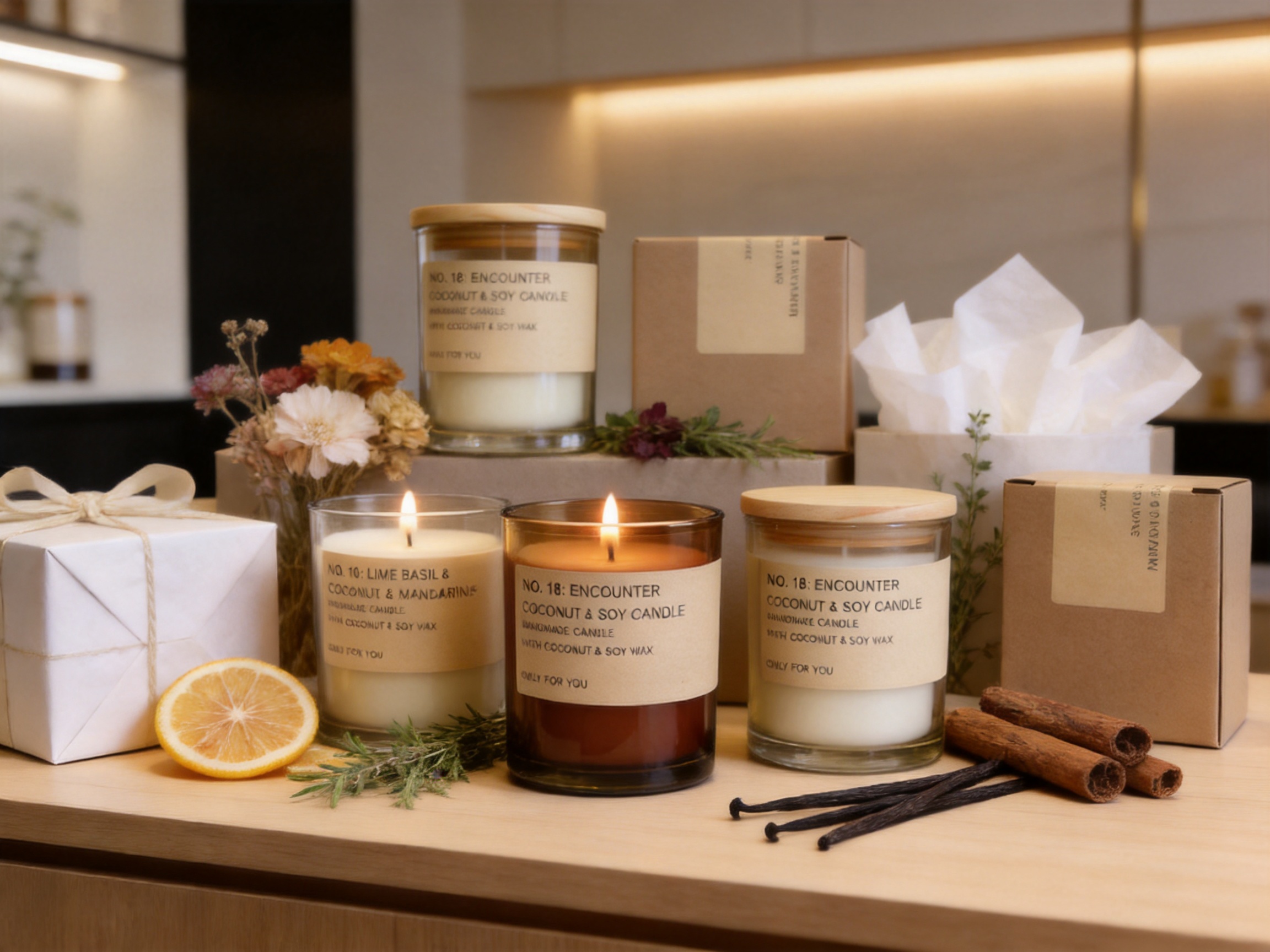
The candle is well suited to homeware stores, lifestyle boutiques, department stores, and online home fragrance shops. Its neutral aesthetic allows it to sit comfortably beside ceramics, textiles, decorative objects, diffusers, and personal care products.
In a retail environment, the clear jar helps shoppers understand the product quickly. The wooden lid adds a visible feature that distinguishes the candle from simple open containers. Retailers can build a collection around scent families such as floral, woody, citrus, fresh, gourmand, or seasonal blends.
Candles are frequently associated with quiet routines, meditation, reading, bathing, and relaxation. The gentle flame and fragrance can help create a warm atmosphere in bedrooms, desks, studios, and personal care spaces.
The product can be incorporated into wellness gift boxes alongside bath products, sleep accessories, essential home items, or relaxation tools. The minimalist appearance supports a calm visual language without requiring excessive decoration.
Boutique hotels, spas, salons, restaurants, and serviced apartments may use candles to shape the atmosphere of guest areas. A lidded jar is practical because the product can be covered between uses and stored with less exposure to dust.
Hospitality buyers may also benefit from customized labels that match a property’s interior design or guest experience. Consistent candle presentation across rooms, reception areas, lounges, and gift shops can strengthen the overall visual identity of a space.
The candle’s compact format and complete design make it suitable for gift sets. It can be paired with reed diffusers, room sprays, decorative accessories, hand-care products, or other home fragrance items. Seasonal packaging can transform the same core product into a holiday, wedding, housewarming, anniversary, or corporate gift offering.
For seasonal programs, careful production planning is essential. Buyers need to confirm artwork, fragrance selection, carton specifications, order quantity, and shipping schedules well in advance. A supplier with multiple factory resources and export experience can help coordinate these requirements more effectively.
Customization is one of the most commercially important strengths of this product. A standard product structure can be adapted to different customer groups while maintaining a controlled manufacturing process.
Fragrance is often the main reason consumers choose one candle over another. Buyers can develop collections around specific scent directions, including clean laundry, fresh linen, botanical herbs, sweet desserts, warm spices, woods, fruits, florals, and seasonal accords.
Fragrance development should consider the target market, intended room, packaging language, product positioning, and regulatory requirements. A scent designed for a bedroom may emphasize softness and calmness, while a living-room fragrance may use stronger woody or citrus notes.
The minimalist label provides a clean starting point for private-label artwork. Buyers can add logos, collection names, fragrance descriptions, batch information, warning statements, barcodes, and market-specific information according to the project requirements.
Typography, color, material, and finish can significantly change how the product is perceived. Natural paper may support an artisanal concept, while a smooth coated label may suit a contemporary premium range. Foil details, embossed elements, or restrained monochrome printing can add distinction without changing the jar itself.
Color boxes can be developed to protect the candle during transportation and create a stronger shelf presence. Packaging may include fragrance illustrations, lifestyle graphics, usage instructions, safety information, and coordinated collection elements.
For gift sets, the candle can be combined with other products in a fitted box or presentation package. The supplier’s network of color box factories helps support packaging development and production coordination. This is particularly useful for buyers who want the candle, carton, and accessories to arrive as one consistent retail program.
Depending on project requirements, buyers may discuss fill weight, jar dimensions, lid style, wick construction, label format, carton size, case packing, and shipping marks. These specifications should be evaluated together because a change in one area can affect other parts of the product.
For example, changing the jar diameter may require a different wick. Increasing the fragrance concentration may affect burn behavior. Modifying the carton may change the number of units per export case. Professional development support helps ensure that customization decisions remain technically and commercially balanced.
Like all candles, this product should be used responsibly. The candle should be placed on a stable, heat-resistant surface away from curtains, paper, furniture, children, pets, and drafts. The wick should be trimmed before lighting, and the candle should never be left unattended.
Users should avoid burning the candle for excessively long periods and should discontinue use when only a small amount of wax remains. The glass jar may become hot during use, so it should not be moved while the candle is burning or while the wax is still liquid.
The wooden lid is intended for storage and protection after the flame has been extinguished and the candle has cooled. It should not be placed on the jar while the candle is burning. Clear safety instructions on the label or packaging can help customers use the product correctly and protect the long-term reputation of the retailer or brand.
Good consumer guidance is not only a safety responsibility; it also helps improve product performance. Proper wick trimming and suitable burn intervals can reduce smoke, support a more even melt pool, and help customers obtain greater value from the candle.
When purchasing candles for resale or private-label use, buyers should evaluate more than photographs and unit price. The supplier’s manufacturing coordination, inspection standards, communication efficiency, and ability to repeat production are equally important.
A candle collection may require several connected services: raw material sourcing, fragrance coordination, vessel selection, label printing, carton production, assembly, inspection, documentation, and shipping. If these services are handled separately without strong coordination, the project may experience delays, mismatched colors, inconsistent components, or unclear responsibilities.
The supplier’s operating model brings these stages together through a dedicated team covering product development, international sourcing, and cross-border marketing. Its digital tools and supply chain management system are intended to improve communication and provide more efficient support for overseas clients.
The company was founded in January 2025 and has developed its business around international trading and supply chain solutions. Although the company is relatively new as an independent organization, its stated operating resources include experienced manufacturing partners, quality management capabilities, and long-term industry experience within its broader supply network.
This distinction is important for buyers. A supplier does not need to manufacture every component in one building to provide a reliable product. What matters is whether it can manage partner factories, maintain specifications, monitor quality, coordinate schedules, and take responsibility for the finished order.
Before placing an order, buyers should define their expectations clearly. The following areas can help guide product evaluation and supplier discussions.
Ask about the wax blend, wick type, fragrance options, jar dimensions, expected burn behavior, and available test reports or samples. Sample testing is especially useful when the product will be sold under a new brand or in a different climate.
Review the wax surface, wick alignment, glass clarity, lid fit, label placement, and carton quality. If the product is intended for repeat orders, confirm how visual consistency will be maintained between batches.
Clarify which elements can be customized, including fragrance, wax color, label design, lid style, box construction, case packing, and product dimensions. Ask for a clear development timeline and approval process for samples and artwork.
Discuss raw material inspection, in-process controls, burn testing, finished-goods inspection, packaging checks, and export documentation. Buyers should also identify the information required for their own market, including warning labels and product specifications.
Confirm production lead time, minimum order quantities, trial-order options, daily capacity, shipping arrangements, and port coordination. A product that sells well requires dependable replenishment, so delivery planning should be considered from the beginning.
Evaluate the supplier’s communication, response speed, product knowledge, ability to solve problems, and willingness to support long-term development. Strong commercial support can be as valuable as a competitive price, particularly when several components must be coordinated.
The best market position for this candle is based on balanced value rather than exaggerated claims. It combines a plant-based wax blend, clean visual design, protective lid, transparent glass vessel, hand-poured construction, and flexible customization. These features support a premium yet adaptable product concept.
Retailers can present it as an everyday luxury that makes ordinary spaces feel warmer and more personal. The product does not require a highly formal setting. It can be placed beside a bed, on a home office desk, in a reading corner, or in a guest room. Its understated appearance allows it to become part of the surrounding décor rather than competing with it.
For private-label brands, the candle can serve as a foundational item in a larger home fragrance range. The same jar format can be repeated across multiple scents, helping create a recognizable collection. Additional products such as reed diffusers, scented sets, LED candles, and other fragrance accessories can be developed around the same design language.
For wholesalers and distributors, the product offers broad channel potential. Its neutral style can suit different regions, while customization allows each customer to create a more distinctive final presentation. This combination of standardized manufacturing and flexible branding can simplify sourcing while preserving market differentiation.
The candle uses a coconut and soy wax blend. This formulation is designed to support a smooth appearance, consistent melt pool, balanced burning, and reduced soot and residue under appropriate use conditions.
Blending the two waxes allows the formulation to combine complementary characteristics. The goal is to achieve a stable and attractive candle with reliable burn behavior and a refined material profile suitable for modern home fragrance collections.
The clear glass jar allows users to monitor the flame and wax level while providing a stable container for the candle. Its thick wall is designed to improve heat resistance and support safe, normal use when the product is handled correctly.
The wooden lid helps protect the wax from dust and unwanted odors after use. It also gives the candle a more complete and gift-ready appearance. The lid should only be placed on the candle after the flame has been extinguished and the wax has cooled.
Yes. The product can support OEM and ODM programs involving fragrance selection, specifications, labels, packaging, and gift-set development. Buyers can use the neutral jar and minimalist structure as a foundation for their own brand identity.
Fragrance options can be discussed according to the buyer’s target market and product concept. Possible directions include floral, fruity, fresh, woody, herbal, gourmand, and seasonal profiles. Final development should be confirmed through sampling and performance evaluation.
Yes. The supplier reports daily capacity of up to 50,000 units and works with multiple candle, jar, and packaging partners. This supports bulk orders, replenishment programs, seasonal campaigns, and coordinated product collections.
The supplier also supports smaller volumes and trial runs. This can help new brands and retailers test fragrances, packaging, customer response, and sales performance before moving to larger production quantities.
Quality management covers raw material selection, incoming inspection, in-process production checks, burn and performance evaluation, and finished-goods inspection. The company also reports access to an in-house laboratory and a coordinated network of manufacturing partners.
The company has supplied products to more than ten countries and regions across North America, Europe, and the Middle East. Its export support includes sourcing coordination, product development, quality control, documentation, and logistics planning.
The candle is suitable for bedrooms, desks, living rooms, reading areas, relaxation spaces, hospitality settings, gift collections, and lifestyle retail displays. Its neutral appearance allows it to complement many interior styles.
Consumers should place the candle on a stable, heat-resistant surface, keep the area clear of flammable materials, and trim the wick to a suitable length. The candle should be monitored during use and kept away from children, pets, and drafts.
The coconut soy wax lidded glass jar candle is a versatile home fragrance product built around practical performance and refined presentation. Its coconut and soy wax blend is designed to burn evenly, reduce soot and residue, and support a consistent melt pool. The clear glass jar provides visibility and visual appeal, while the thick wall contributes to heat-resistant construction. The wooden lid protects the wax between uses and adds value to the overall design.
Its hand-poured construction gives production teams the opportunity to focus on wick alignment, surface finish, and careful assembly. At the same time, reliable results depend on systematic manufacturing controls, material inspection, burn testing, and finished-product evaluation.
The supplier strengthens the product offering through OEM and ODM services, an in-house laboratory, a network of ten candle factories, eight jar customization partners, and eight color box factories. Its reported capacity of up to 50,000 units per day supports large programs, while smaller trial runs provide flexibility for new product development. International experience across North America, Europe, the Middle East, and other regions further supports overseas buyers.
For retailers, wholesalers, hospitality groups, and private-label brands, this candle offers an effective balance between standardized production and customization. It can become an everyday home fragrance item, a premium gift, a wellness accessory, or the foundation of a larger scented collection. By combining thoughtful materials, functional packaging, careful craftsmanship, and coordinated supply chain support, it presents a strong option for modern candle programs.
1. Internal product specifications for the coconut soy wax lidded glass jar candle, including material composition, container design, wooden lid, hand-poured construction, and product application information.
2. Supplier company profile and operational overview, including product development, international sourcing, quality control, OEM/ODM customization, manufacturing partnerships, export markets, and logistics capabilities.
3. General candle manufacturing principles concerning wax selection, wick alignment, melt pool development, container compatibility, curing, finishing, and burn-performance evaluation.
4. General home fragrance packaging practices concerning glass containers, protective lids, product labeling, gift presentation, transportation protection, and retail display requirements.
5. General candle safety guidance concerning stable placement, wick trimming, supervision during burning, protection from flammable materials, and safe extinguishing procedures.

Room 1701, Building C1, Wangjing, Xiaoshan District, Hangzhou City, Zhejiang Province, China.

+86-15937257616

Copyright© 2026 Hangzhou Leo Home Trading Co., Ltd. All Rights Reserved.

Luxury Candles Home Fragrance Manufacturers Modern Candles Factory