 English
 Français
News
Home / Author / Emily Chen — After-Sales Service Supervisor / Volcanic Crater Sculptural Artist Candle: A New Standard for Decorative Home Fragrance
Content
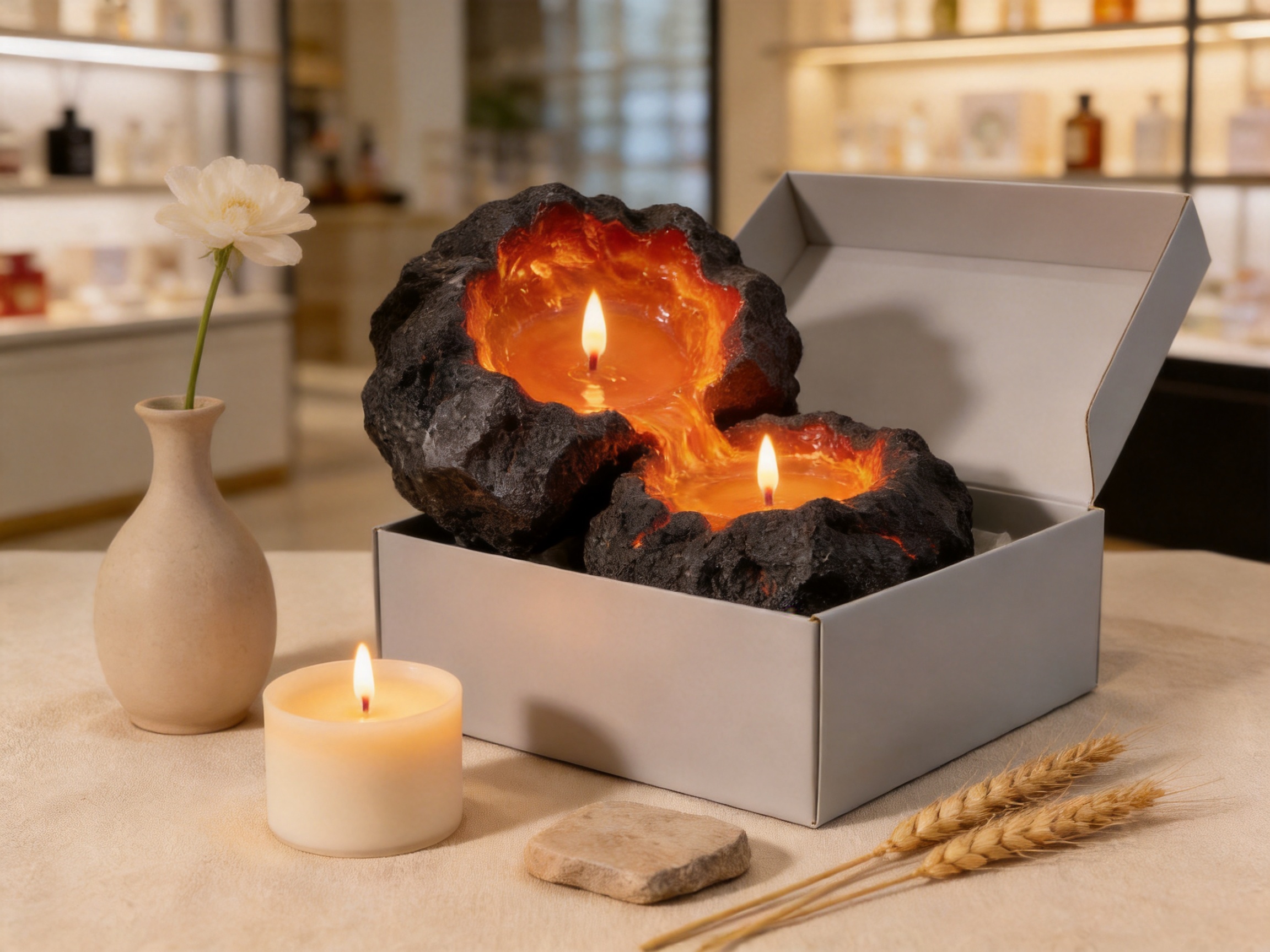
Home fragrance has evolved far beyond the traditional jar candle. Today, consumers increasingly look for products that combine atmosphere, visual identity, craftsmanship, gift appeal, and reliable performance. A candle is no longer judged only by whether it burns. Its shape, texture, packaging, fragrance potential, material quality, and ability to complement an interior are all part of the purchasing decision. The Volcanic Crater Sculptural Artist Candle responds to this broader expectation by treating the candle as both a functional fragrance product and a miniature work of decorative art.
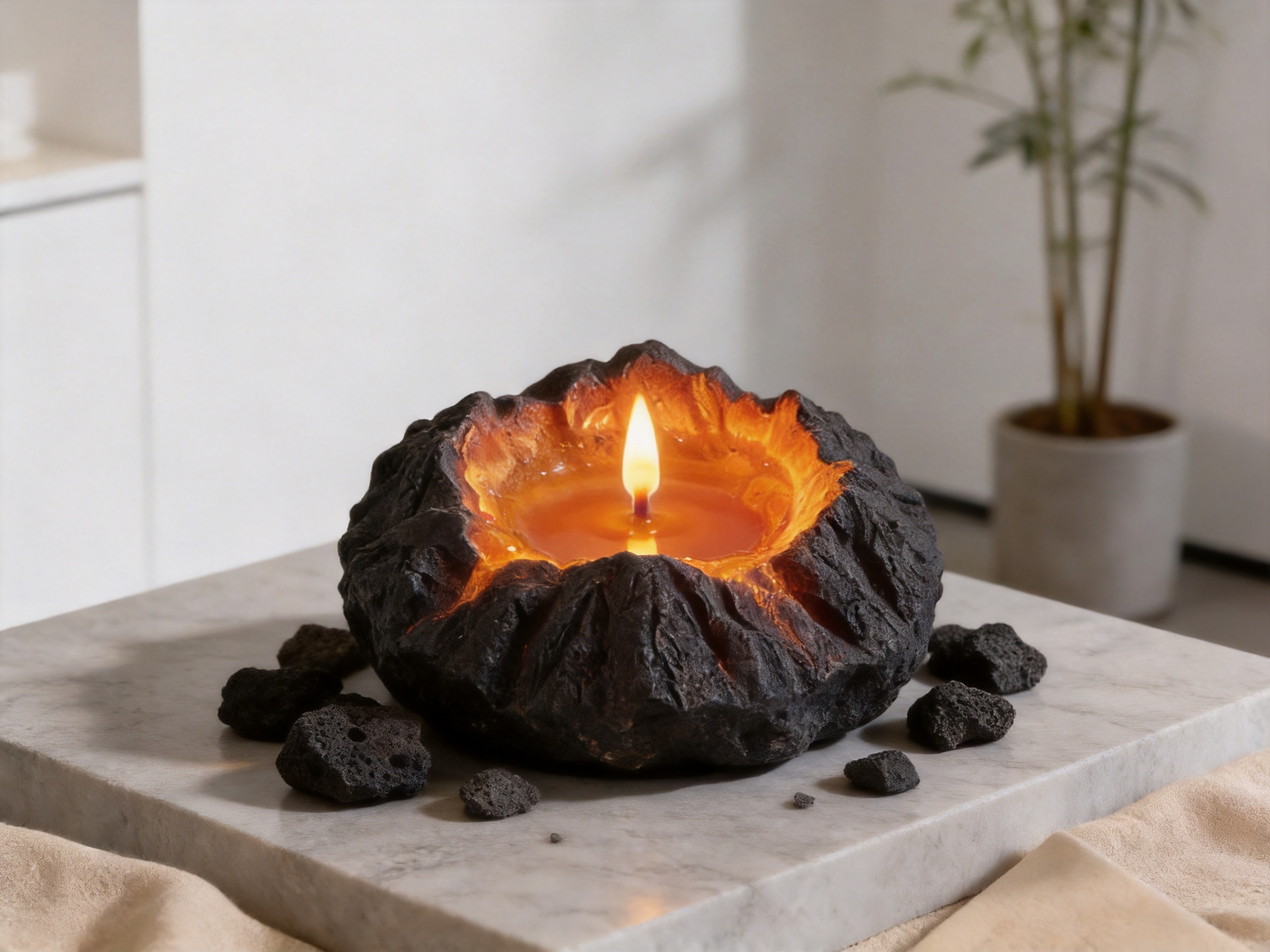
Inspired by volcanic landscapes, geological formations, and the glowing energy hidden beneath the earth’s surface, this sculptural candle presents a rugged outer structure surrounding a vivid central wax pool. The form resembles a naturally eroded crater, while the colored center suggests molten material illuminated from within. This visual contrast gives the piece a distinctive presence before it is ever lit. Once burning, the warm flame adds movement and atmosphere, emphasizing the impression of a living landscape.
With a candle size of 11×5 cm and a gift box measuring 15×16×6 cm, the product is compact enough for retail display, gifting, hospitality styling, and residential decoration. At the same time, its sculptural form gives it greater visual impact than an ordinary cylindrical or container candle of similar dimensions. It can function as a centerpiece, a seasonal decoration, a premium gift item, or a design-led home fragrance product.
For importers, wholesalers, retailers, gift companies, interior brands, and private-label buyers, the product also represents an opportunity to enter the growing market for decorative candles with a design story. Its strongest advantages are not limited to appearance. The product is supported by a supply network capable of customization, quality control, packaging development, and flexible delivery. These capabilities make the Volcanic Crater Sculptural Artist Candle suitable for both established product lines and new collections seeking a recognizable artistic signature.
The central idea behind the Volcanic Crater Sculptural Artist Candle is the transformation of natural geological imagery into a small, accessible home object. Volcanic terrain is visually powerful because it combines irregular textures, dramatic elevation changes, dark mineral surfaces, and the suggestion of intense heat. Translating these characteristics into wax creates a product with immediate storytelling value.
The candle’s outer structure resembles a rugged crater shaped by geological forces. Rather than presenting a perfectly smooth or purely geometric body, the surface is designed to feel irregular and dimensional. This texture creates shadows across the candle when it is displayed under natural or artificial light. The result is a more dynamic appearance than that of a flat decorative candle.
At the center of the form, a vibrant wax pool creates a visual focal point. This colored area evokes the glowing heart of the earth and gives the candle its most recognizable characteristic. The contrast between the textured exterior and the brighter interior makes the product easy to identify in a retail display or online product image. A strong central feature is particularly valuable for e-commerce because it gives the product a clear visual message even when viewed quickly on a mobile screen.
The concept also supports two different use occasions. When unlit, the candle operates as a sculptural decorative object. It can be placed on a coffee table, bedside table, open shelf, reception desk, dining table, or display tray. When lit, it becomes an ambient lighting object that introduces warmth and motion. This dual function expands its appeal beyond consumers who purchase candles solely for fragrance.
Many standard candles are consumed primarily through burning, which means their design value decreases as the wax is used. A sculptural candle can provide value before, during, and after the lighting experience. The form attracts attention while unlit, the flame enhances the design during use, and the remaining structure can continue to contribute to the setting until it is fully consumed. This creates a more complete product experience.
The decorative candle market includes container candles, pillar candles, taper candles, novelty shapes, molded figures, and fragrance gift sets. Each format has its own strengths, but the Volcanic Crater Sculptural Artist Candle is differentiated by the way it combines recognizable natural inspiration with an artistic silhouette.
Conventional cylindrical candles are easy to manufacture and stack, but they often offer limited visual differentiation. Their appearance usually depends on color, label design, vessel material, or fragrance branding. The Volcanic Crater design creates differentiation directly through the candle body itself. Because the shape is part of the product identity, retailers can present it without relying exclusively on a printed label or elaborate external decoration.
Container candles provide practical advantages such as clean presentation and protection from surface contact. However, the vessel may conceal much of the wax and can make one product look similar to another. A sculptural candle places the material itself at the center of the presentation. The buyer can see the shape, texture, and color immediately, which helps communicate craftsmanship and artistic value.
Novelty candles often use recognizable figures or playful themes. While these products can perform well during holidays or special occasions, their appeal may be limited to a particular audience. The volcanic landscape concept is more adaptable. It can suit modern interiors, minimalist spaces, nature-inspired collections, art-themed assortments, and premium gifting programs without being tied to a single character or season.
The product also offers a stronger connection between decoration and emotion. A rugged crater suggests exploration, natural power, transformation, and hidden energy. These associations can make the candle more memorable than a generic fragrance item. Retailers can build merchandising stories around earth, travel, geology, landscape, wellness, creativity, or contemporary design.
| Product characteristic | Volcanic Crater Sculptural Artist Candle | Typical standard candle |
| Primary visual identity | Textured crater-inspired sculptural body | Cylindrical shape, vessel, or label |
| Decorative role | Functions as a small landscape sculpture | Usually depends on container or color |
| Focal point | Vibrant central wax pool | Often a uniform wax surface |
| Display flexibility | Suitable for modern, artistic, minimalist, and nature-inspired settings | Often associated with conventional candle styling |
| Gift presentation | Supplied in a refined 15×16×6 cm gift box | Packaging varies and may provide less product storytelling |
| Customization potential | Shape, color, fragrance, label, and packaging development can be considered | Customization may focus mainly on labels or fragrance |
This comparison does not suggest that traditional candles are unsuitable. Rather, it demonstrates how the Volcanic Crater format occupies a more design-oriented position. It adds a strong visual proposition while retaining the familiar comfort of a candle flame and the commercial flexibility of a giftable home accessory.
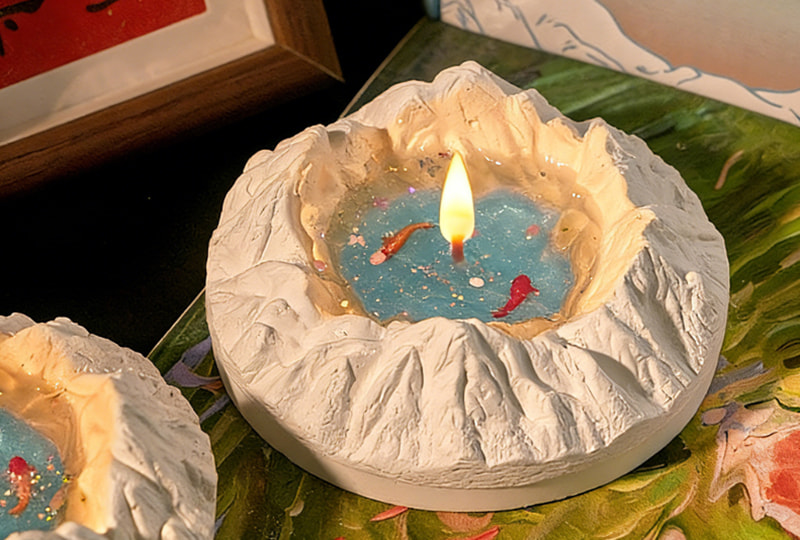
Volcanic Crater Sculptural Artist Candle
The product’s value depends heavily on the quality of its molded surface. A crater-inspired shape must appear intentionally irregular rather than accidentally damaged. The difference between an artistic texture and a rough-looking defect lies in the consistency of the design, the control of the mold, the finishing process, and the inspection standards applied to each unit.
In a professional production environment, the form begins with design development. Product developers may work from drawings, reference images, prototypes, or client samples. The objective is to preserve the visual character of a volcanic crater while making the object stable, manufacturable, packable, and suitable for burning. The shape must have enough depth to create convincing shadows, but it must also maintain structural integrity during handling and transport.
Mold design is especially important for sculptural candles. Deep recesses, narrow channels, sharp edges, and uneven surfaces can create difficulties during demolding. A well-developed mold balances artistic complexity with production reliability. The manufacturing team must consider wax flow, cooling behavior, release from the mold, wick placement, and the protection of delicate details.
Surface finish inspection is another essential stage. The exterior should retain the intended crater character while avoiding excessive cracks, unwanted air pockets, weak edges, or visible production marks that do not belong to the design. Because the candle is displayed without a separate vessel, the surface is exposed and must meet a high visual standard.
The handcrafted appearance is one of the product’s advantages, but handcrafted appearance does not have to mean uncontrolled variation. Advanced manufacturing can reproduce an artistic design with a consistent overall silhouette while preserving subtle visual individuality. This combination is useful for buyers who want a product that feels artisanal but still meets the requirements of organized retail, international distribution, and repeat ordering.
The company’s stated customization capability supports development based on drawings or samples. For business customers, this means the crater concept can potentially serve as a starting point for different sizes, color centers, surface treatments, fragrance profiles, or packaging directions. A buyer may use the existing design as a ready-to-market product or work with the development team to create a related collection.
Wax is not simply a base material. Its characteristics influence surface appearance, color expression, fragrance performance, burning behavior, mold release, and finished-product stability. For a sculptural candle, the material must satisfy both aesthetic and functional requirements.
The exterior needs to hold its shape during production, storage, transport, and display. If the wax is too soft, edges may deform and the textured surface may lose definition. If it is too brittle, the crater structure may chip or break during handling. A suitable formulation should support a clear molded form while remaining appropriate for the intended candle application.
Color selection is particularly important for this design because the central wax pool is a major visual feature. The color should create contrast with the outer structure and remain attractive under both daylight and candlelight. A vibrant center can be developed as part of a broader palette, allowing buyers to match the product with seasonal collections, interior color trends, or brand guidelines.
Fragrance is another area of potential development. The supplied product description focuses on the artistic form rather than identifying a single fragrance, which gives the product flexibility for customization and assortment planning. Buyers may consider warm woods, mineral-inspired accords, smoky notes, fresh botanical scents, amber, vanilla, citrus, or fragrance-free decorative versions depending on the target market.
A professional development process should evaluate fragrance compatibility with the wax, the wick, the mold, and the packaging. Fragrance loading must be balanced so that the scent is noticeable without compromising surface quality or burn stability. Different fragrance oils can affect wax texture, color, curing time, and flame behavior, so each variation should be assessed rather than treated as an automatic substitution.
For private-label and OEM/ODM customers, the ability to adjust fragrance selection is commercially valuable. It allows one sculptural form to serve several market segments. A home décor retailer may prefer a subtle woody scent, while a gift company may request a floral or seasonal option. A hotel or hospitality buyer may require a signature fragrance aligned with its interior identity.
A decorative candle must remain practical. Its artistic shape should not make it difficult to display, package, light, or use. The Volcanic Crater Sculptural Artist Candle is designed to balance visual expression with everyday usability.
The stated candle dimensions of 11×5 cm create a compact profile suitable for shelves, trays, gift baskets, and small decorative arrangements. Its size also allows retailers to merchandise it alongside other home fragrance products without requiring unusually large display fixtures. For consumers, the dimensions make it easy to place in bedrooms, living rooms, entryways, studios, offices, and intimate dining settings.
The product’s proportions provide enough height for the sculptural structure to be visible while keeping the overall footprint manageable. This is useful for buyers who want a decorative item that creates impact without occupying the space of a large centerpiece. The candle can stand alone or be grouped with ceramics, stones, dried flowers, books, trays, or other candles.
The central flame reinforces the crater illusion. When the candle is lit, light reflects softly on the colored wax center and the surrounding textured structure. Shadows move across the uneven surface, creating an atmosphere that changes over time. This movement gives the product an experiential quality that static décor cannot provide.
As with all candles, safe-use instructions should be included with the final product and packaging. Buyers should consider wick positioning, stable placement, heat-resistant surfaces, clearance from flammable objects, and supervision during burning. Product development and quality control should also evaluate the relationship between the sculptural shape and the flame so that the design remains appropriate for its intended use.
The product is therefore not limited to purely visual display. It can support relaxation, creative work, evening rituals, dining, meditation environments, hospitality styling, and gift-giving. The warm flicker makes the candle suitable for settings where consumers want a calm and comforting atmosphere, while the sculptural shape appeals to those who value design and artistic detail.
Packaging plays a decisive role in the success of a decorative candle. A well-designed product can lose commercial appeal if it arrives in packaging that does not protect the surface, communicate the concept, or create a satisfying unboxing experience. The Volcanic Crater Sculptural Artist Candle is presented in a refined gift box measuring 15×16×6 cm.
The gift box dimensions are designed to accommodate a compact sculptural form while maintaining a presentation suitable for retail and gifting. The box can help protect the candle during handling and transport, reduce the risk of surface damage, and provide a defined presentation format for online listings and physical stores.
Gift packaging also enables the product to reach customers who may not initially be shopping for a candle. A sculptural object in an attractive box can be positioned as a birthday gift, housewarming present, seasonal gift, creative professional gift, hospitality amenity, or small luxury item. Its artistic concept gives the buyer a clear reason to choose it over a generic candle.
For retailers, consistent packaging simplifies assortment planning. Products can be placed on shelves, in gift sections, on display tables, or in curated home décor collections. The box can also support product information such as fragrance notes, material details, burning guidance, origin, customization information, and brand storytelling.
The available information includes a reference table listing several gift-box formats, including Freesia, Blue Wind Chimes, and Sandalwood variations, each shown with a weight of 400 grams. These listed formats indicate that gift-boxed home fragrance products can be organized into different scent or theme options while maintaining a consistent packaging and weight structure. For final commercial production, buyers should confirm the exact fragrance name, net product weight, gross shipping weight, carton quantity, and packaging configuration for the Volcanic Crater design.
This flexibility is useful for building collections. A single sculptural shape can be offered in several fragrance directions, allowing retailers to create a coordinated range. A floral variant may appeal to customers seeking softness and elegance, a sandalwood version may suit warm and refined interiors, and a fresh or aquatic variant may attract buyers looking for a lighter atmosphere. The visual consistency of the shape can connect the collection, while scent provides variety.
The product’s commercial potential is strengthened by the supplier’s broader manufacturing and sourcing network. According to the provided company information, the business integrates 10 candle factories, 8 jar customization partners, and 8 color box factories. This structure creates access to multiple production resources rather than relying on a single narrow manufacturing channel.
A connected supply network can improve flexibility in several ways. It may support different order quantities, product categories, packaging structures, and delivery schedules. It can also allow the development team to match a particular project with a suitable factory or partner based on equipment, experience, product complexity, or capacity.
For a sculptural candle, this is important because production requirements differ from those of a simple jar candle. The project may require specialized molding, color control, surface inspection, packaging inserts, and protection for irregular shapes. A supplier with experience across different candle formats is better positioned to coordinate these requirements.
The company also states that daily capacity can reach up to 50,000 units for stable bulk delivery and replenishment, while supporting smaller volumes and trial runs. This combination is particularly useful for buyers following a staged product strategy. A new customer may begin with samples or a limited test order, evaluate market response, and then increase volume after confirming sales performance.
Flexible order support can reduce the risk associated with introducing a new decorative design. Retailers do not necessarily need to commit immediately to a very large quantity before testing consumer response. At the same time, larger customers can plan repeat orders if the product gains traction in their markets.
The company’s location in Hangzhou, Zhejiang Province, and stated logistics connection near Ningbo Port support international shipment planning. Efficient access to export logistics can help coordinate bulk cartons, container loading, documentation, and delivery schedules. Buyers should still confirm current freight terms, export documentation, lead times, carton dimensions, and destination requirements for each order.
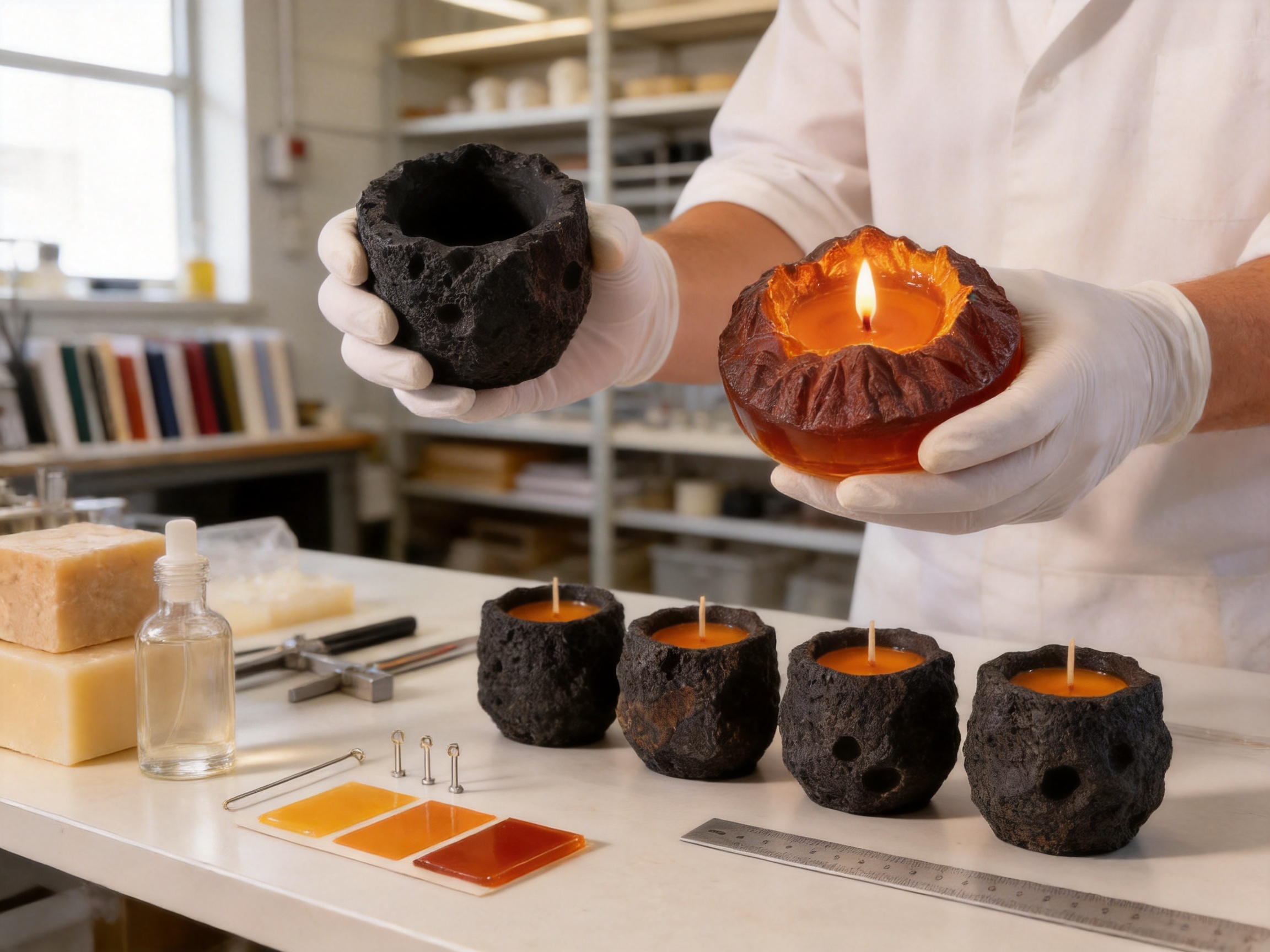
The manufacturing process for a product of this type can be organized into several coordinated stages. First, the design is reviewed for visual proportion, structural stability, mold feasibility, wick positioning, packaging space, and intended use. If a buyer provides a drawing or sample, the development team can translate the reference into a production-ready concept.
Second, the mold and prototype are developed. A prototype allows the team to assess the crater texture, central feature, dimensions, stability, and overall appearance. At this stage, adjustments may be made to the depth of the surface, the size of the central area, the edge profile, or the relationship between the decorative and functional zones.
Third, the wax and color system are evaluated. The chosen formulation must flow into the mold, capture the sculptural details, release cleanly, and remain stable during storage. Color samples are compared under different lighting conditions to ensure that the central wax area communicates the intended glowing effect.
Fourth, the wick and burning performance are assessed. Wick selection should consider candle diameter, wax composition, fragrance load, central design, and expected burn behavior. Testing helps determine whether the flame remains stable and whether the surrounding structure responds appropriately as the candle is used.
Fifth, production molding and finishing are performed. Each candle should be checked for surface definition, color consistency, visible defects, wick alignment, base stability, and overall conformity to the approved sample. Artistic products require careful visual inspection because even small surface issues can influence perceived quality.
Sixth, the finished candles are packed into the gift boxes. Packaging inspection should verify fit, protection, printed information, box strength, and presentation. Carton packing is then organized for efficient transportation, with consideration given to stacking, impact protection, humidity, temperature, and handling conditions.
Finally, quality control and shipment preparation are completed. Samples may be retained for reference, production records can be reviewed, and the order can be checked against the approved specifications. This sequence helps connect creative development with repeatable commercial production.
Quality assurance is central to the performance of any candle, but it is especially important for a sculptural design that has visible surface details and a premium gift position. The company states that it operates an in-house laboratory and applies quality control across key stages, from materials to finished goods.
Raw material inspection may include checking wax appearance, fragrance characteristics, colorants, wick materials, packaging components, and other production inputs. Consistent raw materials help reduce variation between batches and support more reliable product development.
During production, quality checks can focus on mold filling, cooling, demolding, trimming, wick placement, surface finish, color uniformity, and dimensional accuracy. For the Volcanic Crater candle, inspectors should pay close attention to the crater texture because the product’s main artistic advantage depends on the clarity and balance of its surface.
Finished-goods inspection can include visual checks, packaging checks, weight verification, stability checks, and burning evaluations based on the approved product specification. The exact testing program should be confirmed with the buyer and adapted to the target market’s regulatory and retail requirements.
The company’s stated quality approach is beneficial for international clients because buyers often require consistent products across repeat orders. A design that looks excellent in a first shipment must remain recognizable in later production. Documented specifications, approved samples, inspection procedures, and communication between the development and production teams all contribute to continuity.
Quality assurance also protects the product’s competitive position. A sculptural candle can command a higher perceived value when its shape, packaging, and finish appear intentional and dependable. If the surface is inconsistent or the packaging is damaged, the product may be judged as a low-cost novelty rather than as a carefully developed design object.
Customization is one of the strongest commercial advantages associated with this product. The company provides OEM/ODM services covering specifications, fragrance selection, labels, and packaging. This means buyers may be able to adapt the product to different channels instead of selling an identical version to every customer.
Shape customization can involve adjustments to dimensions, crater depth, edge profile, outer texture, or central wax area. Any design change must be evaluated for production feasibility and burning performance, but the existing concept provides a clear foundation for a related family of products.
Color customization can help align the candle with a retailer’s visual identity or a seasonal range. Dark mineral colors may support a dramatic, masculine, or contemporary collection. Terracotta, amber, orange, or red tones may emphasize heat and volcanic energy. Cream, ivory, sage, or muted blue may create a softer interpretation inspired by landscapes rather than molten rock.
Fragrance customization allows the candle to serve different consumer preferences. A warm sandalwood or amber fragrance can reinforce the earth-inspired concept. A floral fragrance can make the shape more approachable as a gift. Fresh botanical notes can connect the product with wellness and nature. A fragrance-free version may be appropriate for decorative retail, hospitality spaces, or customers sensitive to scent.
Label and packaging customization is useful for private-label programs. Buyers can develop their own logo placement, product name, fragrance description, warning information, barcode, language version, and collection story. Packaging can be adapted for different retail requirements, provided that the final structure continues to protect the sculptural surface.
Customization also supports market segmentation. One version can be positioned as an accessible design gift, another as a premium home décor item, and another as part of a hotel or spa collection. The underlying manufacturing system remains connected, while the presentation is adapted to the target customer.
The Volcanic Crater Sculptural Artist Candle is suitable for multiple sales channels because it combines decorative value, gifting potential, and functional use. In home décor stores, it can be displayed as a small art object or grouped with ceramics, vases, trays, and natural materials.
In fragrance boutiques, the product can add a more visual and artistic format to an assortment that may otherwise be dominated by jars and diffusers. Its form encourages customers to interact with the product visually before exploring the fragrance options.
In gift shops, the boxed presentation gives the candle an immediate gifting role. The product can be offered for birthdays, anniversaries, housewarmings, holidays, creative celebrations, and thank-you occasions. The volcanic theme also creates a distinctive alternative to conventional floral or seasonal motifs.
Online retailers can benefit from the product’s strong image appeal. The crater surface, central wax color, and gift box create several opportunities for product photography. A product page can show the candle unlit, lit, boxed, displayed in a room, and presented alongside complementary décor. The design story can be communicated through short descriptions, lifestyle imagery, and educational content about geological inspiration.
Hotels, restaurants, spas, and interior designers may use the candle as a decorative accent. It can contribute to a warm atmosphere in guest rooms, lounges, reception areas, dining tables, or treatment spaces. Commercial users should select the appropriate fragrance strength and confirm all safety and operational requirements for their environment.
Corporate gifting is another possibility. A carefully packaged sculptural candle can be included in appreciation boxes, event gifts, creative-industry promotions, real estate closing gifts, or lifestyle subscription programs. Its unusual shape makes it more memorable than a basic promotional item, while its practical function keeps it relevant after the recipient opens the package.
Responsible product development is becoming increasingly important in the home fragrance sector. Buyers are evaluating not only appearance and price but also packaging efficiency, material choices, production waste, shipping volume, and product longevity.
The compact dimensions of the Volcanic Crater Sculptural Artist Candle can support efficient retail presentation and shipment planning. However, buyers should assess the complete packaging system, including inner protection, gift-box materials, outer cartons, and shipping configuration. The objective is to protect the sculptural surface without creating unnecessary packaging volume.
Manufacturing efficiency also matters. A well-designed mold can reduce production waste, improve repeatability, and support consistent output. Careful control of wax filling, cooling, trimming, and finishing can help reduce rejected units. The company’s integrated supply chain may assist in coordinating these improvements across product development and factory production.
Because the product is both decorative and functional, its perceived value can extend beyond a single brief use. Consumers may display it for a period before lighting it, which can encourage more thoughtful consumption. The product’s artistic character may also make it suitable for curated interiors even after the main burning experience has ended.
For buyers seeking specific environmental claims, those claims should be verified separately. Material composition, fragrance ingredients, packaging recyclability, wax origin, production certifications, and market-specific compliance should be documented before appearing in commercial marketing. Responsible communication is as important as responsible manufacturing.
The strongest products in the premium decorative candle market usually combine three elements: a recognizable design, dependable quality, and a clear commercial story. The Volcanic Crater Sculptural Artist Candle addresses all three.
Its recognizable design comes from the crater-inspired form and colorful central wax pool. These features distinguish it from ordinary candles and provide an immediate visual narrative. The product can be recognized from a distance and described in simple, memorable language.
Its quality potential comes from controlled mold development, material evaluation, production inspection, laboratory support, and finished-goods quality control. The product is not merely an improvised novelty shape. It is positioned as an artistically developed item that must be made consistently for international customers.
Its commercial story comes from the connection between nature, geology, atmosphere, craftsmanship, and modern interior design. This story can be adapted to retail displays, e-commerce descriptions, gift packaging, social media content, seasonal collections, and private-label campaigns.
Compared with a basic candle, it offers more visual value. Compared with a purely decorative sculpture, it offers the sensory experience of light and fragrance. Compared with a conventional gift set, it offers a more distinctive object that can create an emotional response. This multi-layered value proposition gives buyers several ways to position the product.
The product is also supported by the supplier’s ability to handle different stages of the commercial process. Product development, sourcing, customization, packaging coordination, quality management, and export logistics can be brought together through one trading and supply-chain partner. This can simplify communication for overseas buyers who would otherwise need to coordinate multiple vendors.
The candle can be positioned as an artistic home fragrance product rather than as a low-cost novelty candle. Language should emphasize sculptural craftsmanship, natural inspiration, warm atmosphere, gift presentation, and decorative versatility.
For a modern interior collection, the product can be presented as a compact landscape sculpture with a functional flame. For a wellness collection, the focus can shift toward calm lighting, quiet rituals, and sensory relaxation. For a gift collection, the box and distinctive form can lead the presentation. For a nature-inspired line, the volcanic origin story can connect the candle with earth, stone, fire, and transformation.
Retailers may also create coordinated displays using multiple colors or fragrances. Grouping several versions together can emphasize the central crater motif and make the product appear collectible. Combining the candle with reed diffusers, scented sets, accessories, or other home fragrance products can create a complete merchandising story.
For wholesale buyers, the best product positioning will depend on target market, price point, fragrance expectations, packaging regulations, and distribution channel. The supplier’s OEM/ODM capability makes it possible to discuss the most suitable configuration rather than accepting a one-size-fits-all product strategy.
Buyers interested in the product should begin by confirming the core specification: candle dimensions of 11×5 cm, gift-box dimensions of 15×16×6 cm, design details, intended fragrance, color, wick configuration, and packaging format.
They should then request samples or prototypes for visual review and burning evaluation. The sample approval process should cover surface texture, central color, overall stability, box fit, printed information, and product presentation under the lighting conditions expected in retail or photography.
For customized programs, buyers should prepare reference materials such as drawings, color samples, fragrance preferences, packaging ideas, target price, estimated order quantity, destination market, and desired delivery schedule. Clear information at the beginning of development can reduce revisions and improve efficiency.
Commercial discussions should also confirm minimum order quantities, sample charges, tooling charges if applicable, production lead time, payment terms, shipping terms, carton specifications, inspection standards, and documentation. If the product will be sold in multiple countries, buyers should verify language, labeling, safety, and compliance requirements for each destination.
Because the supplied reference table includes several 400-gram gift-box formats, the exact net and gross weights for the Volcanic Crater version should be confirmed before quotation and shipping calculation. This is particularly important for e-commerce fulfillment, freight planning, customs documentation, and retail pricing.
The product combines a crater-inspired sculptural body with a vibrant central wax pool. Instead of relying mainly on a jar, label, or fragrance name for differentiation, it creates its identity through shape, texture, color, and geological inspiration. It can function as decorative art when unlit and as an atmospheric candle when lit.
The stated candle size is 11×5 cm. The refined gift box measures 15×16×6 cm. Buyers should confirm final production tolerances and packaging specifications during sample approval.
Yes. Its distinctive sculptural form and gift-box presentation make it suitable for birthdays, housewarmings, holidays, corporate gifts, creative celebrations, and premium home décor assortments.
The supplier provides OEM/ODM services and supports fragrance selection. Buyers can discuss floral, woody, amber, fresh, botanical, seasonal, or other fragrance directions, subject to formulation testing and production feasibility.
Color customization can be discussed as part of product development. The selected color should maintain sufficient contrast with the outer structure and remain visually attractive under both daylight and candlelight.
The company supports customization of labels and packaging. Buyers can discuss logos, language versions, fragrance descriptions, warning information, barcodes, box artwork, inserts, and collection themes.
The company states that it supports smaller volumes and trial runs in addition to large-scale supply. Exact minimum order quantities and sample policies should be confirmed for the specific design and customization level.
The stated capabilities include product development based on drawings or samples, access to 10 candle factories, 8 jar customization partners, 8 color box factories, in-house laboratory support, quality control from raw materials to finished goods, and daily capacity of up to 50,000 units for stable bulk delivery and replenishment.
No. It can also be considered for gift shops, home décor stores, fragrance boutiques, online retailers, hotels, restaurants, spas, interior design projects, subscription boxes, and corporate gifting programs. Commercial users should confirm suitability for their specific operating environment.
Buyers should confirm the final dimensions, wax and wick specifications, fragrance, color, net and gross weight, packaging structure, carton details, safety information, testing requirements, order quantity, lead time, shipping terms, and destination-market compliance.
The supplied information lists Freesia, Blue Wind Chimes, and Sandalwood gift-box formats at 400 grams each. Since these names may represent related product variations, buyers should verify whether the 400-gram specification applies to the Volcanic Crater version before using it for quotation, labeling, or shipping calculations.
It can be positioned around its combination of sculptural design, volcanic landscape inspiration, colorful central feature, gift-ready packaging, customization potential, and supply-chain support. The strongest message is that it offers the visual impact of decorative art together with the warmth and sensory value of a candle.
The Volcanic Crater Sculptural Artist Candle represents a contemporary direction for the home fragrance market. Its appeal comes from the relationship between form and function: it looks like a miniature landscape sculpture, yet it also provides the familiar comfort of a warm flame and the potential for fragrance customization.
Its crater-inspired texture, vibrant central wax pool, compact 11×5 cm format, and 15×16×6 cm gift box create a strong foundation for retail, gifting, interior décor, and private-label development. Compared with conventional candles, it offers greater visual differentiation. Compared with purely decorative objects, it adds light, atmosphere, and sensory engagement.
The supplier’s manufacturing strengths further increase the product’s commercial potential. Access to multiple candle factories, jar customization partners, color box factories, an in-house laboratory, quality-control procedures, OEM/ODM support, flexible order sizes, and bulk delivery capacity provides a practical framework for international buyers.
For companies seeking a product with a distinctive story and adaptable market positioning, this candle can serve as a valuable addition to a modern home fragrance range. With careful material selection, controlled molding, consistent inspection, protective packaging, and clear customization planning, the Volcanic Crater Sculptural Artist Candle can move beyond the category of novelty décor and become a recognizable design-led product for contemporary consumers.
1. Product specification materials supplied for the Volcanic Crater Sculptural Artist Candle, including dimensions, packaging details, product description, and related gift-box information.
2. Company profile materials supplied for Hangzhou Leo Home Trading Co., Ltd., including sourcing capabilities, OEM/ODM services, quality-control processes, factory network, logistics support, and product categories.
3. General principles of candle product development, including wax formulation, mold design, wick selection, fragrance compatibility, surface inspection, packaging protection, and finished-goods quality control.
4. General retail and merchandising practices for decorative candles, home fragrance products, gift items, and design-oriented interior accessories.

Room 1701, Building C1, Wangjing, Xiaoshan District, Hangzhou City, Zhejiang Province, China.

+86-15937257616

Copyright© 2026 Hangzhou Leo Home Trading Co., Ltd. All Rights Reserved.

Luxury Candles Home Fragrance Manufacturers Modern Candles Factory